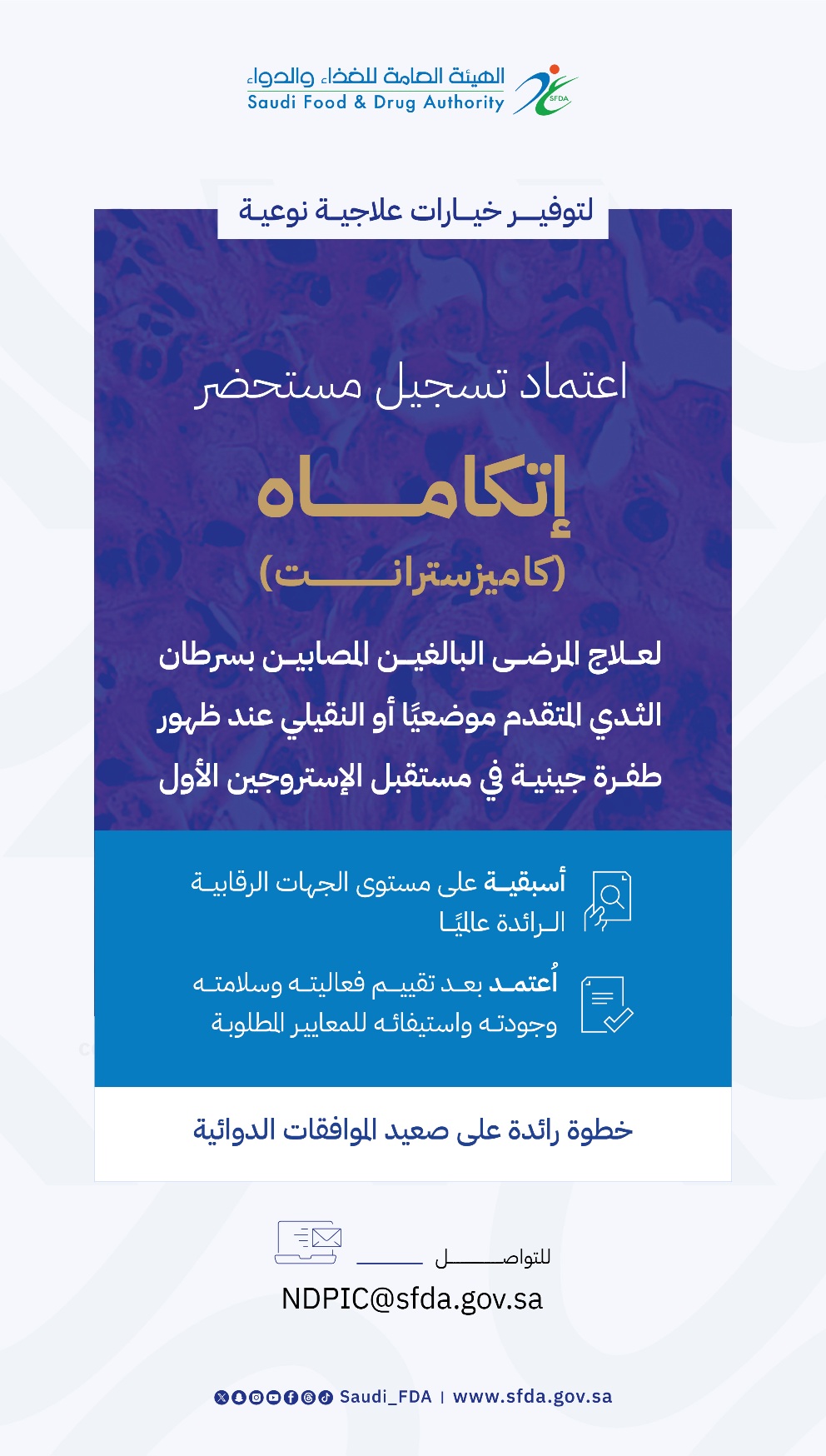
The Saudi Food and Drug Authority (SFDA) has approved the registration of the drug Itcamah “Camizestrant” for treating adult patients with advanced (locally advanced or metastatic) hormone receptor-positive, HER2-negative breast cancer, when an ESR1 gene mutation emerges during first-line endocrine therapy, to be used alongside standard approved treatment.
This approval marks a first for the SFDA among leading global regulatory bodies, reflecting its commitment to accelerating access to innovative treatment options for patients in the Kingdom through the Promising Drugs Program.
Innovative Mechanism of Action
The drug is a selective inhibitor of estrogen receptors found in breast cancer cells. It works by inhibiting these receptors inside cells, whether in their normal or mutated form, which contribute to the growth and proliferation of cancer cells, thereby limiting tumor growth and spread.
Comprehensive Evaluation Process Preceded Approval Decision
The authority stated that the decision to approve the drug’s registration came after a comprehensive evaluation of its efficacy, safety, and quality, based on the totality of evidence and data submitted. Key indicators showed a statistically significant 56% reduction in the risk of disease progression compared to continuing standard endocrine therapy.
It explained that the median progression-free survival was about 16 months for patients using the drug, compared to about 9 months for those using standard therapy, among patients who developed an ESR1 mutation during first-line endocrine therapy, in conjunction with standard approved treatment.
It added that secondary endpoint results related to time to second disease progression supported the drug’s therapeutic benefit, showing an additional 37% reduction in risk. Patient-reported outcome measures also showed improved quality of life and delayed deterioration in general health status and disease-related symptoms.
Most Common Side Effects
Clinical studies revealed that the most common side effects included visual effects, such as transient lights or brief image persistence after the visual stimulus disappears, along with other mild visual effects, and bradycardia (slow heart rate) in some patients.
A New Step Towards Enhancing Healthcare Quality
This approval embodies the SFDA’s efforts to support pharmaceutical innovation and enable patients to access modern treatment options through the Promising Drugs Program, thereby enhancing healthcare quality and improving treatment service efficiency, in line with the goals of the Health Sector Transformation Program, one of the programs under Saudi Vision 2030.
It is appropriate to learn more about “Camizestrant” through global numbers.. Does the drug slow breast cancer by up to 56% and extend disease control for additional months? This requires us to examine:
The Global Scale of the Problem (Important Scientific Context):


- Breast cancer accounts for about 1 in 8 cancer diagnoses worldwide.
- Appro