
Director of Public Security Inspects Hajj Security Forces and Supporting Military Entities Participating in the Hajj
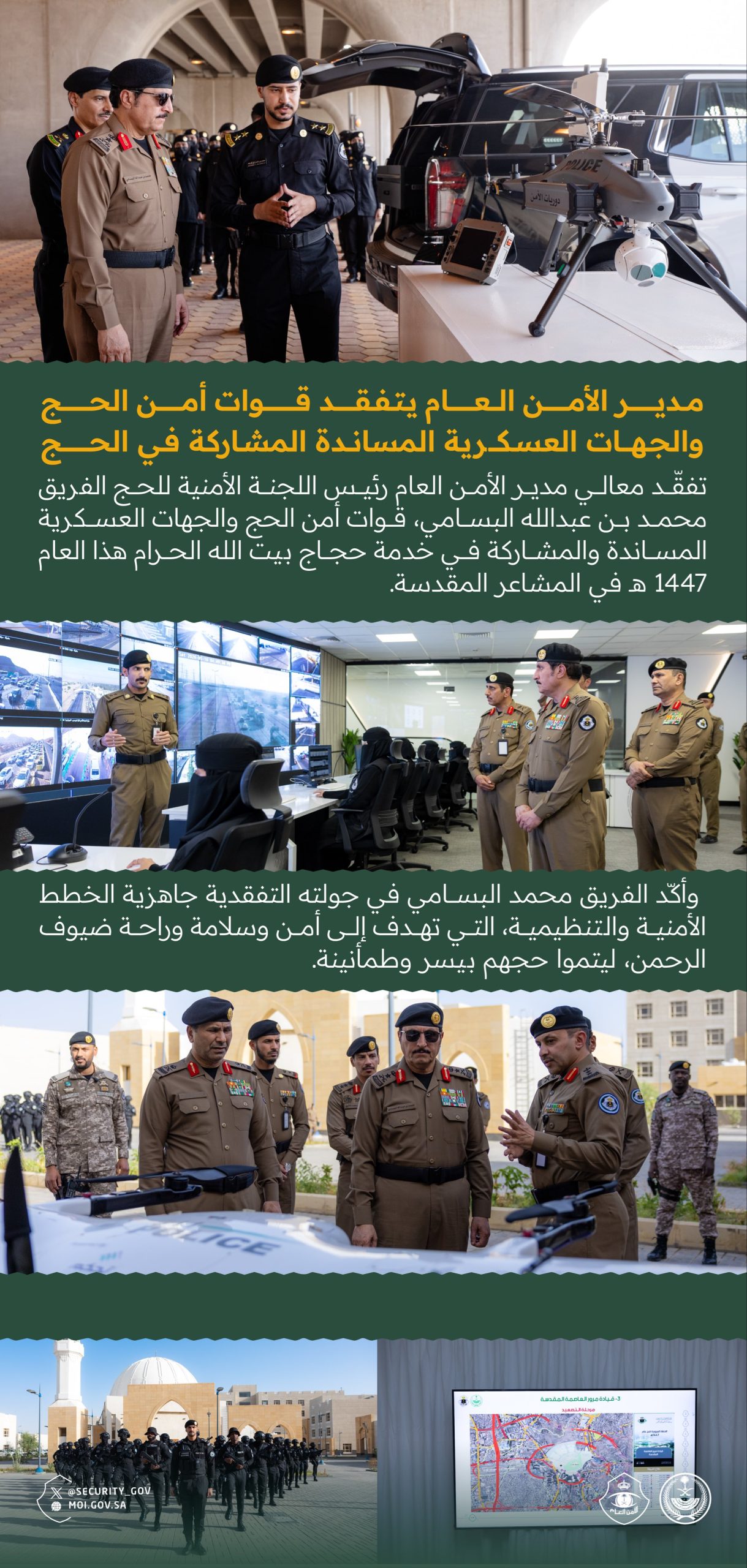
The Director of Public Security, Chairman of the Hajj Security Committee, Lieutenant General Mohammed bin Abdullah Al-Bassami, inspected the Hajj security forces and the supporting military entities involved in serving the pilgrims of the Holy House of God for this year’s Hajj season 1447 AH, in the holy sites.
During his inspection tour, General Al-Bassami affirmed the readiness of the security and organizational plans prepared by the Public Security, aimed at enhancing the safety, security, and comfort of the guests of God, enabling them to perform their rituals with ease and tranquility.
These efforts are part of a comprehensive security plan implemented by the Public Security for the Hajj season, focusing on crowd management and organization, regulating pedestrian and vehicle movement, and applying systems and instructions to ensure smooth mobility between the holy sites, in addition to intensifying field presence in vital locations.
The plan also relies on employing modern technologies in monitoring and follow-up, and enhancing response speed for emergency situations, contributing to the efficiency of security and service work.
The Hajj security forces work in integration with various government and service sectors, including health authorities, civil defense, the Red Crescent, and the Ministry of Hajj and Umrah, within a unified system aimed at providing the best services to the guests of God and achieving the highest levels of safety and organization during the season.
This integration reflects the high level of coordination among the relevant entities, within the framework of the efforts made annually by the Kingdom to develop the Hajj system and improve the services provided, in line with the goals of Saudi Vision 2030.
Holy House of God
The “Holy House of God,” also known as the Sanctuary of the Holy House of Loreto in Italy, is a renowned Catholic shrine believed to be the house where the Virgin Mary lived and where the Annunciation occurred. According to tradition, the house was miraculously transported by angels from Nazareth to Loreto in the late 13th century. Today, it is a major pilgrimage site, with the house enshrined within a lavish Renaissance basilica built to protect and honor it.
holy sites
Holy sites are locations revered for their religious or spiritual significance, often associated with major events in a faith’s history. These places, such as Jerusalem’s Western Wall, Mecca’s Kaaba, or Varanasi’s ghats, have been centers of pilgrimage and worship for centuries, drawing believers from around the world. Their histories are deeply intertwined with cultural traditions, conflicts, and the evolution of human spirituality.
Holy House of God
The “Holy House of God” is a traditional name for the Basilica of the Holy House in Loreto, Italy, which is believed to be the house where the Virgin Mary was born and where the Annunciation took place. According to legend, the house was miraculously transported from Nazareth to Loreto by angels in the late 13th century to protect it from destruction. This site has been a major Catholic pilgrimage destination for centuries, with the current basilica built around the small, revered structure.
holy sites
“Holy sites”
Holy House of God
The Holy House of God, commonly known as the Basilica of the Annunciation in Nazareth, is a major Christian shrine believed to mark the site where the Angel Gabriel announced to the Virgin Mary that she would conceive Jesus. Its history dates back to early Christian veneration, with a church built over a grotto as early as the 4th century, later replaced by a Crusader-era structure. The modern basilica, completed in 1969, incorporates ancient ruins and features stunning art from around the world, making it a key pilgrimage destination.
holy sites
Holy sites are locations of profound religious or spiritual significance, often associated with major world faiths such as Judaism, Christianity, Islam, Hinduism, or Buddhism. These places, like Jerusalem’s Western Wall, Mecca’s Kaaba, or India’s Varanasi, have deep historical roots, frequently serving as centers of pilgrimage, worship, and cultural identity for millennia. Their histories are marked by events like divine revelations, the lives of prophets, or the founding of religions, making them enduring symbols of faith and human heritage.
Basilica of the Holy House in Loreto
The Basilica of the Holy House in Loreto, Italy, is a major Catholic pilgrimage site renowned for enshrining the “Holy House of Nazareth,” believed to be the home where the Virgin Mary lived and received the Annunciation. According to tradition, the house was miraculously transported by angels from the Holy Land to Loreto in the late 13th century. The current basilica, built around the house in the 16th century, is a masterpiece of Renaissance architecture and holds immense religious and historical significance.
Related news

Filipino twins successfully separated in Saudi Arabia after 18-hour surgery.
The specialized medical and surgical team of the S...
Hotel project approved in Taybah district to boost tourism investment.
The Medina Region Municipality has approved the im...

Medina Municipality issues over six thousand licenses and permits through the “Baladi” platform during last October.
In October 2025, the Medina Region Municipality is...

Will we fly on planes powered by poop in the near future?
In the race to create alternative and sustainable ...
A Medina municipality announces a unique investment opportunity.
The Medina Region Municipality has launched a uniq...