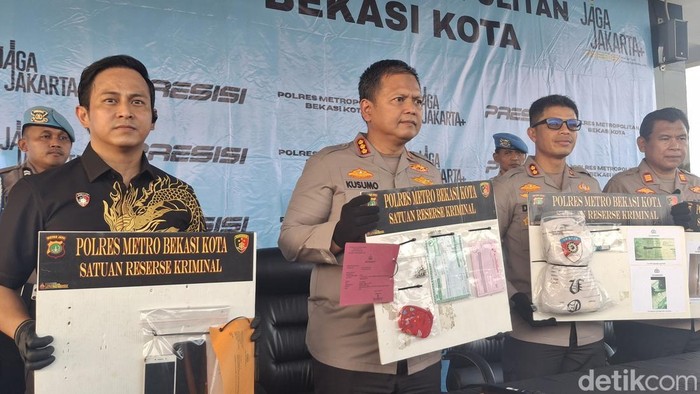
Jakarta – A domestic worker with the initials R (53) in Medan Satria, Bekasi, was arrested by police for stealing jewelry belonging to her employer. The perpetrator took various gold jewelry items from the victim totaling more than 50 grams.
“The victim is Ms. YA and the perpetrator is Ms. R, aged 53, she (R) is a domestic worker and has worked for the victim for about 5-6 years,” said the Bekasi Metro City Police Chief Kombes Kusumo Wahyu Anggoro, Wednesday (13/5/2026).
Kusumo stated that R’s actions were discovered by the victim when she wanted to exchange her gold jewelry on Sunday (15/3). The victim was shocked to see all her jewelry missing from its storage place.
“Finally, the victim questioned the perpetrator about this, but the perpetrator did not answer. Then she reported the matter to the police, and the perpetrator confessed to her actions,” said Kusumo.
The investigation results showed that the perpetrator admitted to taking the victim’s jewelry gradually by exploiting the trust of her employer. The victim’s gold jewelry stolen by the perpetrator included necklaces, pendants, and bracelets with a total weight of more than 50 grams.
“The modus operandi is that the perpetrator was trusted by the victim. The perpetrator knew where the victim stored her jewelry and from there took the victim’s jewelry gradually,” said Kusumo.
“The missing items include one necklace weighing 5.12 grams, a round pendant weighing 1.99 grams, then a butterfly pendant weighing 2.24 grams, then an engraved keroncong bracelet weighing 6 grams, then a scale chain bracelet weighing 15.75 grams, then a dragon scale chain bracelet weighing 20.7 grams,” he added.
The perpetrator’s items, said Kusumo, have all been sold. The perpetrator allegedly intended to give the money from the sale of the stolen goods to a spiritual figure who claimed to be able to multiply money supernaturally. The perpetrator is charged under Article 477 of Law Number 1 of 2023 concerning the Criminal Code, with a maximum penalty of 7 years in prison.
“The perpetrator sold those items. Then, the perpetrator also got acquainted with a spiritual expert, who claimed to be able to multiply money or supernatural money, (met) through social media,” said Kusumo.
Bekasi
Bekasi is a city in West Java, Indonesia, historically part of the ancient Tarumanagara Kingdom, with archaeological evidence such as the Tugu inscription dating back to the 5th century. Today, it has grown into a major industrial and residential suburb of Jakarta, known for its rapid urbanization and role as a key economic hub. Despite its modern development, Bekasi retains cultural elements like traditional Betawi and Sundanese influences.
Medan Satria
Medan Satria is a district located in Bekasi City, West Java, Indonesia. Historically, the area developed from a rural settlement into a densely populated suburban region as Jakarta’s urban sprawl expanded eastward, particularly during the late 20th century. Today, it is known for its mix of residential neighborhoods, local markets, and small industries, reflecting the rapid urbanization characteristic of the Greater Jakarta area.
Jakarta
<div class="
Bekasi
Bekasi is a city in West Java, Indonesia, located east of Jakarta. Historically, it was part of the Tarumanagara kingdom and later became a key area during the Dutch colonial era. Today, Bekasi is a rapidly growing industrial and residential suburb, known for its role as a major commuter hub for workers traveling to Jakarta.
Medan Satria
Medan Satria is a district located in Bekasi City, West Java, Indonesia, known for its rapid urbanization and residential areas. Historically, the name “Satria” evokes the concept of knighthood or valor, reflecting local cultural values. Today, it functions primarily as a suburban hub, connecting residents to the greater Jakarta metropolitan area.
Jakarta
Jakarta, the capital of Indonesia, has a rich history as a major trading port, originally known as Sunda Kelapa before being renamed Batavia by the Dutch colonial rulers in the 17th century. It became a center of Dutch East India Company operations and later the colonial capital, leaving a legacy of Dutch architecture and urban planning. Today, it is a sprawling, bustling metropolis that serves as the country’s political, economic, and cultural hub, blending modernity with historical landmarks like the Old Town (Kota Tua).
Tarumanagara Kingdom
The Tarumanagara Kingdom was one of the earliest known Hindu kingdoms in Indonesia, flourishing on the island of Java from the 4th to the 7th centuries CE. It is primarily known from inscriptions found in the Jakarta and Bogor areas, such as the Tugu inscription, which describe irrigation projects and the rule of King Purnawarman. The kingdom played a crucial role in the early cultural and political development of West Java.
Tugu inscription
The Tugu inscription is a 5th-century stone artifact from the Tarumanagara kingdom, discovered in Tugu village, Jakarta, Indonesia. It records King Purnawarman’s order to dig two canals, the Gomati and Candrabhaga, for irrigation and flood control, highlighting early hydraulic engineering in the region. This inscription provides crucial evidence of ancient Javanese civilization and its Hindu-Buddhist influences.
West Java
West Java is a province in Indonesia known for its rich cultural heritage and natural beauty, including volcanic landscapes and tea plantations. Historically, it was a center of the Sundanese kingdom of Pajajaran before the arrival of Islam and later became a key area during the Dutch colonial period. Today, it remains a vibrant region blending traditional Sundanese arts with modern development.
Greater Jakarta
Greater Jakarta, known as Jabodetabek, is a sprawling metropolitan region in Indonesia that includes Jakarta and its surrounding satellite cities like Bogor, Depok, Tangerang, and Bekasi. Its rapid expansion began in the 20th century as Jakarta grew from a Dutch colonial port into Indonesia’s political and economic center, leading to massive urbanization and infrastructure development. Today, it is one of the world’s most populous urban areas, facing challenges like traffic congestion and flooding while serving as the country’s cultural and commercial hub.
Betawi
Betawi refers to the indigenous ethnic group of Jakarta, Indonesia, whose culture emerged from a blend of Malay, Javanese, Sundanese, Chinese, Arab, and European influences beginning in the 17th century. Historically, the term “Betawi” derives from “Batavia,” the Dutch colonial name for Jakarta, and the community developed as a distinct identity among the city’s diverse laborers and traders. Today, Betawi culture is celebrated through traditional arts like Ondel-ondel puppetry, Gambang Kromong music, and its unique cuisine, such as kerak telor.
Sundanese
The term “Sundanese” refers to an ethnic group native to the western part of Java, Indonesia, with a rich cultural history dating back to the ancient Tarumanagara and Sunda Kingdoms. Known for their distinct language, arts, and traditions—such as the graceful Jaipongan dance and angklung bamboo music—the Sundanese people have maintained a strong identity despite centuries of Javanese and colonial influence. Today, their culture remains vibrant in provinces like West Java, Banten, and Jakarta, celebrated through festivals and traditional ceremonies.