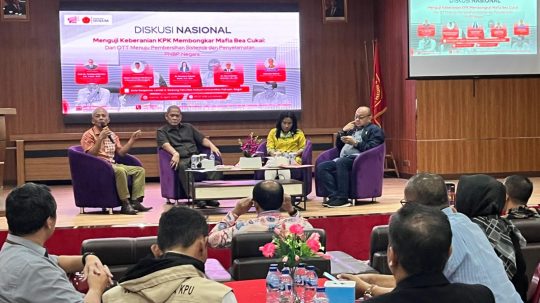
BOGOR – The courage of the Corruption Eradication Commission (KPK) in uncovering mafia practices within the Directorate General of Customs and Excise (DJBC) was a central focus during a discussion titled “Testing the KPK’s Courage in Exposing the Customs Mafia: From OTT to Systemic Cleanup and Safeguarding State Non-Tax Revenue,” held at the Faculty of Law, Pakuan University, on Thursday, April 16.
The Dean of the Faculty of Law at Pakuan University emphasized in his opening remarks that the theme was highly relevant to the current situation. He stated that mafia practices in the customs sector have reached a systemic level.
“The KPK’s courage is a key point of attention. Hand operations alone are not enough; they must also build a transparent and accountable system,” he said.
He added that academic forums like this are important to encourage constructive ideas from academics and practitioners. Healthy discussions, he noted, provide practical insights for improving governance.
During the discussion, a lecturer at the Faculty of Law, Pakuan University, who is also a legal practitioner and lawyer for Blueray Cargo, revealed that the KPK has indeed worked by naming several suspects in cases of alleged bribery and gratuities related to goods imports.
“The KPK has named four suspects. However, there are certain parties who are clearly visible but have not yet been named as suspects,” she said.
She explained that in practice, cargo service companies often find themselves in difficult positions. According to her, a system that lacks certainty forces businesses into deviant practices.
“I asked a client, why would you give money to customs officials? The answer was, we don’t want to. But the system forces us. There is no certainty in goods inspections. Eventually, communication emerges in the name of customs personnel,” she clarified.
She stressed that her clients are “victims of the system” rather than the main perpetrators.
Meanwhile, the KPK has named several suspects, including individuals from Blueray Cargo and DJBC officials. These include the Director of Enforcement and Investigation (P2) at DJBC for the period 2024–January 2026, Rizal; the Head of the Intelligence Subdirectorate at P2 DJBC, Sisprian Subiaksono; the Head of the Intelligence Section at DJBC, Orlando Hamonangan; and DJBC employee Budiman Bayu Prasojo, who is currently under investigation.
An intelligence analyst and state counterintelligence specialist assessed that the issues within the customs body have crystallized and require extraordinary measures.
“In intelligence, there are principles of investigation, security, and mobilization. Meanwhile, counterintelligence works to counter adversaries. The current condition of customs is heavily influenced by a system that has already broken down,” he said.
He added that the violations are no longer sporadic but have become deeply rooted. Therefore, a thorough internal cleanup is necessary.
“There needs to be a ‘clean sweep’ of personnel to ensure reforms run effectively,” he asserted.
Furthermore, a professor of Digital Governance Science at Muhammadiyah University Jakarta highlighted the importance of digital-based system reform in customs oversight.
“In the digital era, the state is undergoing a revolution. Indonesia is moving toward becoming a developed country, so oversight must be stricter. The KPK should not only catch small cases,” he said.
He also noted that in some aspects, the KPK as a “superbody” law enforcement agency is actually less aggressive than the Attorney General’s Office.
According to him, the root of the problem lies in a system that allows for abuse of authority.
“The current system in customs traps people. It’s not just individual wrongdoing, but a broken system. The solution is regulatory reform, system coding, and ensuring no single individual dominates the system,” he explained.
This discussion underscored that eradicating the customs mafia cannot rely solely on hand operations but requires comprehensive systemic reform to safeguard state non-tax revenue and restore public trust in state institutions.