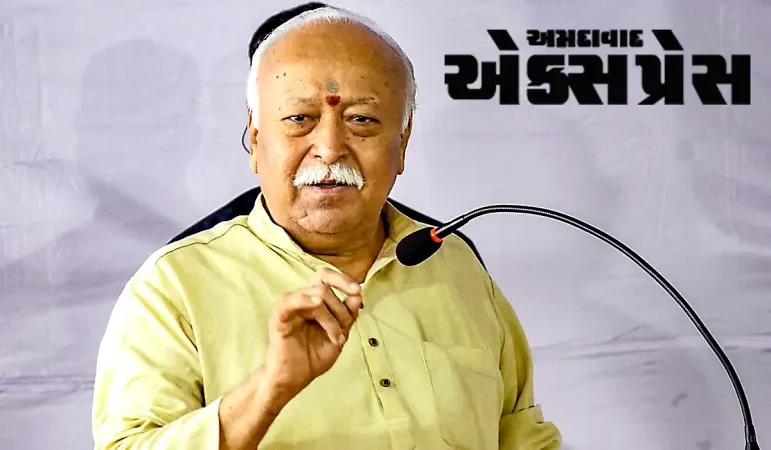
The Power of Triveni: RSS Chief Mohan Bhagwat Presents Devotion as a Compass for Knowledge and Action
In the power of Triveni, RSS Chief Mohan Bhagwat presented devotion as a guide for knowledge and action. He said this at an event organized in Nagpur on the birth centenary of Yashwantrao Kelkar. He stated that without devotion, knowledge becomes destructive and action becomes chaotic. This Triveni is essential for the upliftment of society.
Bhagwat said that the confluence of knowledge, action, and devotion is indispensable for the welfare of the people. This confluence brings well-being to both the individual and society. He cited Yashwantrao Kelkar’s life as a living example of this Triveni.
This speech holds special significance in today’s times. When knowledge and action are often used for selfish purposes, devotion guides them on the right path.
The RSS chief emphasized that without this Triveni, the upliftment of society is impossible.
Key Highlights:
Confluence of Triveni: Mohan Bhagwat considered the union of knowledge, action, and devotion necessary for the welfare of the people.
Importance of Devotion: He said that without devotion, knowledge becomes destructive and action becomes chaotic.
Example of Yashwantrao Kelkar: His life was presented as an ideal for human development.
Sanatan Tradition: Bhagwat stated that this tradition is the reason for India’s immortality.
RSS Working Method: Building the individual and society through human development.
Deep Analysis:
Speaking about the power of Triveni, Mohan Bhagwat said that devotion gives direction to knowledge and action. Furthermore, he added that devotion without knowledge becomes blind, and devotion without action becomes futile. However, the main point is that without devotion, both remain unbalanced.
At this event in Nagpur, Bhagwat commemorated the birth centenary of Yashwantrao Kelkar. Notably, Kelkar played a significant role in establishing the RSS student wing, the Akhil Bharatiya Vidyarthi Parishad. According to sources, his life is a living example of human development.
Additionally, Bhagwat said that India’s existence never fades because there is a tradition of adopting eternal truths in life. However, in modern times, knowledge and action are often used for personal gain. Notably, devotion redirects these towards the benefit of society.
According to sources, the programs of various RSS organizations may differ, but the working method is the same: human development. Furthermore, Bhagwat appealed to the workers of the Akhil Bharatiya Vidyarthi Parishad to focus on individual development. However, this work should be based on friendship and affection.
Notably, Bhagwat said that when a person lives according to these traditions, India’s cultural heritage remains intact. Moreover, in today’s time, when there are many global challenges, the power of this Triveni becomes even more important. According to sources, India has built institutions based on these values even in adverse times.
However, even in favorable times, these same values will provide guidance. Notably, in this speech, Bhagwat also linked India’s stability to this tradition. Furthermore, he told the workers to build themselves first, and then build others. This process happens through affection and friendship.
In this deep analysis, one thing is clear: without Triveni, no work succeeds. According to sources, this message is especially inspiring for today’s youth.
Technical Aspects:
Model of Confluence: The confluence of knowledge, action, and devotion was presented as a technical model for social upliftment.
Working Method: Human development was defined as the primary working method.
Cultural Continuity: Individual development was presented as a technique to keep eternal values intact.
In Mohan Bhagwat’s speech about the power of Triveni, it is clear that without devotion, knowledge and action are incomplete. This message serves as a guide for RSS workers and society. Drawing inspiration from the life of Yashwantrao Kelkar, it is essential to adopt this Triveni. By doing so, India’s cultural heritage will</p