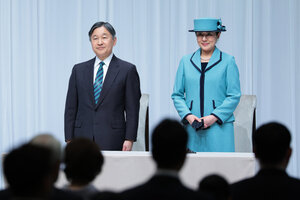
The Emperor and Empress attended the “20th Midori Ceremony” held on the 24th at the Palace Hotel Tokyo. The ceremony, commemorating Greenery Day on May 4, honored individuals and groups for achievements in research and technological development related to domestic plants, forests, green spaces, landscaping, and nature conservation.
This year’s Greenery Award recipients were Yuji Isagi, Professor Emeritus at Kyoto University (age 65), and Tetsuya Higashiyama, Professor at the University of Tokyo’s Graduate School of Science (age 54).
During a discussion after the ceremony, Professor Emeritus Isagi was asked by the Emperor and Empress about the plants he researches, including the question, “Why is conservation difficult?” Professor Higashiyama, who discovered attractants for plant pollen tubes, was asked by them, “Was it found due to advances in analytical technology?” He recalled, “There were many questions that researchers themselves would ask.”
Palace Hotel Tokyo
The Palace Hotel Tokyo is a luxury hotel located in the Marunouchi district, adjacent to the Imperial Palace gardens. Originally built in 1961 as the first Western-style hotel in Japan, it underwent a complete reconstruction and reopened in 2012, blending modern elegance with traditional Japanese hospitality. Its history reflects Tokyo’s post-war modernization and its ongoing status as a premier destination for global travelers.
Greenery Day
Greenery Day is a Japanese national holiday celebrated on May 4th, originally established to honor Emperor Showa’s love for nature. It was designated as a day to appreciate the environment and reflect on the blessings of nature, following the posthumous renaming of his birthday (April 29th) to “Showa Day.” Observed as part of Golden Week, it encourages outdoor activities and connection with the natural world.
Kyoto University
Kyoto University, founded in 1897 as the second oldest university in Japan, is a prestigious national research institution located in Kyoto. It has a rich history of academic excellence and innovation, producing numerous Nobel laureates and playing a key role in modern Japanese science and culture. The university is also known for its beautiful campus, which blends traditional Japanese architecture with modern facilities.
University of Tokyo
The University of Tokyo, often referred to as Todai, is Japan’s most prestigious university, founded in 1877 during the Meiji period. It was established by merging several Edo-era institutions, including the Shoheizaka School, with the goal of modernizing Japan through Western-style education. As a leading research university, it has produced numerous prime ministers, Nobel laureates, and influential figures in Japanese society.
Palace Hotel Tokyo
The Palace Hotel Tokyo is a luxury hotel located in the Marunouchi district, adjacent to the Imperial Palace’s East Gardens. Originally opened in 1961, the hotel underwent a complete reconstruction and reopened in 2012, blending modern elegance with traditional Japanese hospitality. Its history is tied to the site of the former Imperial Palace moat, offering guests panoramic views of the palace grounds and the city skyline.
<div class="my-4 p-4 rounded-lg shadow-md bg-blue-50 border-l-4 border-blue-
Palace Hotel Tokyo
The Palace Hotel Tokyo is a luxury hotel located in the Marunouchi district, adjacent to the Imperial Palace grounds. Originally opened in 1961, the hotel underwent a complete reconstruction and reopened in 2012, blending modern elegance with traditional Japanese hospitality. Its prime location and rich history make it a landmark for both business and leisure travelers visiting the capital.
Greenery Day
Greenery Day is a Japanese national holiday celebrated on May 4th, dedicated to appreciating nature and the environment. Its history stems from the birthday of Emperor Showa, which was originally observed as his birthday; after his death in 1989, the day was renamed to honor his love for plants and nature, and it now serves as a time for outdoor activities and reflection on the natural world.
Kyoto University
Kyoto University, established in 1897 as the second oldest university in Japan, is a prestigious national research institution located in Kyoto. It has a rich history of academic excellence and innovation, producing several Nobel laureates and fostering a tradition of free and open scholarly inquiry. Known for its beautiful campus blending traditional and modern architecture, the university remains a leading center for higher education and scientific discovery in Asia.
University of Tokyo
The University of Tokyo, often referred to as Todai, is a prestigious public research university in Japan, founded in 1877 as the nation’s first modern university. It was established through the merger of several Edo-period institutions, including the Shoheizaka School and the Kaisei School, and played a pivotal role in Japan’s rapid modernization during the Meiji era. Today, it is renowned for its academic excellence, producing numerous prime ministers, Nobel laureates, and leading figures in science, literature, and politics.
Imperial Palace
The Imperial Palace, also known as the Forbidden City, is a vast palace complex in Beijing, China, built from 1406 to 1420 during the Ming Dynasty. It served as the imperial residence and political center for 24 emperors over nearly 500 years, until the end of the Qing Dynasty in 1912. Today, it is a UNESCO World Heritage Site and a major museum, showcasing traditional Chinese architecture and imperial artifacts.
Marunouchi district
Marunouchi is a major business and commercial district located in central Tokyo, Japan, situated between Tokyo Station and the Imperial Palace. Historically, it was once a residential area for samurai during the Edo period, but it was later developed into a modern financial hub in the early 20th century. Today, Marunouchi is known for its skyscrapers, upscale shopping, and cultural venues, blending historic landmarks with contemporary urban life.
Showa Day
Showa Day, observed on April 29th in Japan, honors the birthday of Emperor Hirohito (the Showa Emperor) and reflects on the Showa period (1926–1989). Originally celebrated as the Emperor’s Birthday, it was renamed after his death and is now part of Golden Week, a cluster of national holidays. The day encourages reflection on Japan’s tumultuous modern history, including recovery from war and economic growth.
Golden Week
Golden Week is a major holiday period in Japan, spanning from late April to early May, and includes four national holidays: Showa Day, Constitution Memorial Day, Greenery Day, and Children’s Day. Historically, it originated in 1948 with the establishment of these holidays, but the term “Golden Week” was coined in 1951 to describe the unusually high number of holidays in a short span. During this time, many people travel, visit family, and participate in festivals, making it one of the busiest travel seasons in Japan.