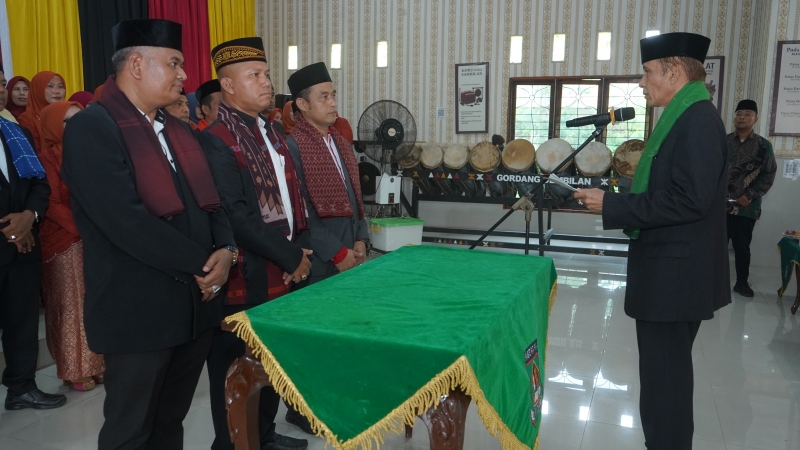
The board of the Dalihan Natolu Tapanuli Bagian Selatan (Tabagsel) Customary Institution for Asahan Regency for the 2025-2029 term was inaugurated on Saturday (April 25, 2026) at the Solo Godang Tabagsel Traditional House, located on Jalan Nusa Indah, Sei Renggas Village, West Kisaran District, Asahan Regency.
The inauguration was attended by Asahan Regency’s Assistant I for Government and People’s Welfare, M Azmi Ismail; the Chair of Tabagsel Asahan Regency, H Nauli Parlaungan Siregar; the Chair of the Hatobangon Council, Isa Harahap; member of the Indonesian House of Representatives (DPR RI), Anshori Siregar; and member of the North Sumatra Provincial House of Representatives (DPRD Provinsi Sumut), Armin Simatupang.
In his speech, M Azmi Ismail congratulated the newly inaugurated board and emphasized the importance of the customary organization’s role in strengthening unity, maintaining social stability, and supporting regional development.
He also expressed hope that the customary institution would contribute to the development of Asahan Regency, gather community aspirations, strengthen synergy with the local government, and enhance human resource capacity to be more professional and competitive.
The Chair of Tabagsel Asahan Regency, H Nauli Parlaungan Siregar, highlighted the importance of tangible work programs that benefit the community, as well as strengthening solidarity among Tabagsel residents and preserving the culture of mutual cooperation.
He also invited all board members to synergize with the Asahan Regency Government in supporting accelerated development and to make the organization a platform for community service.
Solo Godang Tabagsel Traditional House
The Solo Godang Tabagsel Traditional House is a historical wooden longhouse located in North Sumatra, Indonesia, representing the architectural heritage of the Mandailing and Angkola Batak communities. Built without nails, it features a distinctive elongated structure with a high peaked roof, traditionally serving as a communal residence and a symbol of social status. The house’s name reflects its unique “solo” (single) ridgepole design and its location in the Tabagsel (Tapanuli Selatan) region, preserving centuries-old building techniques and cultural traditions.
Dalihan Natolu Tabagsel Customary Institution
The Dalihan Natolu Tabagsel Customary Institution is a traditional governance and social system of the Batak Toba and Angkola-Mandailing communities in North Sumatra, Indonesia. Its name, meaning “three hearth stones,” symbolizes the three pillars of society: the king (ruler), the religious leader, and the elders, who work together to maintain harmony and justice. Historically, this institution has preserved indigenous laws, customs, and dispute resolution methods for centuries, adapting to modern governance while remaining a vital cultural cornerstone.
Asahan Regency
Asahan Regency is a region in North Sumatra, Indonesia, known for its rich history as part of the former Sultanate of Asahan, which was established in the 17th century. The sultanate played a significant role in the region’s trade and culture until its integration into the Indonesian republic after independence. Today, Asahan is recognized for its natural resources, including palm oil and rubber plantations, as well as its cultural heritage sites like the Asahan Sultanate Palace.
<div class="my-4 p-4 rounded-lg shadow-md bg-blue-50 border-l-4 border-blue-
Solo Godang Tabagsel Traditional House
The Solo Godang Tabagsel Traditional House is a cultural landmark of the Mandailing people in North Sumatra, Indonesia. Historically, it served as both a royal residence and a center for traditional governance and ceremonies, featuring a distinctive elongated roof and intricate wood carvings that symbolize social status and ancestral beliefs. Today, it stands as a preserved heritage site, offering insight into the region’s pre-Islamic and Islamic-influenced customs.
Dalihan Natolu Tabagsel Customary Institution
The Dalihan Natolu Tabagsel Customary Institution is a traditional governance and social system of the Batak Angkola and Mandailing peoples in North Sumatra, Indonesia. Its name, meaning “Three Furnaces,” reflects the three key social pillars: the king (ruler), the priest (religious leader), and the elders (community advisors), who together maintain harmony and justice. This institution has historically guided customs, conflict resolution, and cultural ceremonies, preserving the region’s indigenous laws and values through generations.
Asahan Regency
Asahan Regency is a region in North Sumatra, Indonesia, located along the eastern coast of the island. Historically, it was part of the Sultanate of Asahan, which was established in the 17th century and played a significant role in regional trade and politics until its dissolution in the mid-20th century. Today, the regency is known for its diverse culture, palm oil plantations, and the city of Kisaran as its administrative center.
Asahan Sultanate Palace
The Asahan Sultanate Palace, located in Tanjungbalai, North Sumatra, Indonesia, served as the royal residence of the Asahan Sultanate, a Malay Islamic kingdom established in the 17th century. The palace reflects a blend of Malay, European, and Islamic architectural styles, symbolizing the kingdom’s historical trade and cultural exchanges. Today, it stands as a cultural heritage site, preserving the legacy of the sultanate before its dissolution following Indonesia’s independence.