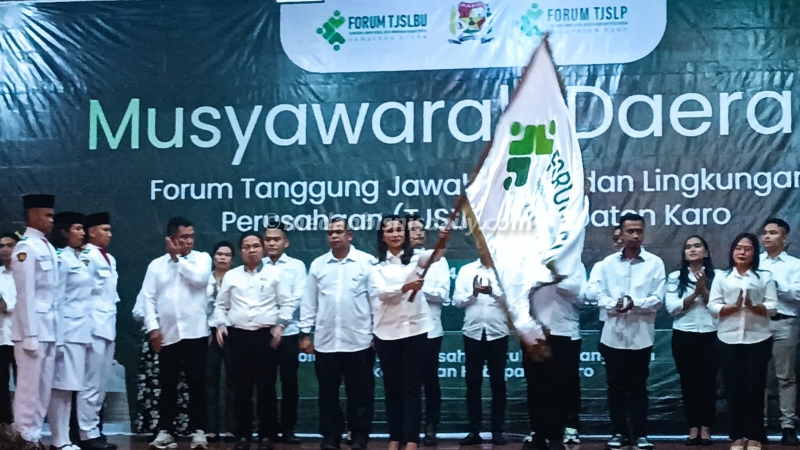
Karo. The Karo Regency Government, together with the Business Entity Social and Environmental Responsibility Forum (TJSLBU), officially held the First Regional Conference (Musda) and the inauguration of the 2026–2031 term management at the Sibayak International Hotel (HIS) in Berastagi, Karo, on Friday (April 24, 2026).
This event marked the formation of the TJSLBU Karo Forum management and served as a momentum to strengthen synergy between the regional government and the business sector in promoting sustainable social and economic development.
Susi Susanty Ginting, elected head of TJSLBU Karo for the 2026–2031 term, expressed her commitment to strengthening collaboration and ensuring that TJSLBU Karo programs provide direct benefits to the community.
“We will push for stronger synergy with all stakeholders and ensure that the programs we run truly address the needs of the people of Karo Regency,” she said.
She further stated that TJSLBU was established as a forum consisting of business leaders in Karo Regency to support government programs. TJSLBU is not meant to stand alone or become a competitor, but to assist government programs not covered by the regional budget.
“We will work together with entrepreneurs, business entities, and companies in Karo to support regional government programs. For now, we will focus on four programs: public health, educational scholarships, culture, and the development and planning of underdeveloped village areas,” she explained.
At the same event, the head of TJSLBU North Sumatra expressed appreciation for the implementation of the Regional Conference and the inauguration of TJSLBU Karo. He emphasized the importance of this forum as a cross-sector coordination platform.
“The TJSLBU Forum must be able to act as a bridge between the government, the business world, and the community so that CSR programs are more targeted, precise, and have a real impact,” he said.
Meanwhile, the Regent of Karo stated in his speech that the role of TJSLBU must be part of the regional development strategy.
“TJSL programs are not just social activities, but must become strategic instruments in improving community welfare, reducing poverty, and opening new economic opportunities in Karo Regency,” he said.
Also present at the event were the Vice Regent of Karo and the Regional Secretary of Karo Regency.
The series of activities also included a Regional Working Meeting (Rakerda) that discussed the organization’s priority programs, including empowering small and medium enterprises, strengthening the people’s economy, poverty alleviation, and increasing the role of the business sector in regional development.
Sibayak International Hotel (HIS)
Berastagi
Sibayak International Hotel (HIS)
Berastagi
Mount Sinabung
Mount Sibayak
Related news
Pertamina Patra Niaga Sumbagut Launches Affordable Market for 1,000 Residents
Two Traffic Police Personnel at Sudirman Post in Medan Caught in North Sumatra Police Internal Affairs Sting Operation
Prabowo’s Two Terms and the Deli Serdang Regent Election Echo at Gerindra’s 18th Anniversary Event.
PAD Deli Serdang Committee to Recommend Temporary Closure of PT Antara Kusuma (Artco) Tanjung Morawa