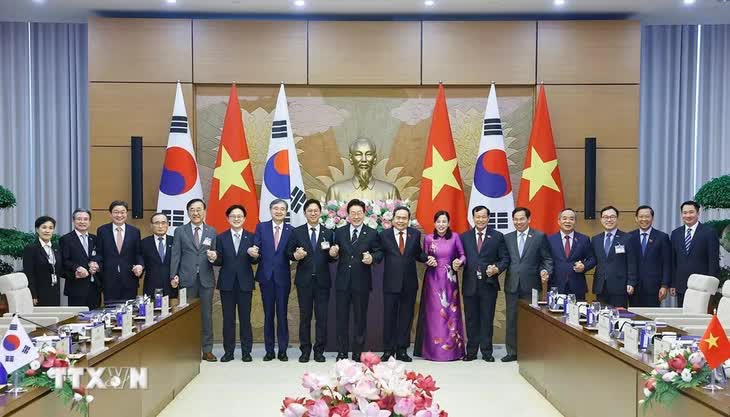
In a world fractured by fierce geopolitical competition, this visit carries profound significance for both nations.
More than three decades since establishing diplomatic relations at the end of 1992, Vietnam and South Korea have traveled a long path from strangers to comprehensive strategic partners, and even deeper than any formal titles suggest.
For decades, the story of Vietnam-South Korea economic relations was often summarized in a simple model: South Korea provided capital and technology, Vietnam provided land and labor. The year 2026 can be said to mark the beginning of deep high-tech cooperation and sustainable security.
A key highlight of President Lee’s visit, accompanied by about 200 major South Korean businesses, is the transformative shift in investment flows.
South Korea brings outstanding strengths in strategic fields such as energy, infrastructure, construction, science and technology, and innovation—areas Vietnam is eager to leverage for breakthroughs.
In an era of intense competition, the phrase “technology sharing” is often used cautiously, as technology is seen as power and national competitive advantage.
Yet, during the talks between General Secretary and President To Lam and President Lee Jae Myung, technology transfer was mentioned with an unprecedented strong commitment.
No longer just about assembly, South Korea’s largest tech chaebols now want Vietnam to participate more deeply in their ecosystems and become an indispensable link in South Korea’s global supply chain.
Indeed, today’s world leaves no room for isolated nations. Broken supply chains, inflation, and geopolitical turmoil in global hotspots demand a trust deeper than ordinary trade levels.
President Lee Jae Myung’s commitment to supporting Vietnam’s modernization to become a self-reliant and resilient nation is not just a generous diplomatic gesture, but also an effort to create a “closed ecosystem” between South Korea and Vietnam, helping to minimize risks from global logistics disruptions.
Vietnam and South Korea share a remarkable similarity in history and culture: resilience in rising from the harsh aftermath of war and a desire to assert their position on the international stage.
These similarities have created a special bond rarely found in bilateral relationships. President Lee recently affirmed that the Vietnam-South Korea relationship is special and as close as brotherly ties.
This is not “diplomatic language,” but a living reality. The Vietnamese community in South Korea has grown strongly to about 352,000 people, while over 200,000 South Koreans are currently living, studying, and working in Vietnam.
This does not include the fact that annually, an average of over 4 million South Koreans travel to Vietnam, along with about 100,000 Vietnam-South Korea families. This fosters increasingly close understanding between the two nations.
However, the rosy picture of cooperation still has areas needing improvement. For billion-dollar investment commitments to be truly sustainable, Vietnam needs to implement stronger institutional reforms than ever before.
Recently, complaints from South Korean business associations about delays in value-added tax refunds have become a test of trust.
A friendly South Korean diplomat confided that in diplomatic meetings with South Korean investors in Vietnam, the first issue raised is always tax-related obstacles. When investors face difficulties in rotating capital due to cumbersome administrative procedures, long-term enthusiasm can erode.
“If you want to go fast, go alone. If you want to go far, go together.” This proverb is perhaps more relevant than ever for Vietnam-South Korea relations today. The commitment of leaders from both sides is a strategic investment in a future where both nations stand tall in the realm of science and technology.
On the afternoon of April 23, Prime Minister Le Minh Hung and South Korean President Lee Jae Myung jointly attended a roundtable discussion on Vietnam-South Korea economic, trade, and investment cooperation, within the framework of the