Acharya Yuvraj Pandey Maharaj’s discourses moved devotees with emotion, huge crowd gathered on the final day
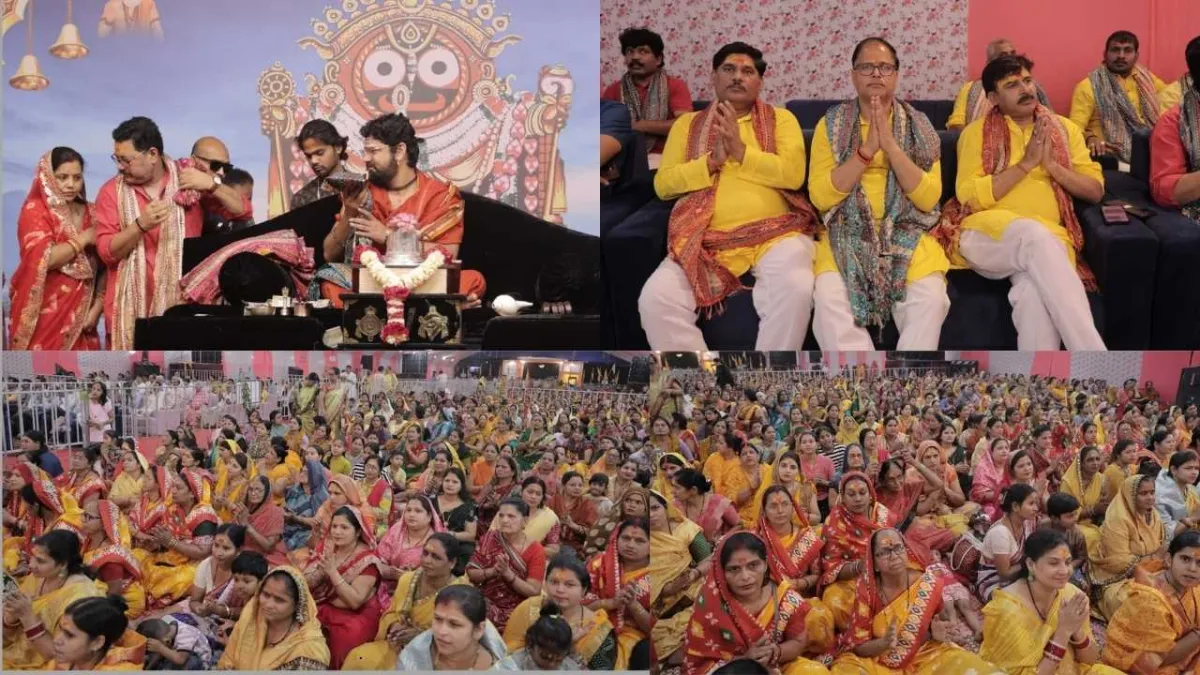
The seven-day Shri Ram Katha organized in the Bhestan area concluded in an extremely grand and devotional atmosphere. Devotees who had the opportunity to listen to the discourses from Acharya Yuvraj Pandey Maharaj were overwhelmed with emotion. On the seventh and final day of the Katha, such a large crowd gathered that devotees could not even find space to sit; despite this, the devotees enjoyed the Katha while standing or sitting in the crowd.
Maharajji described various episodes of the Ramayana so vividly and touchingly that the listeners felt as if all the characters of the Ramayana were present before them. Devotees attending the Katha were seen discussing that such a learned storyteller had arrived on the land of Surat for the first time. Many religious enthusiasts described this as the first unique Katha event of its kind in Surat.
The organization’s president, Bhargav Panda, expressed gratitude to all devotees and thanked them. He said that the presence and enthusiasm of the listeners made the Katha successful. During the Katha, the descriptions of the Lanka Kanda and Uttara Kanda were particularly the center of attraction, which Maharajji presented in a highly impactful manner.
The vice president Manoj Giri, treasurer Om Prakash Chaube, Kapil Pandey, Rajkumar Pathak, W. Singh, Devendra Singh, Ram Janak Shukla, Bablu Dubey, Bhagwat Shukla, Chitrasen Padhi, Shrikant Narayan, Ajay Master, Rajan Dwivedi, Rinku Rai, Guddu Singh, Anil Singh, Anil Pandey, Manu Mahapatra, Saroj Tiwari, Govind Panda, along with all office bearers and members, made special contributions to the success of this event.
At the conclusion of the Katha, Maharajji also expressed thanks to all devotees. Devotees say that such a grand and spiritual event was witnessed for the first time on the land of Surat.
Shri Ram Katha
Shri Ram Katha refers to the sacred recitation and storytelling of the Ramayana, the ancient Indian epic that narrates the life and virtues of Lord Rama. Rooted in Hindu tradition, these discourses have been held for centuries, often in temples or public gatherings, to inspire devotion and moral teachings. The practice gained widespread prominence through saints like Tulsidas, who composed the Ramcharitmanas, making the story accessible to common people in vernacular languages.
Ramayana
The Ramayana is an ancient Indian epic poem that narrates the story of Prince Rama, his wife Sita, and his loyal companion Hanuman. Composed by the sage Valmiki around 500 BCE to 100 BCE, it explores themes of duty, devotion, and the battle between good and evil, with Rama’s quest to rescue Sita from the demon king Ravana. The epic has profoundly influenced the cultural and religious traditions of South and Southeast Asia, inspiring countless adaptations in art, literature, and performance.
Surat
Surat is a historic port city in the Indian state of Gujarat, known for its significant role in global trade during the Mughal era. It was a major hub for textile and diamond industries, attracting merchants from Europe, Africa, and Asia, and was briefly controlled by the British in the 17th century. Today, it remains a thriving commercial center, often called the “Diamond City of India” due to its diamond cutting and polishing industry.
Bhestan
Bhestan is a suburban area located in the Surat district of Gujarat, India. Historically, it was a small village that grew significantly during the 20th century, largely due to the expansion of Surat’s textile and diamond industries. Today, Bhestan is known for its residential colonies, industrial estates, and its proximity to the Surat Airport.
Lanka Kanda
Lanka Kanda is a significant archaeological and cultural site located in the Anuradhapura District of Sri Lanka, associated with the ancient kingdom of Anuradhapura. Historically, it is believed to be the location of a fortress or palace mentioned in the Mahavamsa chronicle, linked to the legendary King Ravana and the epic Ramayana. Today, the site features ruins of ancient structures and a reservoir, offering insights into early Sri Lankan engineering and mythology.
Uttara Kanda
The Uttara Kanda is the seventh and final book of the ancient Indian epic, the Ramayana, traditionally attributed to the sage Valmiki. It narrates the later life of Lord Rama after his return to Ayodhya, including his coronation, the banishment of his wife Sita due to public doubt, and the birth of his twin sons, Lava and Kusha. This book is often considered a later addition to the original epic, and it concludes with Rama’s departure from the mortal world, marking the end of his earthly incarnation.