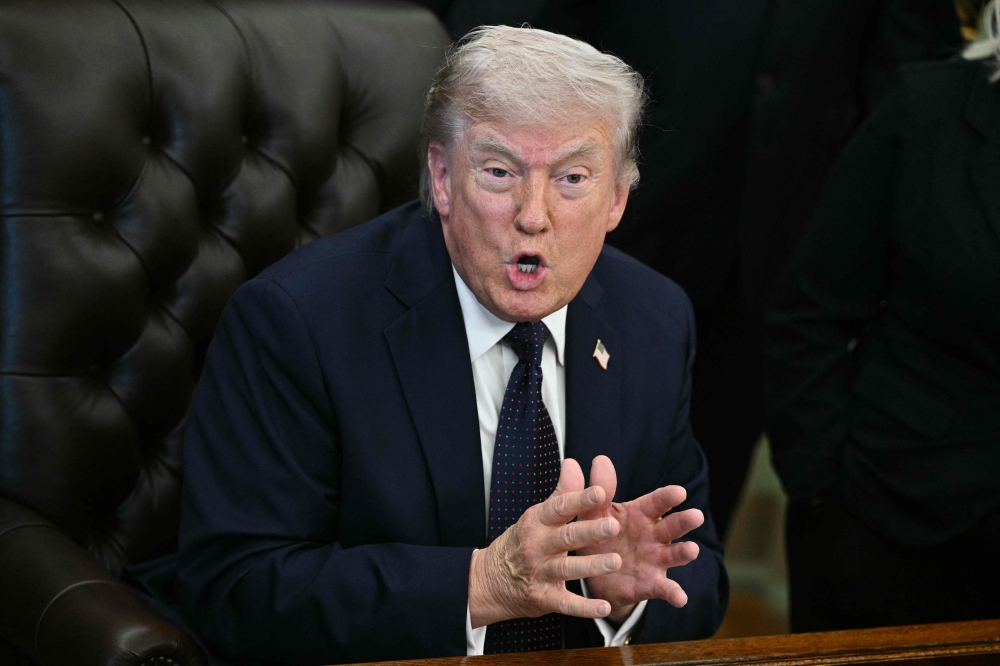
U.S. President Donald Trump said the war will not last long, and that his country will not use nuclear weapons in Iran.
Trump added in a speech: Iran’s missiles can reach Europe and may reach us in the future, and I will not allow it to possess a nuclear weapon that threatens the Middle East or America.
He continued: Iran’s new leaders are hiding their identities for fear of being killed, and we do not know who is currently leading Iran.
He noted that high oil prices are better than Iran possessing a nuclear weapon, pointing out that gasoline prices in America will remain high for a while, and that U.S. financial markets are thriving despite the war.
Opening the Strait of Hormuz
Trump said: We have full control over the Strait of Hormuz, and we will not rush to open it, but we will open it through a deal or other means.
He believed the blockade would lead to explosions in Iran’s oil production due to storage problems, and that it has deprived Iran of commercial transactions.
He added: I could make a deal with Iran now, but I want a permanent deal. Tehran’s leaders are disorganized; we are talking to the Iranians, but they are in turmoil. We have created chaos that caused a conflict among the leadership over power, and there is now a conflict among Iranian leaders.
Trump: We will not use nuclear weapons in Iran
Destruction of 75% of Iranian targets
Trump indicated that U.S. forces have hit about 75% of Iranian targets, but Iran may have re-equipped its forces during the truce period. We will eliminate the capabilities they may have re-equipped, and we will also eliminate their small boats.
He added: Iran responded to my request not to execute 8 female protesters.
Iran
Iran, historically known as Persia, is a country in West Asia with a rich cultural heritage spanning over 2,500 years. It was the center of the ancient Persian Empire, including the Achaemenid, Parthian, and Sassanid dynasties, and later became a major hub of Islamic civilization after the 7th century. Today, Iran is renowned for its stunning architectural sites, such as Persepolis and Isfahan’s Naqsh-e Jahan Square, as well as its contributions to art, literature, and science.
Middle East
The Middle East is a historically and culturally rich region spanning parts of Western Asia and North Africa, often considered the birthplace of major civilizations and three of the world’s major religions: Judaism, Christianity, and Islam. Its history includes ancient empires like Mesopotamia, Persia, and Egypt, as well as the rise and fall of the Ottoman Empire, which shaped modern borders. Today, the region is known for its diverse cultures, significant oil reserves, and ongoing geopolitical complexities.
America
America is a vast nation in North America, originally inhabited by Indigenous peoples for thousands of years before European colonization began in the 15th century. It declared independence from Great Britain in 1776, forming the United States of America, and has since grown into a major global power shaped by immigration, cultural diversity, and pivotal historical events like the Civil War and the Civil Rights Movement. Today, America is known for its influential economy, democratic institutions, and diverse cultural landmarks.
Strait of Hormuz
The Strait of Hormuz is a narrow, strategically vital waterway connecting the Persian Gulf to the Gulf of Oman and the Arabian Sea. Historically, it has been a crucial trade route for centuries, linking Middle Eastern oil producers to global markets. Today, it remains one of the world’s most important chokepoints, with about one-fifth of the world’s petroleum passing through it.
Europe
Europe is a continent with a rich and complex history, home to the ancient Greek and Roman civilizations that laid foundations for Western philosophy, democracy, and law. Its cultural sites range from the Colosseum in Rome and the Palace of Versailles in France to the medieval castles of Germany and the Renaissance art of Florence. Shaped by wars, empires, and revolutions, Europe remains a diverse mosaic of languages, traditions, and architectural wonders.
Tehran
Tehran is the capital and largest city of Iran, with a history dating back to the 13th century when it was a small village. It rose to prominence in the late 18th century when it was chosen as the capital of the Qajar dynasty, replacing Isfahan. Today, it is a bustling metropolis blending modern urban life with historic sites like the Golestan Palace and the Azadi Tower.