The Jakarta Provincial Government will conduct a simultaneous and participatory lights-out event as part of an energy-saving and carbon emission reduction initiative, implementing Governor Instruction Number 14 of 2021 on Lights-Out Implementation.
“encouraging energy savings,”
The lights-out activity will take place from 8:30 PM to 9:30 PM Western Indonesia Time, and will be held three times: Saturday, April 25, 2026, in conjunction with Earth Day; June 13, 2026, in conjunction with Environment Day; and September 26, 2026, in conjunction with World Ozone Day.
The Head of the Jakarta Environmental Agency explained that the mechanism for implementing the lights-out activity is carried out participatively by the managers and/or persons responsible for buildings, facilities, and lighting according to their respective authorities.
“The lights-out activity aims to encourage energy savings, reduce greenhouse gas emissions, and increase public awareness and participation in efforts to prevent and control environmental pollution,” he said.
The following are the locations for the lights-out activity in accordance with Governor Instruction of DKI Jakarta Province Number 14 of 2021:
1) All buildings/offices of the DKI Jakarta Provincial Government (except hospitals, health centers, clinics, and others).
2) Main roads and arterial roads in the 5 (five) Administrative City Areas as follows:
a) Central Jakarta: Jl. Sudirman (from Dukuh Atas to Sampoerna Strategic Building), and Jalan MH. Thamrin; Around Jalan Medan Merdeka (North Medan Merdeka District in front of the Presidential Palace), Jalan Gerbang Pemuda – Jalan Asia Afrika, City Hall Office Yard, Central Jakarta Mayor’s Office.
b) North Jakarta: Jl. Yos Sudarso, North Jakarta Mayor’s Office Complex, and Perintis Kemerdekaan.
c) East Jakarta: Jl. Dr. Sumarno, Jl. Perintis Kemerdekaan, and East Jakarta Mayor’s Office Complex.
d) West Jakarta: Jl. Daan Mogot and Jl. Kembangan Raya (in front of West Jakarta Mayor’s Office), and West Jakarta Mayor’s Office Complex.
e) South Jakarta: Jl. Prapanca Raya, Jl. Gerbang Pemuda – Jl. Asia Afrika, Jl. Sudirman (Sampurna Strategic Building – Patung Pemuda), and Jl. Rasuna Said.
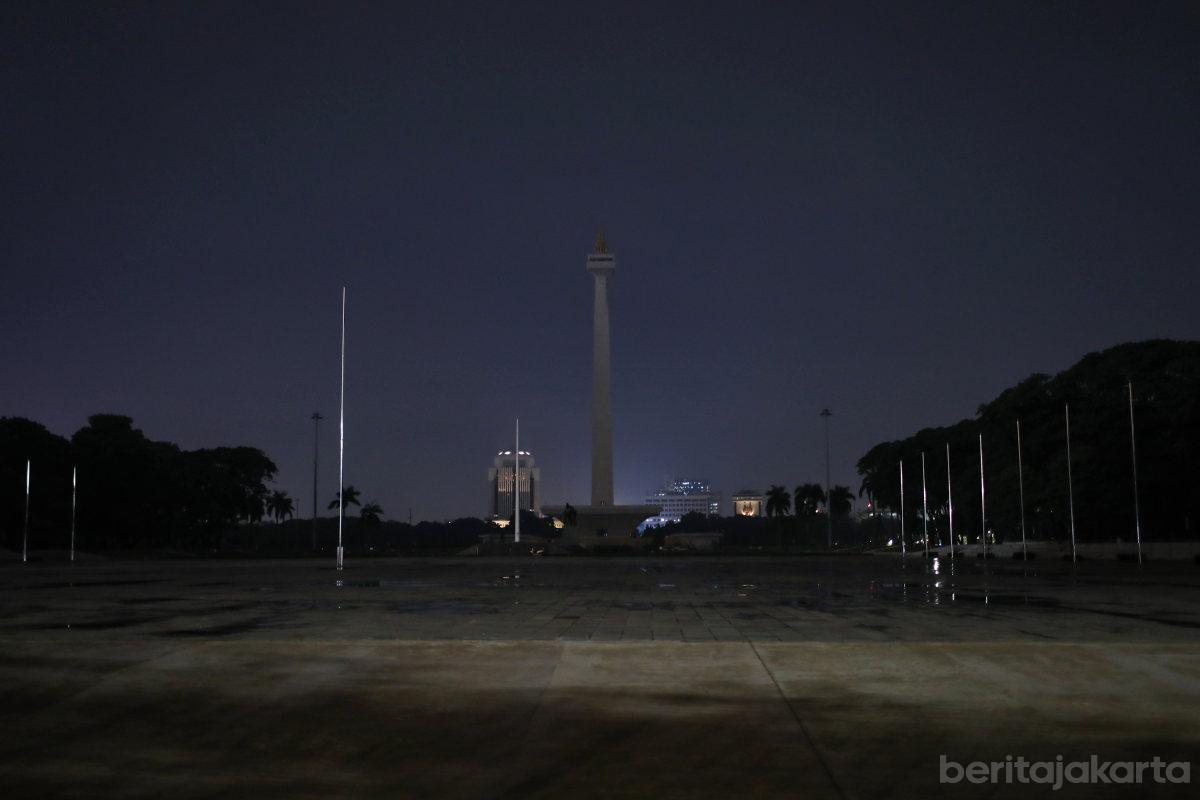
3) Jakarta City symbols: City Hall Building; National Monument and its fountains; Arjuna Wiwaha Statue and its fountains; Hotel Indonesia Roundabout and its fountains; Youth Statue and its fountains; Heroes Statue; and General Sudirman Statue.
4) Several privately-owned buildings, commercial buildings, shopping centers, restaurants, hotels, and apartments also participate in the implementation of the lights-out activity.
National Monument
The National Monument in Jakarta, Indonesia, is a 132-meter tower symbolizing the country’s struggle for independence. Construction began in 1961 under President Sukarno and was completed in 1975, featuring a gold-plated flame at its peak. It stands in Merdeka Square as a central landmark and museum commemorating Indonesia’s history and freedom.
Arjuna Wiwaha Statue
The Arjuna Wiwaha Statue is a prominent landmark in Jakarta, Indonesia, located in the Merdeka Square area. It depicts the Hindu epic hero Arjuna from the Mahabharata, symbolizing victory and heroism, and was created by Italian sculptor Francesco Iacurto in the 1960s. The statue was inaugurated in 1965 as part of President Sukarno’s efforts to beautify the city with monumental art reflecting Indonesia’s cultural heritage.
Hotel Indonesia Roundabout
The Hotel Indonesia Roundabout, located in central Jakarta, Indonesia, is a major landmark and traffic circle named after the adjacent Hotel Indonesia, which opened in 1962 to host foreign delegates for the Asian Games. The roundabout features the iconic “Welcome Monument” (Monumen Selamat Datang), erected to symbolize Indonesia’s openness to the world. It has since become a central hub for protests, celebrations, and cultural events in the city.
Youth Statue
The Youth Statue is a prominent landmark in Pyongyang, North Korea, symbolizing the energy and revolutionary spirit of the country’s younger generation. Erected in the late 20th century, it depicts three young people—a worker, a farmer, and an intellectual—holding aloft a stylized emblem of the Workers’ Party of Korea, representing unity and collective progress. The statue serves as a popular site for political gatherings and a reminder of the regime’s emphasis on youth involvement in national development.
Heroes Statue
The Heroes Statue is a prominent monument located in Harare, Zimbabwe, dedicated to the country’s fallen liberators and heroes of the independence struggle. Erected in the 1980s after Zimbabwe gained independence in 1980, it stands as a symbol of national pride and remembrance, honoring those who fought against colonial rule. The statue’s central figure, a soldier holding a rifle and a flag, represents the sacrifice and resilience of the nation’s freedom fighters.
General Sudirman Statue
The General Sudirman Statue is a prominent monument located in Jakarta, Indonesia, honoring the revered military leader General Sudirman, who played a crucial role in the country’s struggle for independence. Erected to commemorate his leadership as the first commander of the Indonesian National Armed Forces during the Indonesian National Revolution, the statue symbolizes his bravery and dedication. It stands as a lasting tribute to his legacy, inspiring national pride and remembrance of Indonesia’s fight for freedom.
Presidential Palace
The Presidential Palace, often located in a nation’s capital, serves as the official residence and workplace of the head of state. Its history typically reflects the country’s political evolution, sometimes originating as a colonial governor’s mansion or royal palace before being repurposed for a democratic government. Many such palaces are now iconic landmarks, hosting state ceremonies and symbolizing national governance.
City Hall Building
The City Hall Building serves as the administrative headquarters for a city’s government, often housing the mayor’s office and city council chambers. Historically, many city halls were built in the late 19th and early 20th centuries, reflecting architectural styles like Beaux-Arts or Gothic Revival, and they symbolize civic pride and local governance. Notable examples include the Philadelphia City Hall, completed in 1901, which was the world’s tallest habitable building at the time.

![Guru Besar Universitas Jayabaya, Yuhelson. [Istimewa]](https://asiacity.news/wp-content/uploads/2026/04/95169-guru-besar-universitas-jayabaya-yuhelson-150x150.webp)