One of the key tasks is turning off or reducing the power of outdoor advertising and decorative lighting systems after 10 PM, which is considered a central, easy-to-implement solution that brings immediate results.
Many advertising signs have been turned off at night
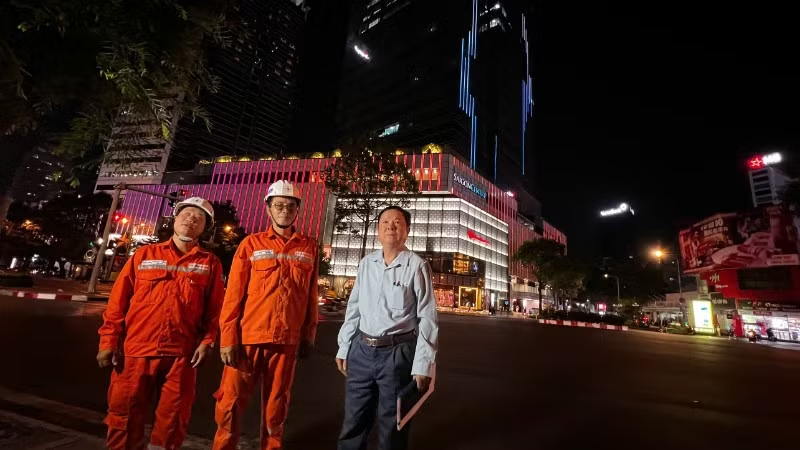
On the evening of April 23, along central city streets such as Nguyen Hue, Le Thanh Ton, Pasteur, Nam Ky Khoi Nghia, many signs and LED advertising and decorative screens simultaneously dimmed or turned off after 10 PM.
This is one of the solutions the city is aggressively implementing to save electricity during the peak dry season of 2026.
Reality shows that nighttime electricity usage has changed noticeably compared to before. Large signs on commercial streets, hotel areas, and shopping centers no longer maintain brightness throughout the night; instead, they proactively reduce light or turn off according to regulated time frames.
Employees of Saigon Power Company, in coordination with local authorities, also conduct inspections and directly remind business establishments that have not yet complied.
This is one of the key policies emphasized and directed by the Ho Chi Minh City People’s Committee to enhance electricity savings and ensure safe, stable power supply during the dry season of 2026 and the period 2027-2030.
According to experts, reducing electricity consumption for advertising and outdoor decorative lighting systems is identified as an easy-to-implement solution that brings immediate effects, especially in the context of continuously increasing load demand.
Along with that, the Ho Chi Minh City power sector has also required its subordinate units to organize nighttime inspection teams to directly encourage customers to turn off or reduce the power of lighting systems after 10 PM. This is implemented uniformly from April 1 to the end of June 2026, focusing on areas with high advertising density and commercial and service streets.
Customers voluntarily join in implementation
Electricity saving from advertising systems is gradually forming a habit in the business community. Some business establishments in the central area said they proactively adjusted the operating time of their signs even before the city’s and power sector’s inspection plans and policies. Turning off early does not significantly affect business operations, while electricity costs are noticeably reduced.
Reality shows that if previously reminders were mainly for propaganda, now there is a clear change in awareness. Businesses no longer see this as a mandatory requirement but as part of cost management and social responsibility.
A representative of Saigon Power Company stated: The management unit in the central area has many outdoor advertising signs. When we raised the issue, we immediately received customer consent. They themselves are also aware that saving electricity also helps with financial calculations and achieves more effective savings.
Sharing about this effort, Mr. Bui Trung Kien, Deputy General Director of EVNHCMC, said that turning off advertising lights after 10 PM is a specific solution that can be implemented immediately, but its greater significance lies in adjusting electricity usage behavior throughout society. Under conditions of increasing load demand during the dry season, saving electricity is no longer a choice but a mandatory requirement to ensure the system operates safely and stably.
According to Mr. Kien, the city’s power sector will continue to closely coordinate with local authorities and departments to maintain this solution long-term, aiming to form a culture of efficient electricity use in the community.
According to statistics, thanks to the synchronized implementation of solutions, in the first quarter of 2026, the city saved 327.4 million kWh, equivalent to 2.45% of commercial electricity.
From central streets to city gateway areas such as Phan Dinh Giot axis and Tan Son Nhat airport area, reducing advertising light after 10 PM is showing clear effectiveness. Not only does it reduce electricity consumption, this solution also contributes to load regulation and maintaining power system stability during peak heat waves.
Not stopping at turning off advertising lights after 10 PM, the city also strongly directs the synchronized implementation of many electricity-saving solutions throughout society, from administrative agencies and businesses to individual households.
Specifically, units and businesses are required to set air conditioner temperatures to 26 degrees Celsius or higher, turn them on