Japan’s new arms export rules risk eroding its pacifist stance
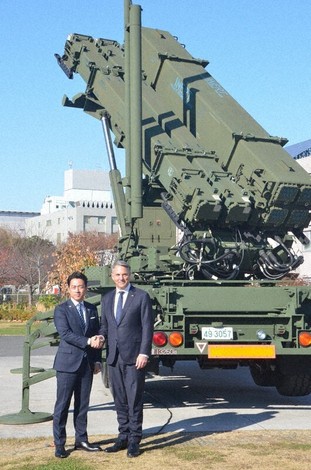
Defense Minister Shinjiro Koizumi, left, and Australian Deputy Prime Minister and Defense Minister Richard Marles inspect Patriot PAC-3 surface-to-air guided missiles at the Defense Ministry in Tokyo’s Shinjuku Ward on Dec. 7, 2025, ahead of Japan-Australia defense ministerial talks.
The Japanese government has revised the “Three Principles on Transfer of Defense Equipment and Technology,” which set rules for arms exports, and its operational guidelines. This marks a major shift away from the restrained stance Japan has maintained for many years.
The framework that had heretofore limited exports to five noncombat categories — rescue, transportation, vigilance, surveillance and minesweeping — has been abolished.
Under the new rules, Japan can export weapons with lethal capabilities, such as missiles, to countries with which it has concluded agreements in advance. It will also allow the export of weapons that Japan has jointly developed and produced with other countries to third countries. The stated aim is to strengthen ties with allies and like-minded nations by supplying them with arms and to enhance regional deterrence.
Another objective is to reinforce the foundations of the domestic defense industry by expanding exports and to secure domestic production capability in preparation for potential contingencies. Behind this lies a strong sense of alarm over the wave of corporate withdrawals from the sector, as companies judged that the domestic market alone offered too few business opportunities.
There is no doubt that Japan’s security environment is becoming increasingly severe. However, if excessive exports trigger an arms race, regional situations will become unstable. Combined with the expansion of the defense industry, this could rather heighten tensions with neighboring countries.
The greatest concern is the lack of a mechanism to curb the expansion of exports. In principle, exports to “countries in which it is judged that actual combat is taking place” will not be allowed, but if the government decides that there are “special circumstances in terms of Japan’s security,” it will permit them as an exception.
The National Security Council (NSC) will review whether exports are allowed, and the government says it will check how the recipient country manages the equipment after export as necessary. However, there remains a risk that weapons will be brought from the recipient country into parties in conflict or countries with serious human rights issues. There are concerns that Japan could become involved in conflicts in unintended ways. The risk of technology leaks has also been pointed out.
A booth showcasing a next-generation fighter jet being jointly developed by Japan, Britain and Italy is seen at the DSEI Japan 2023 defense equipment trade fair at Makuhari Messe in Chiba on March 15, 2023.
The Centrist Reform Alliance and two other opposition parties have argued that easing should remain limited. As a counterproposal, they had compiled a plan to add three items to the five categories for the purpose of defending sea lanes: measures to counter drones, joint training, and air defense systems.
Under the new system, the Diet can hardly be expected to function as a brake. After the NSC decides on an export, it will only send written notification afterward to all Diet members. A mechanism for prior review must be established.
In the United States, export deals that exceed a certain amount must be notified to Congress in advance. There is also a prerequisite that no resolution banning the export has been adopted. To prevent Japan from expanding arms exports without restraint, clear rules and effective safeguards are essential.
To begin with, the latest revision was carried out solely by the government and ruling parties on the grounds that it did not require amending laws. It is hard to say that the public has been sufficiently informed and convinced.
Japan, as a pacifist nation, has long imposed restrictions on arms exports. In 1967, when antiwar sentiment was growing over the Vietnam War, then Prime Minister Eisaku Sato announced the “Three Principles on Arms Exports,” under which Japan was not to export weapons to communist bloc countries, countries subject to United Nations arms embargoes, or parties to international conflicts. In 1976, then Prime Minister Takeo Miki went further and effectively adopted a comprehensive ban.
It was the second Shinzo Abe administration that shifted course toward easing arms export restrictions. Amid China’s military buildup and other factors, the government in 2014 replaced the existing rules with the “Three Principles on Transfer of Defense Equipment and Technology,” allowing exports but limiting them to the five categories and other conditions.
Since then, the Japanese government has continued to create “loopholes.” It allowed exports of finished weapons if they were produced under license, as long as they were shipped to the country that had granted that license. The first such case was the export of the Self-Defense Forces’ Patriot surface-to-air missiles to the United
Patriot PAC-3 surface-to-air guided missiles
The Patriot PAC-3 (MIM-104F) is a modernized, hit-to-kill surface-to-air missile system developed by the United States, designed to intercept and destroy incoming tactical ballistic missiles, cruise missiles, and aircraft. It evolved from the earlier Patriot systems first deployed in the 1980s, with the PAC-3 variant entering service in the early 2000s after extensive upgrades to its guidance and radar technology. Notably, the system gained prominence during the 1991 Gulf War and has since been a key component of U.S. and allied air defense, with the PAC-3 specifically offering enhanced accuracy and effectiveness against advanced threats.
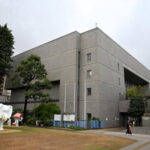
Defense Ministry in Tokyo’s Shinjuku Ward
The Defense Ministry in Tokyo’s Shinjuku Ward is the headquarters of Japan’s Ministry of Defense, responsible for the nation’s military and security policies. Established in its current form in 2007, the site has historical roots in the former Imperial Japanese Army facilities, reflecting Japan’s post-World War II shift toward a pacifist constitution and self-defense forces. The modern building, completed in 2015, symbolizes Japan’s evolving defense posture in the 21st century.
Makuhari Messe in Chiba
Makuhari Messe is a large convention and exhibition center located in Chiba, Japan, built on reclaimed land in the Makuhari area. Opened in 1989, it has become a major venue for international events, including the Tokyo Motor Show and concerts. Its development is part of the broader Makuhari New City project, which transformed the area into a modern business and cultural hub.
DSEI Japan 2023 defense equipment trade fair
DSEI Japan 2023 is a major defense and security trade fair held in Tokyo, part of the global DSEI series of exhibitions. The event serves as a platform for international defense industries, government officials, and military leaders to showcase cutting-edge equipment, foster partnerships, and discuss security challenges in the Indo-Pacific region. It reflects Japan’s increasing focus on strengthening its defense capabilities and deepening alliances, particularly in response to regional tensions.
next-generation fighter jet
The term “next-generation fighter jet” refers to advanced military aircraft currently in development or early deployment, such as the U.S. Air Force’s NGAD (Next Generation Air Dominance) program or the UK-led Global Combat Air Programme (GCAP). These jets are designed to replace current platforms like the F-22 and Eurofighter Typhoon, incorporating cutting-edge technologies such as artificial intelligence, stealth, and networked warfare capabilities. Their history is rooted in the lessons of modern conflicts and the need to counter evolving threats from rival nations like China and Russia.
The Self-Defense Forces’ Patriot surface-to-air missiles are a key component of Japan’s air defense system, operated by the Japan Ground Self-Defense Force. Originally developed in the United States, these missiles were deployed in Japan during the Cold War to protect against potential aerial threats, and have been used in recent years to intercept North Korean missile tests. Their presence reflects Japan’s ongoing commitment to national security and its alliance with the United States.
United Nations
The United Nations is an international organization founded in 1945 after World War II to promote peace, security, and cooperation among nations. Its headquarters in New York City serves as a global forum where member states address issues like human rights, climate change, and conflict resolution. The UN replaced the League of Nations and now includes 193 member countries, working through bodies like the Security Council and General Assembly.
National Security Council (NSC)
The National Security Council (NSC) is a key executive branch agency in the United States, established in 1947 by the National Security Act. It serves as the principal forum for the President to consider national security and foreign policy matters, coordinating advice from senior advisors and cabinet officials. Historically, the NSC has played a pivotal role in shaping Cold War strategy, crisis management, and contemporary U.S. global policy.