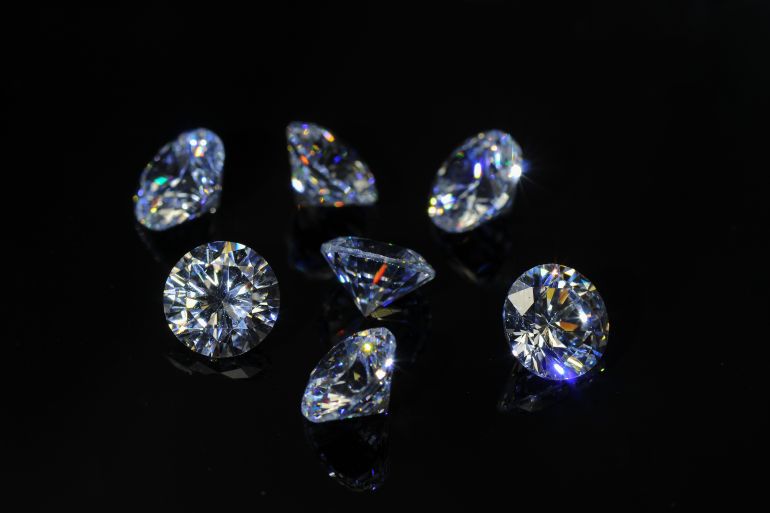
Diamonds are widely known as a material that resists scratches, is used to cut the hardest metals, and is often used as a metaphor for toughness. However, an international research team recently challenged this view, announcing that “nanoscale” diamonds can somehow become “rubbery.”
According to the study, published in the journal Physical Review X, researchers focused on what is known as “nanodiamonds”—extremely tiny crystals ranging in size from 4 to 13 nanometers (thousands of times smaller than the width of a human hair).
The surprise is that these crystals, despite being made of the same hard material we know, do not behave the same way at this scale. In fact, the smallest particles studied, at 4 nanometers in size, showed a reduction in hardness by about 30% compared to larger particles, while still maintaining high toughness.
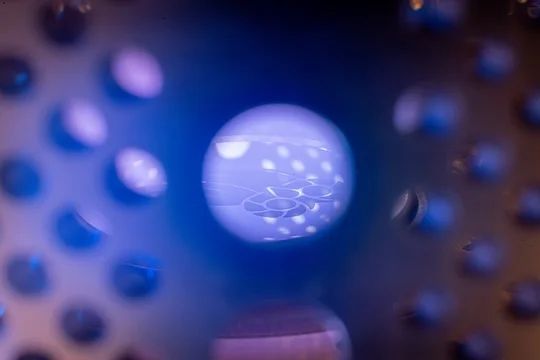
These results came from extremely precise experiments. The researchers used a special tool known as a “diamond anvil cell,” where nanoparticles are placed between two diamond surfaces and then subjected to intense pressure.
At the same time, the team used a transmission electron microscope to observe what happens inside the material at the atomic level, while computer simulations supported these observations. This methodology allowed scientists to see how atoms actually move when diamond is subjected to pressure.
Promising Applications
According to the study, the researchers found that the real reason for this flexibility lies in a very thin layer located just beneath the surface. In this region, the carbon bonds are slightly different from those in the hard diamond core—they are less compact and relatively longer, making them mechanically weaker.
Thus, a three-part structure forms within the same diamond piece: a very hard inner core, a strong outer shell, and a relatively weaker intermediate layer. This intermediate layer acts as a microscopic cushion, according to the scientists, absorbing some of the pressure and giving the particle the ability to bend, somewhat like rubber.
However, according to the study, nanodiamonds do not become soft in the traditional sense, but they become more capable of withstanding stress without cracking.
This discovery holds promising practical applications. Combining high hardness with relative flexibility is a dream in the field of materials engineering, especially in nanoscale sensors, which require materials that can withstand vibration without breaking.
This technology could also benefit advanced computing, including quantum computing, where nanomaterials are used in highly sensitive environments, as well as in detecting viruses and gases through precise sensors that rely on small mechanical changes.