Leju Intelligent (Shenzhen) Co., Ltd. has changed its IPO coaching status to “coaching acceptance,” with its coaching broker being Orient Securities. The company plans to target the STAR Market for its IPO.
On April 22, according to a disclosure on the CSRC website, the IPO coaching status of Leju Intelligent (Shenzhen) Co., Ltd. was updated to “coaching acceptance,” with Orient Securities as the coaching broker. It is understood that the company aims for a STAR Market IPO.
According to the official website, Leju Intelligent was founded in 2016 and focuses on the R&D and production of intelligent robots.
According to IDC data, in 2025, Leju Intelligent shipped approximately 1,000 robots. Additionally, based on the “General Embodied Robot Market Radar” report by international research firm Omdia, Leju Intelligent ranked fourth globally in humanoid robot shipments in 2025, following only Zhiyuan, Yushu Technology, and Ubtech.
The company has previously received strategic investments from institutions such as Shenzhen Capital Group and Tencent. In October 2025, the company completed a 1.5 billion yuan Pre-IPO financing round, with additional capital from Shenzhen Investment Holdings Capital, Shenzhen Longhua Capital, Qianhai Infrastructure Investment, Shijingshan Industrial Fund, and Dongfang Precision.
According to previously disclosed coaching filing reports, Leju Intelligent has no controlling shareholder. The company’s actual controllers are natural persons Leng Xiaokun, Chang Lin, and An Ziwei, who directly hold 15.92%, 6.01%, and 4.15% of the shares, respectively. Additionally, Leng Xiaokun, as the executive partner, indirectly controls 7.64% of the company’s shares through Shenzhen Leyue Intelligent Enterprise Management Partnership (Limited Partnership). The actual controllers collectively control 33.72% of the company’s shares.
Over the past two years, domestic humanoid robots have accelerated their push into the capital market. From the “first humanoid robot stock” Ubtech to Yuejiang Technology, and then to Yushu Technology and Leju Robot, both sprinting for the STAR Market. Recently, Zhipingfang also completed a share reform, possibly signaling an imminent move into the capital market.
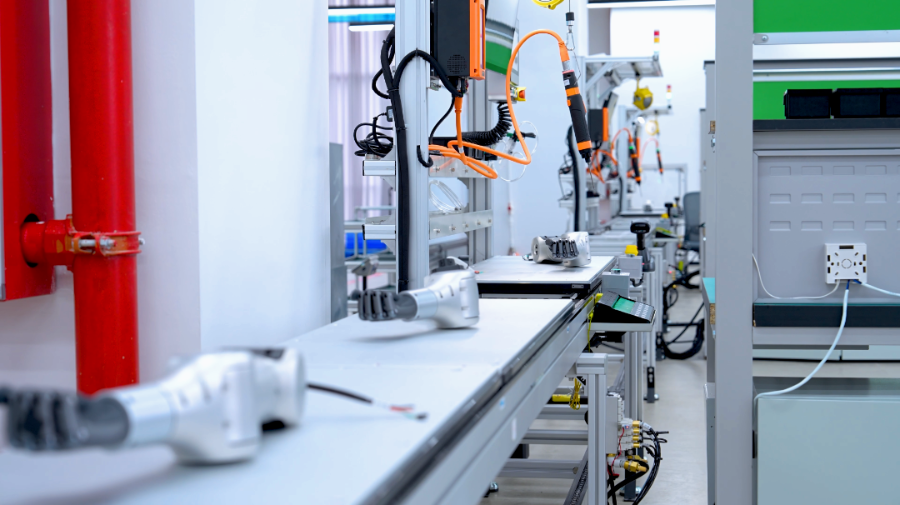
On March 30 of this year, Leju Robot announced that a humanoid robot automated production line with an annual capacity of 10,000 units was officially put into use in Guangdong. This production line was jointly built by Dongfang Precision and Leju Robot.
The production line has an annual capacity exceeding 10,000 units and can produce one humanoid robot every 30 minutes. All 24 precision assembly processes on the line are digitized, improving efficiency by over 50% compared to traditional methods. Seventy-seven inspection and testing checkpoints ensure the reliability of the output. Additionally, the production line features high flexibility in assembly, allowing for adjustable workstations and line lengths to support mixed production of multiple models and products.
On April 12, the Leju Robot pilot production line in Longhua, Shenzhen, was officially launched.
Currently, the manufacturing of humanoid robots generally suffers from unstable processes, high costs, and inconsistent quality. Leju Robot’s pilot production line is key to solving these challenges.
An assistant vice president at Leju Robot stated that pilot verification serves as a checkpoint or validation system between R&D and small-scale mass production, primarily verifying process feasibility as well as supply chain stability and supporting capabilities.
“The core purpose of this step is to establish standards and reduce costs. Without pilot verification, directly moving from R&D to mass production could lead to situations where products cannot be made, are too expensive to produce, are of poor quality, or are unstable,” the representative said.
It is understood that the production line is currently conducting small-batch trial production of the ROBAN 2, focusing on trial production and validation in three main directions: flexibility, standardization, and intelligence.
The flexible production line, combined with manual operations, allows for quick changeovers and leverages human error-correction advantages. For the ROBAN 2, two major versions have undergone validation iterations, with over 170 process improvements to ensure maturity at each step. Modular assembly combined with independent testing covers the entire process from trial production to mass production, establishing quality standards from components to the finished product. An M