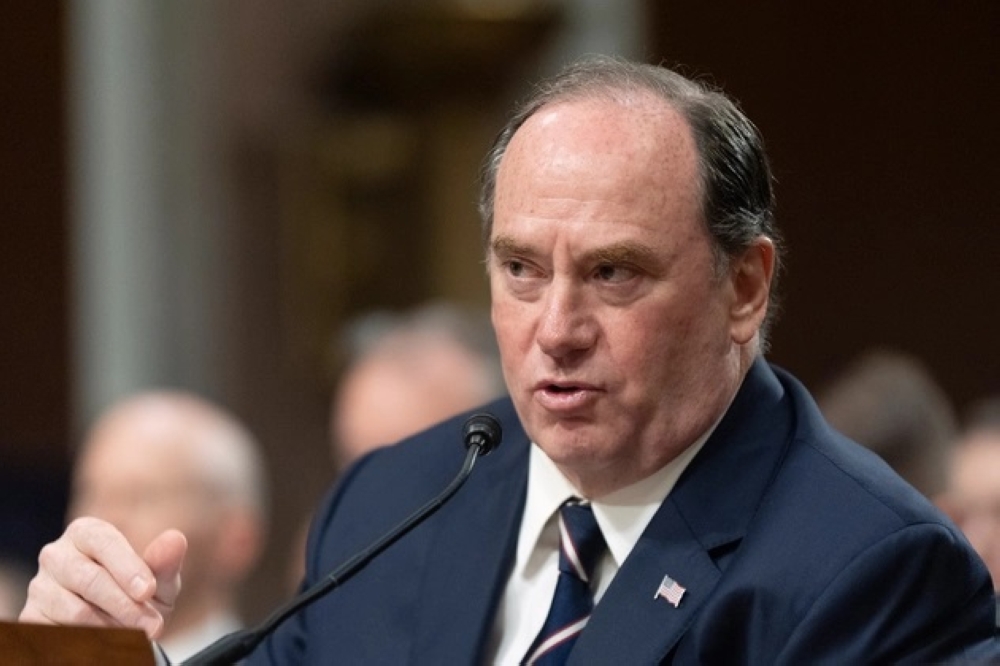
The US Department of Defense (Pentagon) announced that US Navy Secretary John Phelan will leave his post immediately, without providing an explanation for this sudden departure.
Phelan’s departure follows the dismissal of the US Army Chief of Staff General Randy George and two other senior officers earlier this month, amid the war led by the United States and Israel against Iran.
Pentagon spokesman Sean Parnell stated in a post on platform X that Phelan will leave the administration immediately, and will be temporarily replaced by Under Secretary Hong Kao.
Trump dismisses many military officials
Since returning to office at the start of last year, the Trump administration has dismissed many high-ranking military officials, including Chairman of the Joint Chiefs of Staff General Charles Brown without any justification in February 2025, as well as other senior military officials in the Navy and Coast Guard.
The Air Force Chief of Staff also announced his resignation without providing a reason, only two years into a four-year term, while the commander of US Southern Command resigned after one year in office.
Defense Secretary Pete Hegseth insists that the president chooses whom he deems most suitable for the position, but Democrats do not hide their concerns about a potential politicization of the US military institution, which is usually known for its neutrality regarding the political landscape.
Pentagon
The Pentagon is the headquarters of the United States Department of Defense, located in Arlington, Virginia. It was completed in 1943 during World War II and is one of the world’s largest office buildings, famously shaped like a five-sided polygon. The site is a symbol of U.S. military power and was the target of the September 11, 2001 terrorist attacks, when American Airlines Flight 77 crashed into its western side.
US Navy
The United States Navy is the naval warfare service branch of the U.S. Armed Forces, established on October 13, 1775, during the American Revolutionary War. It played a crucial role in securing American independence and has since grown into the world’s largest and most powerful navy, projecting global power through its fleet of aircraft carriers, submarines, and amphibious assault ships. Its history includes pivotal engagements from the War of 1812 to World War II and modern conflicts, underscoring its mission to maintain freedom of the seas and national security.
US Army
The United States Army is the land service branch of the U.S. Armed Forces, established on June 14, 1775, before the Declaration of Independence, to fight the American Revolutionary War. As the oldest and largest branch, it has played a central role in major conflicts from the Civil War and World Wars to modern engagements, while also contributing to humanitarian and peacekeeping missions worldwide. Today, the Army serves to protect national security and interests through ground-based operations.
Navy
The term “Navy” refers to a nation’s maritime military force, responsible for naval warfare, defense, and power projection at sea. Historically, navies have been crucial for protecting trade routes, exploring new territories, and projecting national influence, with early examples including the ancient Athenian navy and the Roman fleet. Modern navies, such as the U.S. Navy, trace their origins to the age of sail and have evolved to include advanced technologies like aircraft carriers and submarines.
Coast Guard
The Coast Guard is a maritime security, law enforcement, and search and rescue service found in many countries, with the United States Coast Guard being one of the most prominent. Established in 1790 as the Revenue Cutter Service to enforce tariff and trade laws, it later merged with other maritime agencies in 1915 to form its modern structure. Today, it operates under the Department of Homeland Security, playing a vital role in protecting coastlines, responding to disasters, and ensuring safe navigation.
Air Force
The term “Air Force” refers to a nation’s military branch responsible for aerial warfare, air defense, and space operations. Modern air forces trace their origins to the early 20th century, with the establishment of the Royal Air Force in 1918 as the world’s first independent air force. Since then, air power has become a crucial element of military strategy, evolving from early biplanes to advanced jets, drones, and missile systems.
US Southern Command
The US Southern Command (SOUTHCOM) is one of eleven unified combatant commands of the U.S. Department of Defense, responsible for military operations and security cooperation in Central America, South America, and the Caribbean. Established in 1963 as the United States Southern Command, its headquarters is located in Doral, Florida. The command’s history includes a significant role during Cold War-era counterinsurgency operations and, more recently, focusing on counter-narcotics, humanitarian assistance, and disaster response in the region.
US military
The U.S. military refers to the unified armed forces of the United States, comprising the Army, Navy, Marine Corps, Air Force, Space Force, and Coast Guard. Its history dates back to the Continental Army, founded in 1775 during the American Revolutionary War, and it has since evolved into one of the world’s most powerful military forces. The U.S. military has played a central role in major global conflicts, including both World Wars, the Cold War, and modern counterterrorism operations, while also serving as a key instrument of U.S. foreign policy and national defense.