The US denies reports that Iranian ships have broken through the blockade; the US Senate again rejects efforts to limit President Trump’s war powers; the UN Deputy Special Envoy criticizes Israel… these are some notable Middle East news for the morning of April 23.
US denies reports that Iranian ships have broken through the blockade
On the morning of April 23 (Vietnam time), the US Central Command (CENTCOM) posted on platform X:
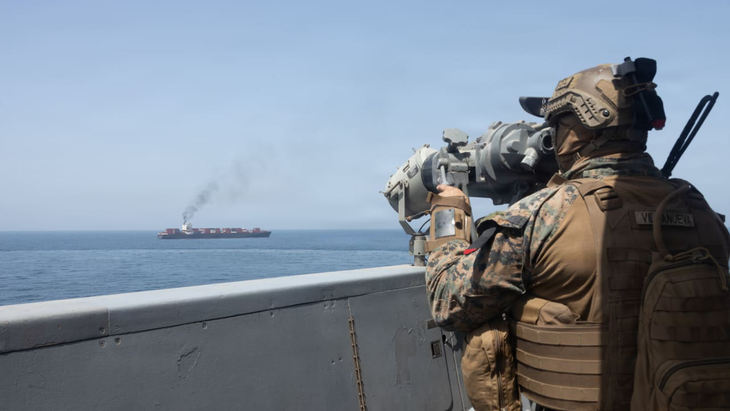
“US forces have ordered 29 ships to turn back or return to port, as part of the US blockade of Iran.
In the past 24 hours, media has reported that many commercial ships have broken through the blockade, citing the ships M/V Hero II, M/V Hedy, and M/V Dorena as examples. However, these reports are inaccurate.
As part of a convoy transporting millions of barrels of oil to market, the Hero II and Hedy did not break through the blockade. In fact, these two Iranian-flagged vessels are currently anchored at Chah Bahar, Iran, after being intercepted by US forces this week.
Meanwhile, a US Navy destroyer is following the Dorena in the Indian Ocean, after this ship attempted to violate the blockade.
The US military has global operational capability. US forces are operating and enforcing the blockade across the Middle East and beyond.”
US Senate again rejects efforts to limit President Trump’s war powers
On April 22, the fifth vote on a war powers resolution aimed at ending President Donald Trump’s military campaign in Iran was not passed, with 51 votes against and 46 in favor.
Before the vote, Senate Democratic leader Chuck Schumer said that “Trump has made empty promises about ending his war for weeks,” and that this vote gave “the Republican puppets in the Senate a fifth chance to do so.”
UN Deputy Special Envoy criticizes Israel, calls for respect for Syria’s sovereignty and territorial integrity
According to Anadolu Agency, on April 22, the United Nations criticized Israel over a new incursion into Syrian territory, warning that such repeated violations threaten Syria’s “fragile” political transition process, and demanded an immediate end to provocative actions.
“First of all, I note that Israeli military activities in southern Syria continue to violate existing agreements and international law,” said Mr. Claudio Cordone, UN Deputy Special Envoy for Syria, speaking at a UN Security Council session on Syria.
He said Israeli forces are carrying out almost daily incursions, setting up checkpoints, and detaining Syrian citizens.
He specifically mentioned a recent incident in which “dozens of Israelis crossed a few hundred meters into the separation zone near the village of Hadar.” He called on Israel to cease its violations and respect Syria’s sovereignty and territorial integrity.
Early analysis: Trump seeks a way out of the war, but Iran is not ready to hand him a victory
On the morning of April 23, AFP commented: By extending the ceasefire agreement
Arabian Sea
The Arabian Sea is a region of the northern Indian Ocean bordered by the Arabian Peninsula, India, and the Horn of Africa, serving as a vital maritime trade route for thousands of years. Historically, it connected ancient civilizations like the Indus Valley, Mesopotamia, and Egypt, facilitating the exchange of spices, textiles, and ideas. Today, it remains a key economic and strategic waterway, supporting major ports and fisheries.
Strait of Hormuz
The Strait of Hormuz is a narrow, strategically vital waterway connecting the Persian Gulf to the Gulf of Oman and the Arabian Sea. Historically, it has been a key chokepoint for global oil shipments, with its control contested by regional powers like Persia (Iran) and Arab states for centuries. Today, approximately 20% of the world’s petroleum passes through the strait, making it a frequent focal point of geopolitical tension and maritime security concerns.
Chah Bahar
Chabahar is a strategic port city located in Iran’s Sistan and Baluchestan Province, on the coast of the Gulf of Oman. Historically, it has been an important trade hub due to its proximity to the Indian Ocean and its role in connecting Central Asia to maritime routes. In modern times, Iran has developed Chabahar as a key economic zone, with India investing in its port infrastructure to boost regional trade and bypass rival ports in Pakistan.
Indian Ocean
The Indian Ocean is the third-largest of the world’s oceans, covering about 20% of Earth’s water surface and serving as a vital trade route for millennia, connecting Africa, Asia, and the Middle East. Its history includes the ancient maritime spice trade, European colonial expansion in the 15th-18th centuries, and its modern role as a key strategic waterway for global commerce and energy transport. Today, the ocean is known for its diverse ecosystems, monsoon weather patterns, and geopolitical significance.
Syria
Syria is a country in the Middle East with a rich history dating back to ancient civilizations, including the Ebla and Ugarit kingdoms, and later becoming a key center of the Roman, Byzantine, and Islamic empires. Its capital, Damascus, is one of the oldest continuously inhabited cities in the world, home to landmarks like the Umayyad Mosque. In modern times, Syria has faced devastating conflict since 2011, which has deeply impacted its cultural heritage and population.
Hadar
Hadar is a paleoanthropological site in Ethiopia, renowned for the discovery of the famous 3.2-million-year-old hominid fossil “Lucy” (Australopithecus afarensis) in 1974. Located in the Afar Depression, the area has yielded numerous ancient fossils and stone tools, offering critical insights into early human evolution. Its rich deposits date back millions of years, making it one of the most important archaeological sites in the world.
United Nations Security Council
The United Nations Security Council (UNSC) is one of the six principal organs of the United Nations, established in 1945 following World War II to maintain international peace and security. It has 15 members, including five permanent members (China, France, Russia, the United Kingdom, and the United States) with veto power, and ten non-permanent members elected for two-year terms. The Council is responsible for authorizing peacekeeping missions, imposing sanctions, and issuing binding resolutions to address global conflicts and threats.
Middle East
The Middle East is a historically and culturally rich region spanning Western Asia and parts of North Africa, often considered the cradle of civilization. It was home to ancient empires like Mesopotamia, Persia, and Egypt, and is the birthplace of three major religions: Judaism, Christianity, and Islam. Today, it is known for its diverse cultures, modern cities like Dubai and Doha, and ongoing geopolitical significance due to its oil resources and historical conflicts.