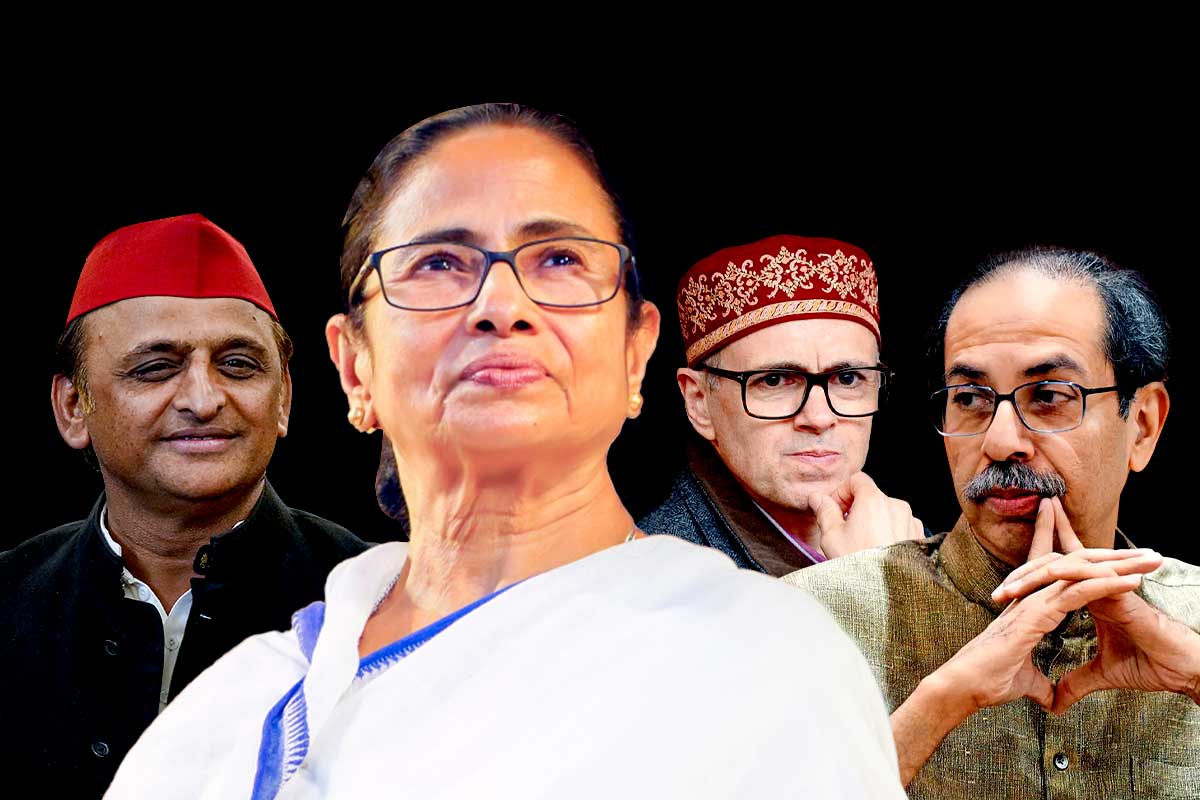
The political focus of the entire country has turned back to Bengal. Ahead of the upcoming state assembly election, a strange note of unity is emerging in the opposition camp—the sole aim is to bring Mamata Banerjee back to power in Bengal. From Kashmir to Kanyakumari, the message from top leaders of the India alliance is the same: the result in Bengal will determine the next equation in national politics.
In this context, Bengal’s election is no longer just a power struggle for one state—it is like the semifinal of the broader national politics of 2026. A victory for Mamata Banerjee means not only a return to the state secretariat but also boosting the morale of the opposition unity and raising new questions about the BJP’s nationwide dominance. From Delhi to Chennai, from Lucknow to Srinagar, opposition politics is now absorbed in this calculation.
Read more:
A strange note of unity is emerging in the opposition camp—the sole aim is to bring Mamata Banerjee back to power in Bengal. From Kashmir to Kanyakumari, the message from top leaders of the India alliance is the same: the result in Bengal will determine the next equation in national politics.
The Congress party’s official stance remains restrained. But within the party, a different tone is growing stronger. A Rajya Sabha member has publicly stated her personal opinion—that Mamata Banerjee should again become the chief minister of Bengal. This comment has further fueled speculation that at least a section of Congress considers the success of the Trinamool Congress in Bengal as crucial for the broader opposition unity.
From the Chief Minister of Jammu and Kashmir to the Chief Minister of Tamil Nadu, everyone is directly or indirectly staying in touch with Mamata. Leaders from the Samajwadi Party, the Shiv Sena (Uddhav group), and even the former Chief Minister of Delhi—all want the BJP to be stalled again on Bengal’s soil.
The opposition camp’s calculation is clear. Just as in the 2021 state election, despite the BJP’s massive propaganda machine and organization, Trinamool had the last laugh—if that picture repeats, the ‘invincible BJP’ theory will suffer a bigger blow. To stop the political ‘ashwamedha’ horse that has been galloping since 2014, the opposition sees Bengal’s soil once again as the most effective ground of resistance.
Kashmir
Kashmir, often called “Paradise on Earth,” is a region in South Asia known for its stunning Himalayan landscapes, lakes, and gardens. Historically, it was a major center of Buddhism and later experienced significant Islamic influence, with the Mughal Empire famously ruling it in the 16th and 17th centuries. The region has been a subject of territorial dispute between India and Pakistan since their independence in 1947, leading to ongoing political conflict.
Kanyakumari
Kanyakumari, located at the southernmost tip of the Indian subcontinent, is a coastal town in Tamil Nadu known for its stunning confluence of the Arabian Sea, Bay of Bengal, and Indian Ocean. Historically, it was a prominent center for trade and pilgrimage, named after the goddess Kanya Kumari, an incarnation of Parvati. The town is famous for landmarks like the Vivekananda Rock Memorial, built in 1970 on a rock where Swami Vivekananda meditated in 1892, and the Thiruvalluvar Statue, a 133-foot-tall monument honoring the Tamil poet.
Delhi
Delhi, the capital of India, is a historic city that has been continuously inhabited for over two millennia, serving as the seat of power for numerous empires, including the Delhi Sultanate and the Mughal Empire. It is home to iconic landmarks such as the Red Fort, Qutub Minar, and Humayun’s Tomb, which reflect its rich cultural and architectural heritage. Today, Delhi is a bustling metropolis that blends ancient traditions with modern urban life.
Chennai
Chennai, formerly known as Madras, is a major cultural and economic hub on India’s southeastern coast. Founded in 1639 by the British East India Company, it grew from a small fishing village into a key colonial port and administrative center. Today, it is celebrated for its classical music, dance, and the iconic Marina Beach, reflecting a rich blend of Tamil heritage and colonial history.
Lucknow
Lucknow, the capital of Uttar Pradesh, India, is renowned for its rich cultural heritage, particularly its “Ganga-Jamuni tehzeeb” (a syncretic Hindu-Muslim culture) and exquisite Mughal-era architecture. Historically, it flourished as the seat of the Nawabs of Awadh in the 18th and 19th centuries, who patronized arts, music, and cuisine, leaving landmarks like the Bara Imambara and Rumi Darwaza. The city also played a pivotal role in the 1857 Indian Rebellion, known for the Siege of Lucknow.
Srinagar
Srinagar, the summer capital of Indian-administered Jammu and Kashmir, is renowned for its stunning natural beauty, including the Dal Lake and Mughal gardens. Founded in the 6th century by Emperor Ashoka, it later became a key center of the Kashmir Sultanate and the Mughal Empire, with many of its iconic gardens and canals built under Mughal rule. Today, it remains a major cultural and tourist hub, known for its houseboats, handicrafts, and rich blend of Hindu, Buddhist, and Islamic heritage.
Jammu and Kashmir
Jammu and Kashmir is a region in northern India known for its stunning Himalayan landscapes and rich cultural heritage. Historically, it was a princely state under British rule before acceding to India in 1947, which led to ongoing territorial disputes with Pakistan. The region is famous for its Mughal gardens, serene Dal Lake, and unique blend of Hindu, Muslim, and Buddhist traditions.
Tamil Nadu
Tamil Nadu is a state in southern India known for its rich cultural heritage, ancient Dravidian architecture, and classical arts like Bharatanatyam dance and Carnatic music. Its history spans over two millennia, with powerful dynasties such as the Cholas, Pandyas, and Pallavas leaving behind magnificent temples and extensive literature. Today, it remains a vibrant center of Tamil language, tradition, and pilgrimage.