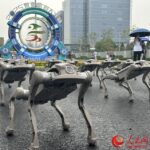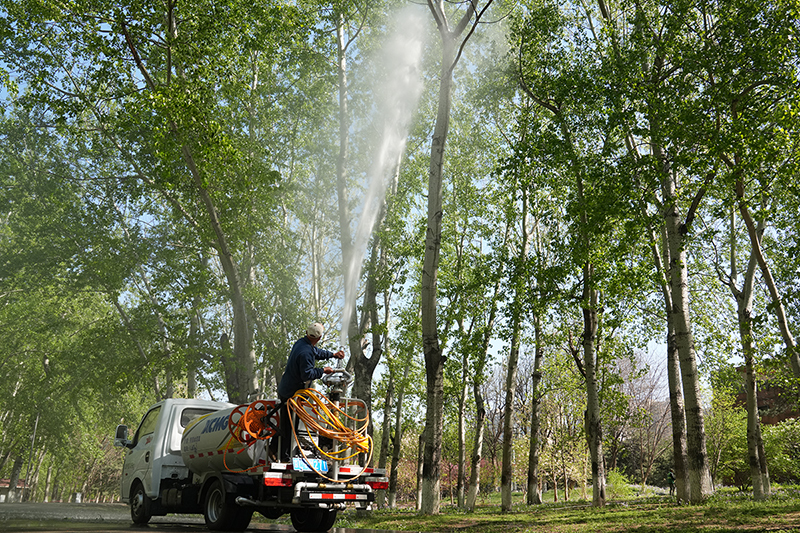
Landscaping workers spraying flocculant on willow and poplar trees to control fluff.
Starting April 6, Beijing officially entered the period of willow and poplar fluff dispersal, lasting until late May, with a fluff season of about 50 days. The first peak occurs around mid-April, the second from late April to early May, and the third in mid-May. To address the governance challenge of spring fluff, Beijing has deployed a combination of scientific prevention and control measures this year, building a comprehensive barrier to reduce the impact on residents’ daily lives and ensure normal city operations.
Managing willow and poplar fluff is a long-term, systematic project. Beijing has established a coordinated prevention mechanism led by the municipal landscaping authority, involving multiple departments such as urban management, meteorology, and state-owned assets, with active participation from central and national agencies, military units stationed in Beijing, and implementation by local district units. A “hand-in-hand” collaborative operation model has been adopted. Additionally, to ensure a pleasant travel experience for citizens during the May Day holiday, Beijing has formulated a special prevention plan for the holiday period, deploying additional personnel and increasing operation frequency in densely populated areas such as parks, large shopping malls, and transport hubs to create a comfortable and clean environment.
Accurate forecasting is key to scientific fluff control. Beijing has deeply integrated meteorological big data with a ground-based manual verification network to build a real-time monitoring and forecasting platform for willow and poplar fluff. This now enables street-level real-time monitoring and precise forecasting in core areas like Dongcheng and Xicheng districts. Currently, over 100 dedicated monitoring points are set up across the city for full-cycle tracking of the development of female willow and poplar inflorescences. Daily joint consultations are held by experts from landscaping and meteorological fields. Through the real-time monitoring and forecasting platform, as well as official public channels for landscaping and meteorology, timely forecasts of high fluff periods are released, providing authoritative data support for various industry departments and local management units to precisely identify key prevention areas and scientifically carry out control operations, effectively improving the accuracy and efficiency of prevention efforts.
In recent years, the municipal landscaping authority has collaborated with research institutes and universities such as the Chinese Academy of Forestry, Beijing Forestry University, and the Beijing Academy of Forestry and Landscape Architecture to conduct ongoing research and introduction trials of improved willow and poplar varieties. To date, nearly 400 excellent germplasm resources of non-fluff or low-fluff willows and poplars have been collected, and 16 superior varieties with no fluff and low pollen have been successfully bred. Additionally, breakthroughs have been made in tissue culture rapid propagation technology for Populus tomentosa, allowing approximately 1 million seedlings to be expanded within 2 to 3 years. Currently, 100,000 seedlings of excellent non-fluff, low-pollen varieties have been cultivated, providing high-quality seedling support for the renewal of willow and poplar species across the city and for new greening projects.
For existing female willow and poplar trees in Beijing that have reached maturity and cannot be immediately replaced, technological innovation is leveraged to apply multiple intelligent control technologies and specialized equipment, achieving efficient and precise fluff management.