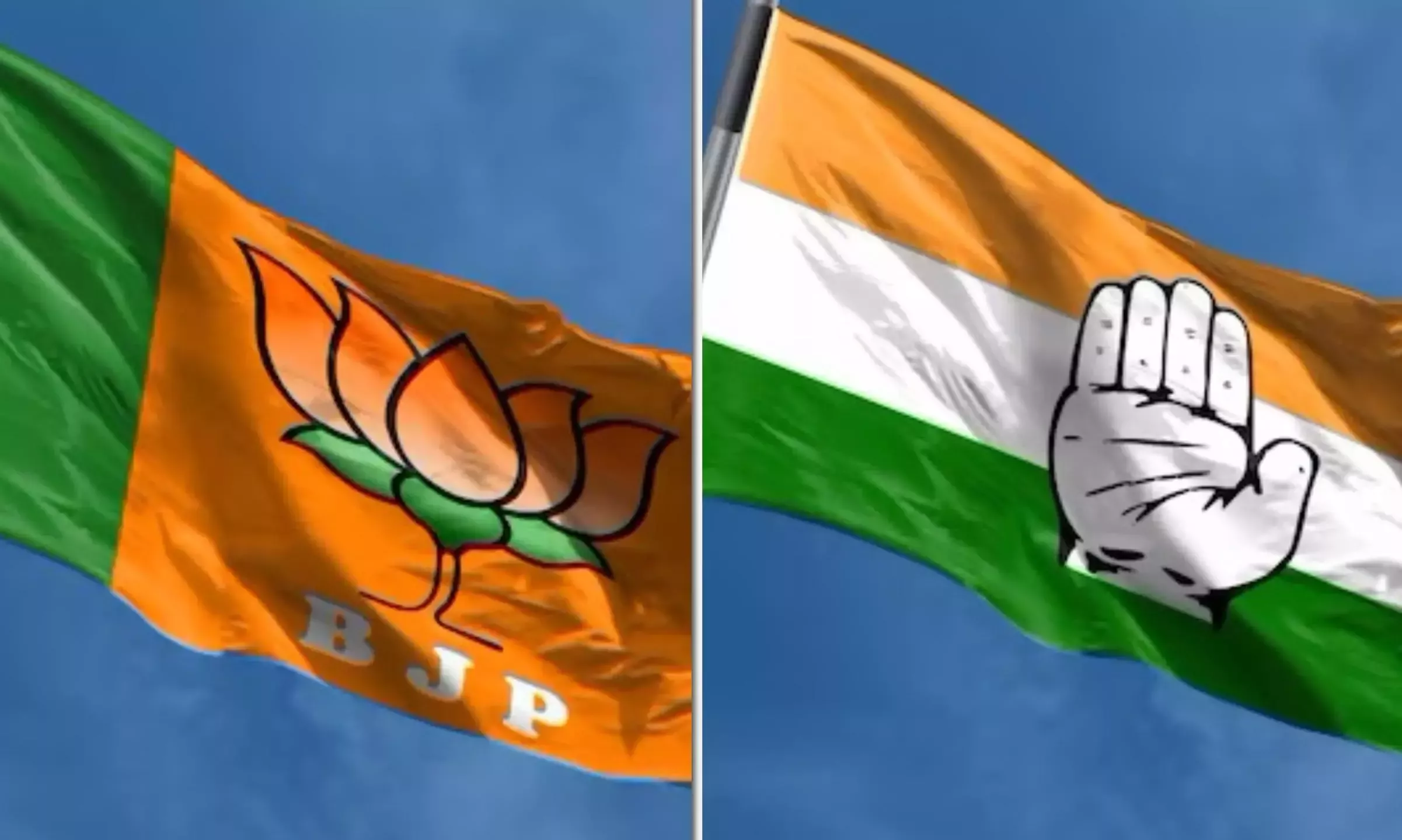
BJP calls Congress’s comment on Pakistan hypocrisy.
New Delhi, The Bharatiya Janata Party (BJP) on Monday retaliated against the Congress for criticizing the government’s foreign policy, accusing the opposition party of supporting a “brokering nation” and displaying “the height of hypocrisy” in its comments regarding Pakistan.
The BJP’s statement came in response to a post on ‘X’ by senior Congress leader Jairam Ramesh, who targeted the Narendra Modi government over Pakistan’s role in US-Iran peace talks. In his post on ‘X’, Ramesh said that Pakistan’s army chief, Field Marshal Asim Munir, has become a “great favorite” of US President Donald Trump, which is a “major setback” for India.
Those silent on 26/11 should not lecture
Ramesh stated that India needs a fundamental change in its diplomatic engagement strategy. Responding to the criticism, BJP spokesperson Pradeep Bhandari posted on ‘X’, “It is the height of hypocrisy for the Congress, a friend of Pakistan, to lecture on how to deal with Pakistan.” He reminded of the failure in the response of the Congress, which was in power at the center during the 2008 Mumbai terror attacks, and asked it to stop “lecturing” on foreign policy.
Ramesh said, “Those who tried to appease Pakistan at that time should stop lecturing India today. The Congress should stop glorifying the ‘broker’.” Congress had claimed that India needs a fundamental change in its diplomatic engagement strategy, which Prime Minister Narendra Modi is completely “incapable” of doing. In his post on ‘X’, Ramesh said that the “brokering” nation, as described by the External Affairs Minister (Jaishankar), is allegedly hosting the second round of US-Iran peace talks today.
New Delhi
New Delhi is the capital of India, officially inaugurated in 1931 as the imperial capital of British India, designed by British architects Edwin Lutyens and Herbert Baker. The city was built to the south of the historic old city of Delhi, incorporating grand boulevards and iconic structures like the India Gate and Rashtrapati Bhavan. Today, it serves as the seat of the Indian government and a vibrant cultural hub, blending colonial heritage with modern Indian life.
Pakistan
Pakistan is a South Asian country with a rich history, home to ancient civilizations like the Indus Valley Civilization. It gained independence from British rule in 1947 and is known for its diverse cultures, languages, and landmarks such as the Badshahi Mosque and the mountainous northern regions. Today, Pakistan is a vibrant nation blending Islamic heritage with modern influences.
US
The United States is a vast and diverse country in North America, originally inhabited by Indigenous peoples for thousands of years before European colonization began in the 16th century. It declared independence from Britain in 1776 and grew through westward expansion, industrialization, and immigration, becoming a global superpower. Key cultural sites include the Statue of Liberty, the Grand Canyon, and the National Mall in Washington, D.C., reflecting its history of freedom, natural beauty, and democracy.
Iran
Iran, historically known as Persia, is a country in West Asia with a rich cultural heritage spanning over 2,500 years. It was the center of the ancient Persian Empire, known for its monumental architecture, art, and the development of Zoroastrianism, one of the world’s oldest religions. Today, Iran is renowned for its Islamic-era architecture, bustling bazaars, and significant contributions to literature, science, and philosophy.
India
India is a vast and diverse country in South Asia, known for its rich cultural heritage and ancient history dating back to the Indus Valley Civilization (c. 3300 BCE). It has been home to major religions like Hinduism, Buddhism, and Jainism, and was shaped by empires such as the Maurya, Gupta, and Mughal dynasties before becoming a British colony. India gained independence in 1947 and is now the world’s most populous democracy, celebrated for its festivals, cuisine, and landmarks like the Taj Mahal.
US-Iran peace talks
The topic of US-Iran peace talks refers to various diplomatic efforts aimed at resolving tensions between the United States and Iran, particularly following the 1979 Iranian Revolution and the subsequent hostage crisis. Notable attempts include the 2015 Joint Comprehensive Plan of Action (JCPOA), which limited Iran’s nuclear program in exchange for sanctions relief, though the US withdrew in 2018. Despite intermittent negotiations, a comprehensive peace agreement remains elusive due to deep-seated mistrust and conflicting regional interests.
Mumbai
Mumbai, formerly known as Bombay, is a major port city on India’s west coast and the country’s financial and entertainment capital. Originally a group of seven islands inhabited by fishing communities, it was colonized by the Portuguese and later given to the British as part of a royal dowry, after which it grew into a vital trading hub under the East India Company. Today, Mumbai is a bustling metropolis known for its iconic landmarks, Bollywood film industry, and diverse cultural heritage.
26/11
26/11 refers to the devastating series of coordinated terrorist attacks that occurred in Mumbai, India, on November 26, 2008, lasting until November 29. The attacks targeted multiple locations, including the iconic Taj Mahal Palace Hotel, Chhatrapati Shivaji Terminus, and the Nariman House Jewish community center, resulting in over 160 deaths and hundreds of injuries. The event remains a significant and somber chapter in India’s modern history, symbolizing both the tragedy of terrorism and the resilience of the city of Mumbai.