The General Secretary Leads the Path to a Strong Nation: Exploring the Universe and Chasing the Stars
Learning New Words: The General Secretary Leads the Path to a Strong Nation | Exploring the Sky and Pursuing the Stars
Source: Xinhua News Agency
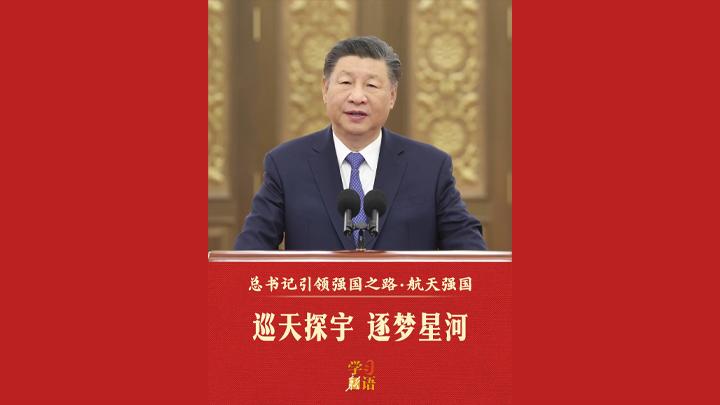
“Exploring the vast universe and building a strong aerospace nation is our unremitting pursuit of the space dream.” Since the new era, the General Secretary has placed great emphasis on building a strong aerospace nation, guiding China’s aerospace industry to continuously create new history.
The “BeiDou” network, the “Chang’e” lunar missions, the “Tiangong” space station, the “Zhurong” Mars rover, and the “Xihe” solar probe… China’s aerospace industry strides forward into the boundless starry sky, with the vast heavens repeatedly marking China’s coordinates.
The “15th Five-Year Plan” outline proposes 16 “strong nation” construction goals, with aerospace as one of them, written into the national five-year plan for the first time.
The starry river stretches for thousands of miles, and the journey is like a rainbow. As the new journey of the “15th Five-Year Plan” begins, the pace of Chinese people exploring space will surely become larger and farther.
BeiDou
BeiDou, meaning “North Dipper” or “Big Dipper” in Chinese, refers to China’s indigenous satellite navigation system, officially named the BeiDou Navigation Satellite System (BDS). Developed in three phases since the 1990s, it became fully operational globally in 2020, making China the third country to possess such a system. BeiDou provides positioning, navigation, and timing services worldwide, with its name symbolizing guidance and direction, much like the constellation it is named after.
Chang’e
Chang’e is the Chinese goddess of the moon, central to the Mid-Autumn Festival myth. According to legend, she drank an elixir of immortality and floated to the moon, where she resides with the jade rabbit. Her story has been celebrated for over two millennia, inspiring China’s lunar exploration program named after her.
Tiangong
Tiangong, which translates to “Heavenly Palace,” is a series of space stations developed by China as part of its ambitious human spaceflight program. The first module, Tiangong-1, launched in 2011, serving as a test bed for docking and orbital experiments, followed by Tiangong-2 in 2016. The current Tiangong space station, with its core module Tianhe launched in 2021, now operates as a permanent crewed outpost in low Earth orbit, symbolizing China’s growing capabilities in space exploration.
Zhurong
Zhurong is a Chinese Mars rover that successfully landed on the Red Planet on May 15, 2021, as part of the Tianwen-1 mission, making China the second country to operate a rover on Mars. Named after the ancient Chinese god of fire, Zhurong explored the Utopia Planitia region for over a year, studying the planet’s geology, climate, and potential signs of water ice. Its mission significantly advanced China’s deep-space exploration capabilities and contributed valuable data to global Mars research.
Xihe
Xihe is a traditional Chinese folk cultural site and ancient town located in Zhejiang Province, known for its well-preserved water town scenery and historic architecture. Historically, it flourished as a commercial hub during the Ming and Qing dynasties, with its network of canals and bridges playing a key role in regional trade. Today, it is celebrated for its intangible cultural heritage, including local crafts and festivals, offering visitors a glimpse into traditional Jiangnan life.