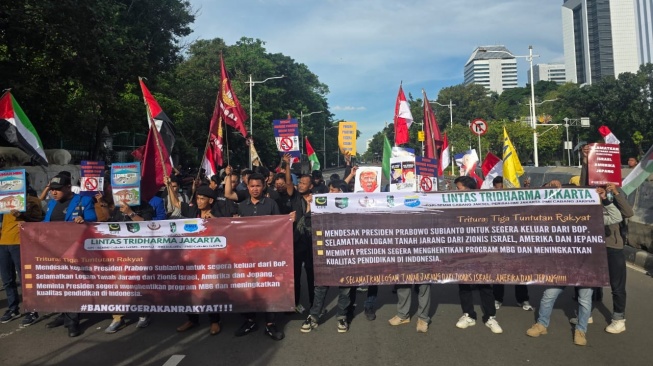
![Lintas Tridharma Jakarta (LTJ), sebuah wadah konsolidasi berbagai elemen mahasiswa yang tergabung dalam PERISAI SI Mahasiswa HMI, SEMMI, PMII, dan GPI, menyelenggarakan aksi damai [Ist]](https://asiacity.news/wp-content/uploads/2026/04/82779-ltj.webp)
- Lintas Tridharma Jakarta urges the government to form an independent Task Force to strengthen governance and oversight of rare earth metal resources.
- The student alliance demands the government exit the BOP to maintain the integrity, independence, and sovereignty of national policy free from conflicts of interest.
- LTJ demands an evaluation of the Free Nutritious Meals program and comprehensive education reform to improve the quality of human resources.
A strong wave of public aspiration is being voiced by students. Lintas Tridharma Jakarta (LTJ), a consolidation forum for various student groups, held a demonstration as a manifestation of conveying public aspirations regarding the direction of national policy.
This action demonstrates the active role of the younger generation in overseeing and critiquing government policy.
In its official statement, LTJ conveyed three main points of demand, formulated comprehensively and based on the nation’s long-term interests.
The first is strengthening the Governance and Oversight of Rare Earth Metals.
LTJ demands the strengthening of governance and oversight of rare earth metals as a national strategic resource.
They assess that the management of this commodity must be carried out transparently, sustainably, and oriented towards optimizing domestic added value.
LTJ also urges the government to immediately establish a Presidential Regulation (Perpres) regarding the formation of an independent, professional, and accountable Rare Earth Metals Oversight Task Force.
“To safeguard the nation’s long-term strategic interests, we urge the President to immediately establish a Perpres regarding the formation of an independent and accountable Rare Earth Metals Oversight Task Force, to ensure fair governance and avoid domination by specific interests.”
The second is maintaining the integrity of national policy by exiting the BOP.
LTJ emphasizes the importance of maintaining the integrity and independence of national policy. They urge the government to take strategic steps to exit the BOP (Balance of Payments).
Involvement in the BOP is assessed as potentially causing conflicts of interest and reducing independence in formulating the country’s strategic policies.
This step is viewed as part of strengthening the sovereignty of national policy.
The third is a comprehensive evaluation of the MBG program and substantive education reform.
LTJ highlights the urgency of a comprehensive evaluation of the Free Nutritious Meals (MBG) program and the need for substantive reform in the education sector.
The education sector, as the main foundation of national development, requires a systemic, sustainable approach oriented towards improving human resource quality.
LTJ also encourages an evaluation of the MBG program to make it more effective and on-target.
Accompanied by improving equitable access, strengthening infrastructure, improving educator welfare, and formulating adaptive and progressive policies.
“Education cannot be managed partially. A comprehensive reform that touches fundamental aspects is needed to produce a generation that is excellent, adaptive, and globally competitive.”
This action, which took place in an orderly and peaceful manner with security personnel escort, demonstrates the social control function of students.
Lintas Tridharma Jakarta reaffirmed its commitment to continue carrying out this function constructively and sustainably, and to open inclusive dialogue with the government to realize public policies that are responsive and side with the people’s interests.
Lintas Tridharma Jakarta (LTJ)
<div class="my-4 p-4 rounded-lg shadow-md bg-blue-