UK Prime Minister faces pressure over ambassador appointment controversy.
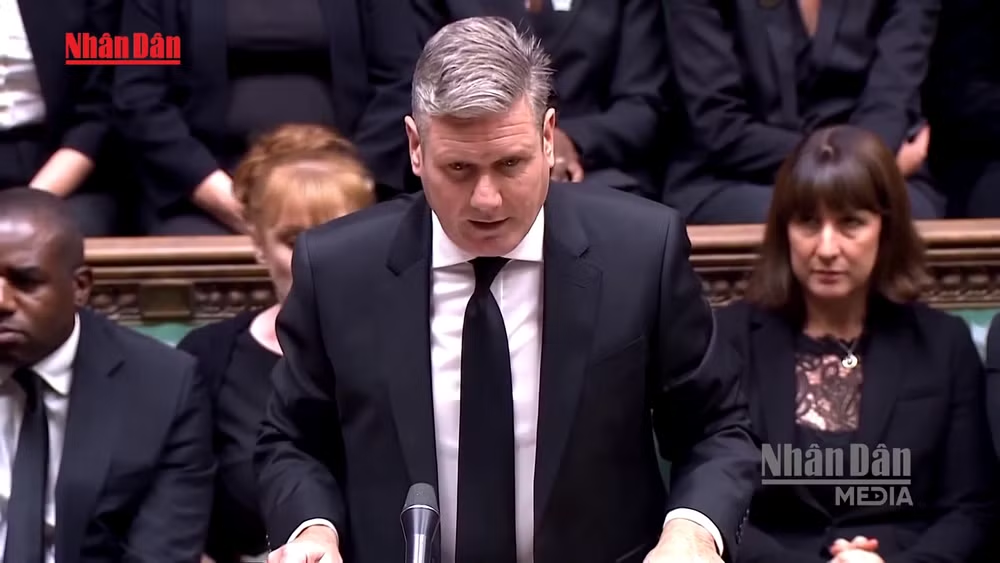
On April 17, UK Prime Minister Keir Starmer faced increased political pressure after admitting he was not informed that the diplomat with ties to Jeffrey Epstein, Peter Mandelson, had failed a security check before being appointed as ambassador to the US.
Video Player is loading.Play VideoMuteCurrent Time 0:00Loaded: 0%Duration 0:00FullscreenView in a small window
This is a modal window.
Beginning of dialog window. Escape will cancel and close the window.
UK Prime Minister K. Starmer was unaware that P. Mandelson had failed the security check
K. Starmer committed to reporting to Parliament but dismissed the possibility of resigning
The opposition suspects the Prime Minister provided false information, increasing criticism
The Labour Party’s internal leadership remains unchanged, but pressure is mounting ahead of local elections
Jeffrey Epstein
Jeffrey Epstein is not a place or cultural site, but a deceased American financier and convicted sex offender. His properties, such as his private island in the U.S. Virgin Islands (Little St. James), became infamous as locations associated with his crimes. These locations are not cultural landmarks but are noted in modern history for their connection to a widespread criminal investigation into sex trafficking and abuse.
Peter Mandelson
“Peter Mandelson” is not a place or cultural site, but a prominent British Labour Party politician. He served as a key advisor and cabinet minister under Prime Ministers Tony Blair and Gordon Brown, playing a significant role in shaping New Labour’s policies in the late 1990s and 2000s. He is also known for being the grandson of Herbert Morrison, a former Deputy Prime Minister, and for serving as a European Commissioner.
UK Prime Minister Keir Starmer
“UK Prime Minister Keir Starmer” is not a place or cultural site, but a person—the current Prime Minister of the United Kingdom and leader of the Labour Party. He became Prime Minister in July 2024 after his party won a general election, following a career as a barrister and the former Director of Public Prosecutions for England and Wales.
Parliament
The term “Parliament” most commonly refers to the supreme legislative body of a country, with the Palace of Westminster in London—home to the UK Parliament—being one of the most iconic examples. Its history dates to the medieval period, with the current Gothic Revival building largely constructed in the 19th century after a fire destroyed much of the old palace. The institution itself evolved from the early English councils of nobles and clergy, developing over centuries into the bicameral system of the House of Commons and House of Lords that symbolizes democratic governance.
Labour Party
The Labour Party is
Palace of Westminster
The Palace of Westminster, also known as the Houses of Parliament, is the meeting place of the UK’s House of Commons and House of Lords. The original medieval palace was largely destroyed by fire in 1834, and the current iconic Gothic Revival structure, designed by Charles Barry and Augustus Pugin, was completed in 1870. It is a UNESCO World Heritage Site, famous for its architecture and the clock tower housing Big Ben.
UK Parliament
The UK Parliament, formally known as the Palace of Westminster, is the supreme legislative body of the United Kingdom, consisting of the House of Commons and the House of Lords. Its iconic home, largely rebuilt in the 19th century after a devastating fire, has been the centre of English and British political life for centuries, with origins dating back to the medieval royal palace that once stood on the site. It is where laws are debated and passed, and its traditions, such as the State Opening of Parliament, reflect its long historical evolution.
House of Commons
The House of Commons is the elected lower house of the UK Parliament in London, where Members of Parliament (MPs) debate and pass laws. Its origins trace back to the 13th century, evolving from advisory councils of commoners to become the dominant legislative chamber following the English Civil War and the 19th-century Reform Acts that expanded voting rights. Today, it is the primary arena for government scrutiny and national political debate.
House of Lords
The House of Lords is the upper chamber of the UK Parliament, historically originating from the medieval council of nobles and clergy that advised the monarch. Its role has evolved significantly, particularly with the Parliament Acts of 1911 and 1949, which reduced its power to a mainly revising and delaying function, while its membership has transitioned from hereditary peers to a majority of appointed life peers.

 Video Player is loading.Play VideoMuteCurrent Time 0:00Loaded: 0%Duration 0:00FullscreenView in a small window