
A $130 Billion Ambition and the Barriers That Must Be Quickly Overcome.
The Limits of the Old Model
At the Vietnam Economic Forum 2026, camera flashes did not stop as a new vision for Vietnam’s economic future was outlined. Gone are the stories of cheap textiles or electronics assembly; policymakers and the tech elite are now focused on an ambitious goal: turning artificial intelligence (A.I.) into the nation’s core production infrastructure.
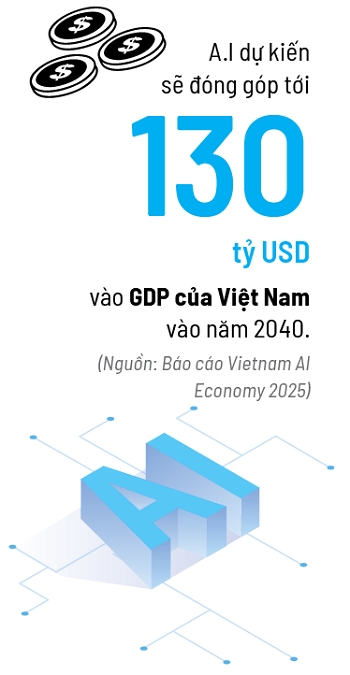
This excitement is not unfounded. According to the Vietnam AI Economy 2025 report, A.I. is projected to contribute up to $130 billion to Vietnam’s GDP by 2040. Furthermore, a new strategic proposal named AI-X sets an even higher target: a contribution of $150-$250 billion by 2045.
However, behind these impressive figures lies a messy reality of infrastructure and human resources, posing a major question for Vietnam: “Will this be a genuine growth driver or just another technological ‘fever’ destined to be forgotten?”
Vietnam’s economy has long operated on the advantages of cheap labor and resource extraction. But that “golden window” is gradually closing. Labor costs are rising while productivity remains modest, at only 7.6% of Singapore’s level and less than half of Thailand’s.
“The world is witnessing breakthroughs from countries that catch the technological wave, while economies slow to adapt risk falling far behind. Choosing a development model based on science and technology is no longer an option, but an imperative,” a stark warning was issued.
 |
This shift requires new thinking. Instead of viewing A.I. as a discrete support tool, experts propose seeing data as a new “factor of production” and A.I. as the “engine” to transform that raw material into surplus value.
Technology Islands
Vietnam is not lacking bright spots. Corporations such as FPT, Viettel, and Vingroup are striving to build R&D centers and announce internationally-class research. With over 765 A.I. startups, Vietnam currently ranks 2nd in Southeast Asia for the number of startups in this field, behind only Singapore.
But these successful “islands” have yet to form a sustainable ecosystem. The biggest bottleneck lies in human resources. Each year, Vietnam graduates 60,000 information technology engineers, but only about 300 are considered true A.I. experts. Additionally, the lack of domestic supercomputing infrastructure forces businesses to rent services from AWS or Google Cloud at high costs.
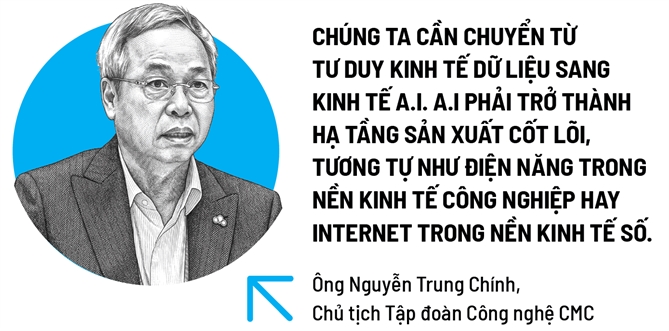
“We need to shift from a data economy mindset to an A.I. economy mindset. A.I. must become the core production infrastructure, similar to electricity in the industrial economy or the internet in the digital economy,” an assessment was made regarding the proposed AI-X strategic framework with 8 pillars and 50 actions.
 |
Sandbox or Barrier?
While Singapore has had an A.I. governance framework since 2019, Vietnam’s legal system is still in the “completion” phase. The decree on personal data protection gives users the right to control, decide, and require digital platforms such as Zalo, Facebook, digital banks, e-commerce platforms… to be transparent in collecting, using, and protecting data…
However, the lack of a clear sandbox mechanism has caused many A.I. startups in healthcare or finance to hesitate before lengthy approval processes. According to a 2024 survey, only about 12% of small and medium-sized enterprises (SMEs) had ever trialed an A.I. application, and the success rate after one year was below 5%. This figure stands in complete contrast to the over 50% rate in Singapore, where the government directly subsidizes SMEs for technology adoption.
Technological history has proven that each innovation cycle lasts only a few years. If it cannot achieve autonomy in data and algorithms, Vietnam will continue to fall into the old scenario: becoming a consumer market dependent on imported technology. The figures of $130 billion or $250 billion will remain paper dreams without decisive action. This includes expanding the sandbox, perfecting the Personal Data Law,