Former Suntory chairman referred to prosecutors over supplement imports
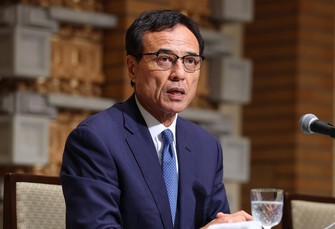
Takeshi Niinami speaks at a press conference in Tokyo’s Chiyoda Ward.
Former Suntory Holdings Ltd. Chairman Takeshi Niinami has had his case referred to prosecutors without arrest along with a female acquaintance for allegedly importing illegal supplements, according to investigative sources.
Niinami denies the allegation that he imported supplements containing a prohibited level of a cannabis-derived substance from the United States. Prosecutors are expected to carefully examine whether to pursue criminal charges.
Last September, Niinami resigned as chairman of Suntory Holdings and as the head of the Japan Association of Corporate Executives, a major business lobby known as Keizai Doyukai.
At a press conference held the same month before his resignation from Keizai Doyukai, Niinami said, “I have not broken any laws and am innocent,” adding, “I have not possessed or used (the supplements) in Japan, and I did not instruct their imports.”
The cannabis-derived substance in the supplements was tetrahydrocannabinol, better known as THC.
The woman sent the supplements from the United States to her brother living in Fukuoka Prefecture. Local police arrested him on suspicion of violating the special narcotics law, with a source quoting him as saying, “I was asked to send them to Niinami.”
Police in Fukuoka Prefecture searched Niinami’s house in Tokyo in August last year based on information from customs authorities but found no illegal drugs. Niinami also tested negative in a urine test.
Suntory Holdings Ltd.
Suntory Holdings Ltd. is a Japanese multinational founded in 1899 as a wine store in Osaka, which has grown into one of the world’s leading beverage companies. It is particularly renowned for its Japanese whisky, pioneered by founder Shinjiro Torii, and for its diverse portfolio of spirits, beer, soft drinks, and health products.
Japan Association of Corporate Executives
The Japan Association of Corporate Executives (経済同友会, *Keizai Dōyūkai*) is a major and influential Japanese business organization, founded in 1946 by business leaders seeking to rebuild the nation’s economy and promote democratic principles in the post-World War II era. Unlike other business federations, it operates as a forum for individual executives to propose progressive policy recommendations on economic and social issues, independent of their specific companies.
Keizai Doyukai
Keizai Doyukai, also known as the Japan Association of Corporate Executives, is a major Japanese economic organization founded in 1946 by business leaders seeking to rebuild Japan’s post-war economy. It is one of Japan’s “big three” business federations, distinct for being a forum for individual executives (rather than companies) to propose policy recommendations and discuss socio-economic issues.
Tokyo
Tokyo is the modern capital of Japan, but its history dates back to the 15th century when it was founded as the small castle town of Edo. It rose to prominence after becoming the seat of the Tokugawa shogunate in 1603 and was renamed Tokyo when the emperor moved there in 1868, beginning the Meiji Restoration. Today, it is a vast, densely populated metropolis known for its cutting-edge technology, historic temples, and vibrant pop culture.
Chiyoda Ward
Chiyoda Ward is the political heart of Japan, located in central Tokyo and home to the Imperial Palace, the National Diet Building, and numerous government ministries. Historically, it was the site of Edo Castle during the Tokugawa shogunate (1603-1868), making it the center of military power before becoming the modern seat of the Japanese government and monarchy after the Meiji Restoration. Today, it is a unique district blending historic landmarks with modern government and business institutions.
United States
The United States is a federal republic founded in 1776 after declaring independence from Great Britain, with its modern government established by the Constitution in 1789. Culturally, it is a vast and diverse nation shaped by waves of immigration, indigenous heritage, and the blending of numerous global traditions. Key historical sites that reflect its development include Independence Hall, Civil War battlefields, and monuments to its civil rights movements.
Fukuoka Prefecture
Fukuoka Prefecture, located on Japan’s Kyushu island, has a long history as a vital gateway for cultural and trade exchange with mainland Asia, notably through the ancient port of Hakata. Today, it is a dynamic region known for its modern capital city of Fukuoka, vibrant food culture, and historical sites like Dazaifu Tenmangu Shrine. It blends ancient traditions with contemporary urban life, serving as a major economic and cultural hub in western Japan.
Tokyo
Tokyo, originally a small fishing village called Edo, rose to prominence after becoming the seat of the Tokugawa shogunate in 1603. It was renamed Tokyo (“Eastern Capital”) when the emperor moved there during the Meiji Restoration in 1868, solidifying its status as Japan’s political and cultural center. Today, it is a vast, modern metropolis known for its cutting-edge technology, historic temples, and vibrant pop culture.