The state visit to China by General Secretary and President To Lam not only marks a new chapter in the history of Vietnam-China relations but also carries a message about shaping the future.
It is a signal that Vietnam is proactively selecting the finest technology and development models to achieve a breakthrough on its own.
Through the practical activities of the head of the Party and State of Vietnam, we see a strong political determination: to usher Vietnam into a new era with the “engine” of high technology and scientific knowledge.
The fact that General Secretary and President To Lam personally experienced the high-speed rail system from Beijing to Hung An New Area, located in the Beijing-Tianjin-Hebei triangle in northeastern China, carries profound implications beyond the scope of a simple tour.
This action sends a meaningful diplomatic message about Vietnam’s interest in the technology, technical standards, and operational experience of China – the country with the world’s largest high-speed rail network.
This is the highest concretization of the strategic infrastructure development direction that the Party and State of Vietnam are determined to implement: absorbing world-leading technical standards to build its own system.
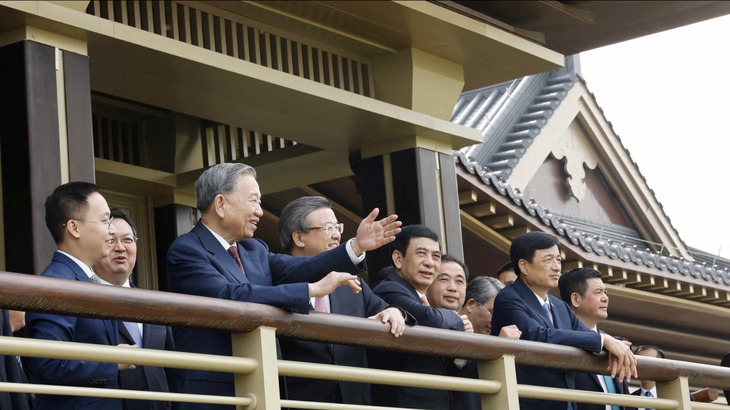
The Vietnamese leader also took time to personally survey Hung An New Area – the “city of the future” – which is also an important signal in national development thinking: the aspiration for a modern, prosperous, and strong Vietnam.
The survey of the smart city model shows that Vietnam’s top leaders are proactively seeking optimal solutions to address the problem of urban overload in Vietnam’s major cities.
Hung An – a city built from scratch with the millennial vision of General Secretary and President of China Xi Jinping – represents a combination of digital governance, a green economy, and synchronized infrastructure.
China, with its massive and world-class modern high-speed rail network, is a proven model demonstrating that infrastructure going first paves the way for socio-economic development.
This nation of over 1.4 billion people has proven that high-speed rail is not just a means of transportation, but a tool to connect urban areas and industrial and service centers across the country into a tightly integrated whole. This is the solution to the problem of connecting Vietnam’s growth poles.
A special highlight in the agenda of General Secretary and President To Lam was the visit to Tsinghua University – a cradle for training world-class talent. Here, the message on cooperation in high-quality human resource training and digital transformation was emphasized as a top priority.
Vietnam has identified science and technology as a national policy through Resolution 57, but to master technology, we need “technology people.”
Promoting cooperation with China’s prestigious educational institutions in fields such as artificial intelligence, semiconductors, and the digital economy is a substantive step to shorten the knowledge gap, absorb the essence of governance and applied scientific research, and simultaneously create a successor generation capable of propelling Vietnam to break through in the global value chain.
The activities of the Vietnamese leader in China show that Vietnam is proactively seeking core values to modernize the country and develop it into a prosperous and powerful nation by 2045.
The strategic mutual understanding and trust between the top leaders of the two countries help resolve challenges and create a peaceful environment for development, and most importantly, lay a solid foundation to translate cooperative ideas into practical results.
At the meeting, General Secretary and President To Lam expressed the hope that in the coming time, the relatives of generals and experts will continue to inspire the next generations, writing new pages of friendship in Vietnam-China relations.