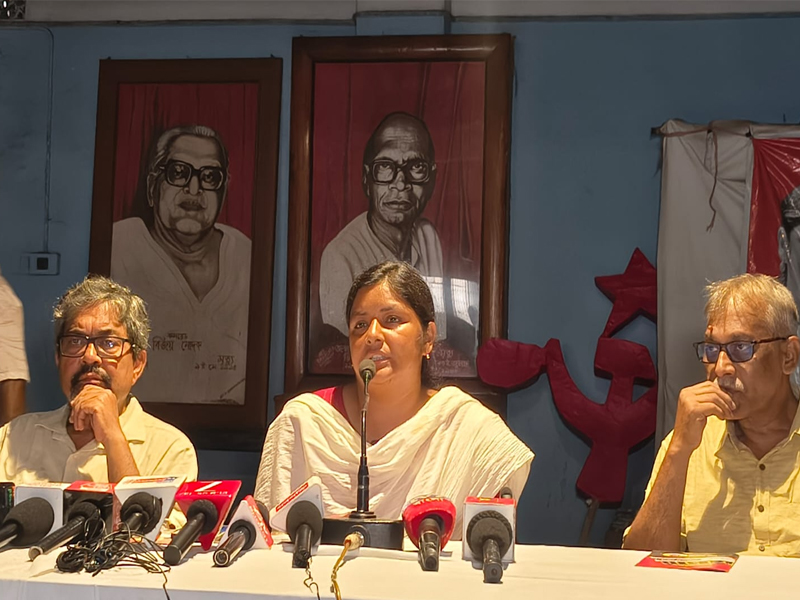
The red flag in Uttarpara is asking for votes not for power, but to work for the people. This was stated during the release of the Uttarpara Assembly manifesto. ‘350 neighborhood meetings have been held. We have spoken with the people. This manifesto has been prepared after listening to their needs and grievances,’ it was said.
It was stated, ‘Uttarpara is a seat of culture. People have built libraries, hospitals, and schools through their own efforts. Today, that Uttarpara is being destroyed. People cannot speak openly. Our first point is that the cultural heritage of Uttarpara must be restored. An open-air stage and a theater hall will be built. The hall rental, which was three thousand rupees before, is now being charged twenty-two thousand rupees. The development of art and culture is being obstructed. After listening to the people, we are therefore saying a theater hall and an open-air stage will be built.’
Like other parts of the state, government schools have been closed in Uttarpara as well. It was stated, ’17 schools have been closed in Uttarpara. 22 schools have been merged. The local people are saying government schools must be saved. Schools must be reopened. Along with that, we are saying a Career Orientation Center will be opened at a minimal subsidized rate. There will be arrangements for preparation for government jobs.’ It was stated, ‘A sense of despair has been created among the people. Efforts will also be made at this center to reduce this pressure.’
Uttarpara was known as an industrial town. But under the current administration, multiple factories have closed. The manifesto states the intention to rebuild this industrial belt anew. It was stated, ‘Factory lands are lying vacant. Factories have closed down. If new factories are not established, we cannot rebuild the economy of this area. The local people want employment for the youth of the area. There is potential for factories in Uttarpara. We will work on that. We are fighting legal battles against attempts to sell off these lands. We also have plans to build an industrial park.’
Environmental protection has received importance in the manifesto. The manifesto states that a green corridor will be developed along the banks of the Ganges. Attempts by syndicates to capture the playgrounds in every neighborhood will be stopped. Playgrounds and ponds will be protected.
For women’s security, the formation of girls’ brigades has also been proposed. It was stated that Uttarpara has a high number of women voters. Today, women are under attack in this state. A pledge has been taken that women will protect themselves. Therefore, girls’ brigades will be formed.
Notably, like other parts of the state, Uttarpara also faces the dominance of microfinance. It was stated that women are being forced to take loans at high interest rates from microfinance institutions. If they cannot repay, bouncers are attacking their homes. The state and central governments have no policy against these companies. It is being said that those who cannot repay these loans must be viewed from a humanitarian perspective. Alongside this, steps will be taken to save these cottage industries.
A youth brigade will be formed to look after senior citizens. This brigade will stand by elderly people who live alone.
It was stated that there is scope to create an information technology sector in Uttarpara. This work can be done on the vacant lands.
A notable aspect is rest areas for gig workers. There, they will be able to charge their phones. There will be Wi-Fi. Medical facilities will also be available there for them. A grievance cell will be created for Toto auto drivers. Any injustice against them will be addressed.
To save Uttarpara’s libraries, it has been stated that librarians will be appointed. The necessary environment for reading and writing will be ensured, and these libraries will be developed in step with modernity.
The manifesto states that extra money is being taken from schools and colleges in the name of a ‘development fee’. An account of where that money is being spent must be made public. Public representatives must take that responsibility.
It was stated, ‘The people of Uttarpara have said in every neighborhood meeting that the government health system must be fixed. They have also spoken about building modern health centers. Mental health services, advanced dialysis centers, ICU facilities. A modern blood bank. The Kanairpur Rural Hospital must be upgraded to a block hospital.’ Alongside this, the manifesto states that health awareness campaigns will be conducted in panchayats and municipalities.
The issue of allowances for municipal temporary workers has been raised. It was stated that municipal temporary workers have no fixed allowance. Their allowances are not increased. They are manipulated. The manifesto proposes