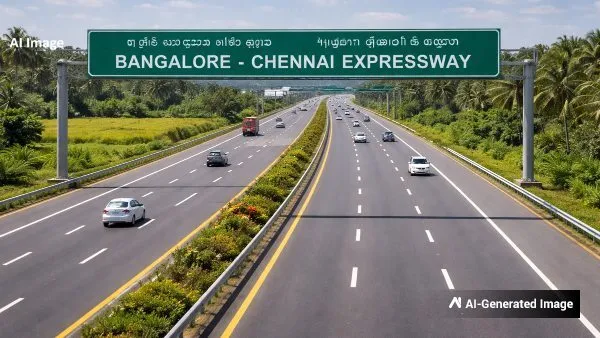
Bengaluru Chennai Expressway: Journey time reduced from 7 hours to 3 hours, expressway to transform road connectivity between the two cities.
Bengaluru Chennai Expressway: The Bengaluru-Chennai Expressway (NE-7) is set to bring a major transformation to South India’s infrastructure. It is the country’s first ‘Horseshoe’ shaped access-controlled expressway, and its construction is rapidly nearing its final stage. According to the latest status, approximately 95% of the project’s work is complete, and its inauguration is likely to occur by May or June 2026.
Certain sections of this expressway have already been opened on a trial basis, particularly from Hoskote to the Andhra Pradesh border. This is allowing for testing of the project’s utility and safety. This expressway will improve road connectivity between the two metro cities. The Bengaluru-Chennai Expressway is about 263 kilometers long and passes through Karnataka, Andhra Pradesh, and Tamil Nadu. It is being built as a high-speed greenfield highway to facilitate easier travel between the cities.
Bengaluru Chennai Expressway: 7-Hour Journey Reduced to 3 Hours
– Once this expressway becomes operational, a significant change in travel time will be observed. Currently, traveling from Bengaluru to Chennai takes 6 to 7 hours.
– Via the new expressway, this time will be reduced to just 2.5 to 3 hours. Furthermore, this new route will be approximately 80 kilometers shorter than the old NH-48.
– This expressway passes through three states: Karnataka, Andhra Pradesh, and Tamil Nadu. Its key towns include Hoskote, Malur, Bangarapet, V. Kota, Palmaner, Gudiyatham, Arakkonam, and Sriperumbudur.
Bengaluru Chennai Expressway: Vehicles to Run at 120 kmph Speed
Technically, this expressway is highly modern. It has been designed for a speed of 120 km per hour. The entire route is equipped with an Intelligent Traffic System (ITS), which includes high-tech cameras and sensors that will immediately alert the control room in case of any accident or traffic jam. Since it is access-controlled, there will be no traffic signals or crossings anywhere along it.
Employment Opportunities to be Created from Bengaluru to Chennai
Economically, this project is also extremely important. New industrial hubs are being developed along the expressway in areas like Sriperumbudur and Hoskote. Additionally, a large multi-modal logistics park is being built in Mudalinganahalli, which will be directly connected to this corridor. Keeping safety in mind, the operation of two-wheelers and auto-rickshaws will remain prohibited on this expressway. This expressway will not only make travel faster and safer but will also give new momentum to regional development.
Bengaluru-Chennai Expressway: Expressway to be Completed by 2027
The entire work on the Bengaluru-Chennai Expressway is now expected to be completed by early 2027. Initially, there were plans to launch it by 2024 and then by June 2026, but delays are occurring due to forest clearances, land acquisition, financial troubles of contractors, and incomplete work in some sections.
The 72-kilometer-long section from Hoskote to KGF in Karnataka has been operational for nearly a year. However, the entire expressway cannot run continuously yet because work is still ongoing in the Andhra Pradesh and Tamil Nadu sections.
Hoskote
Hoskote is a historic town located in the Bangalore Rural district of Karnataka, India. It is known for its ancient Veerabhadra temple and was a significant military outpost and battlefield during the 18th-century Anglo-Mysore Wars. Today, it is primarily recognized as a growing residential and industrial suburb of Bangalore.
Malur
Malur is a town in the Kolar district of Karnataka, India, with historical roots dating back to the medieval period when it was a notable administrative and military center under the Vijayanagara Empire. Today, it is primarily known as an industrial and residential suburb near Bengaluru, with remnants of its past including ancient temples and fortifications.
Bangarapet
Bangarapet is a town in Karnataka, India, historically known as a major railway junction established during the British colonial era. Its development was significantly shaped by the expansion of the South Indian Railway in the late 19th century, connecting it to important regional trade routes. Today, it serves as a commercial and transportation hub for the surrounding Kolar district.
V. Kota
“V. Kota” likely refers to **Vijayawada**, a major city in the Indian state of Andhra Pradesh, historically and culturally significant due to its location on the banks of the Krishna River. It is famed for the **Kanaka Durga Temple**, an ancient Hindu shrine atop the Indrakeeladri Hill, and its history as a bustling trade and cultural center dates back centuries, with nearby archaeological sites like **Amaravati** linking it to ancient Buddhist kingdoms. Today, it remains a vital transportation, religious, and commercial hub.
Palmaner
Palmaner, also known as Palmaneru, is a historic town in the Chittoor district of Andhra Pradesh, India. It is renowned for the 16th-century Palmaner Fort, built by the Vijayanagara Empire, which later came under the control of the Golconda Sultanate and the British East India Company. The town and its fort served as a significant military and administrative center due to its strategic location in the Eastern Ghats.
Gudiyatham
Gudiyatham is a town in the Vellore district of Tamil Nadu, India, historically known as a significant military and administrative center during the British colonial period. Its name, meaning “hidden treasure” in Tamil, reflects local legends, and it served as a key cantonment for the British East India Company in the 18th century. Today, it is primarily an agricultural and industrial hub.
Arakkonam
Arakkonam is a historic town in Tamil Nadu, India, primarily known as a major railway junction established during the British colonial era in the 19th century. It is also home to the ancient Sri Kailasanathar Temple, a significant Hindu pilgrimage site dedicated to Lord Shiva, which adds to its cultural and religious heritage.
Sriperumbudur
Sriperumbudur is a town in Tamil Nadu, India, most famous as the birthplace and memorial site of the 11th-century Hindu philosopher and saint Ramanuja. It gained global attention in 1991 as the location where former Indian Prime Minister Rajiv Gandhi was assassinated. Today, it is a significant pilgrimage destination and is also part of a major industrial and technology corridor near Chennai.