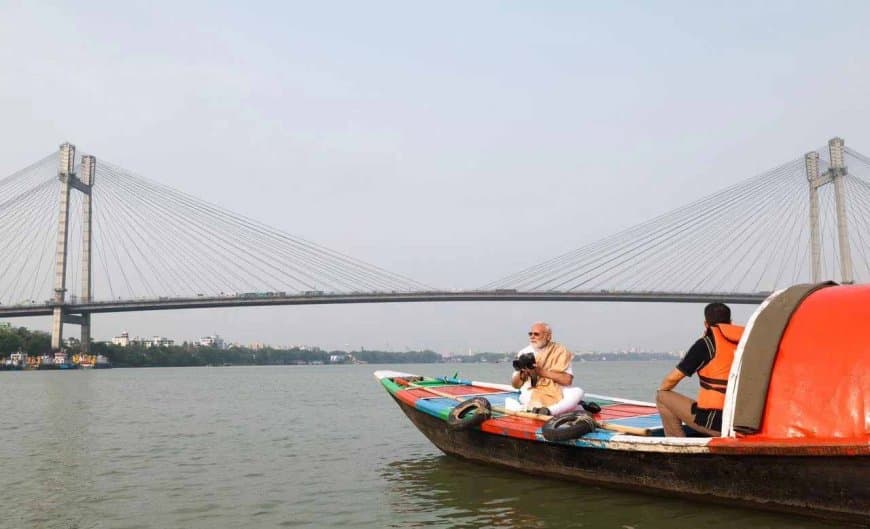
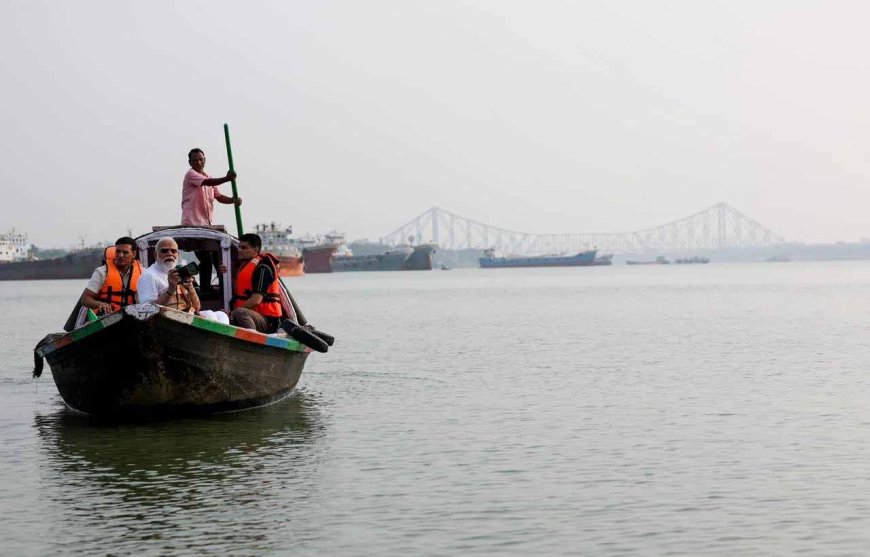
Prime Minister Narendra Modi enjoyed a boat ride in Hooghly, West Bengal, and shared captivating photos.
Said: The Ganges holds a special place in every Bengali’s heart
One can say the Ganges flows in the soul of Bengal
Kolkata.
Prime Minister Narendra Modi took a boat ride on the Hooghly River in Kolkata this morning. He also shared enchanting pictures of it on social media. Along with these pictures, Modi wrote, “A few more glimpses of the Hooghly. During the boat ride on this great river, I also tried my hand at photography. I also captured the Vidyasagar Setu and the Howrah Bridge up close.” Sharing the boat ride pictures on social media, the Prime Minister wrote, “The Ganges holds a special place in every Bengali’s heart. One can say that the Ganges flows in the soul of Bengal. Its holy water carries an entire civilization with it.”
This was an opportunity to meet the boatmen
Modi wrote, “Today, Friday morning, I spent some time on the banks of the Hooghly River in Kolkata. This was an opportunity to express gratitude to Mother Ganga. It was also an opportunity to meet the boatmen, who are hardworking, and also to meet people out on their morning stroll. On the banks of the Hooghly River, we also reaffirmed our commitment to work together for the development of West Bengal and the prosperity of the great Bengali people.”
Difficult to describe the roadshow in words
Earlier, last evening, Prime Minister Modi also held a roadshow in Howrah, Kolkata, which drew a huge crowd of people. Sharing pictures of the roadshow on social media, Modi wrote, “It is difficult to describe the Howrah roadshow in words. This roadshow, which went through the Howrah Bridge and ended in Kolkata, expresses the desire for change in every corner of Bengal. The sins of the TMC will surely be punished. The BJP is Bengal’s choice.”
Also read…..
Hooghly River
The Hooghly River is a distributary of the Ganges in West Bengal, India, flowing past the city of Kolkata. Historically, it served as a vital waterway for European colonial powers, particularly the British East India Company, who established the port of Calcutta (now Kolkata) on its banks in the late 17th century. The river remains an important commercial and cultural artery, lined with landmarks like the Howrah Bridge and ancient temples.
Vidyasagar Setu
Vidyasagar Setu, also known as the Second Hooghly Bridge, is a major cable-stayed bridge in Kolkata, India, spanning the Hooghly River. Completed in 1992, it was named after the 19th-century social reformer and scholar Ishwar Chandra Vidyasagar to honor his contributions to education and social progress. The bridge serves as a vital transportation link, easing congestion on the older Rabindra Setu and symbolizing modern infrastructure in the region.
Howrah Bridge
The Howrah Bridge, officially renamed Rabindra Setu in 1965, is a iconic cantilever bridge spanning the Hooghly River in West Bengal, India, connecting
Hooghly River
The Hooghly River, a distributary of the Ganges in West Bengal, India, has served as a vital waterway for centuries, facilitating trade and the establishment of colonial settlements like Kolkata. Its banks are lined with historic sites, including the Dutch and British trading posts from the 17th and 18th centuries, such as the famous Bandel Church. The river remains a crucial economic and cultural artery, deeply intertwined with the region’s colonial past and its present-day identity.
Vidyasagar Setu
Vidyasagar Setu, also known as the Second Hooghly Bridge, is a major cable-stayed bridge in Kolkata, India, spanning the Hooghly River. It was inaugurated in 1992 and named after the 19th-century social reformer and educator Ishwar Chandra Vidyasagar. The bridge was built to alleviate traffic congestion on the older Rabindra Setu and has since become a vital transportation link in the region.
Howrah Bridge
Howrah Bridge, officially renamed Rabindra Setu, is a iconic cantilever bridge spanning the Hooghly River in Kolkata, India. Completed in 1943, it was built to replace a pontoon bridge and is one of the busiest bridges in the world, carrying over 100,000 vehicles and countless pedestrians daily. Remarkably, it was constructed without any nuts or bolts, relying entirely on riveted joints, and remains a vital symbol of Kolkata’s industrial and cultural heritage.
Ganges
The Ganges is a sacred river in India, revered by Hindus as the goddess Ganga and considered a purifier of sins. Its history spans thousands of years, serving as a cradle for ancient civilizations and a central site for religious rituals, cremations, and festivals like the Kumbh Mela. Today, it remains a vital water source for millions, though it faces severe pollution challenges.
Kolkata
Kolkata, formerly known as Calcutta, is a major cultural and intellectual hub in India, serving as the capital of British India until 1911. Founded in 1690 by the British East India Company, the city grew into a center of trade, literature, and the Indian independence movement. Today, it is renowned for its colonial architecture, vibrant festivals like Durga Puja, and its rich artistic and literary heritage.
Howrah
Howrah is a city in the Indian state of West Bengal, located on the western bank of the Hooghly River, opposite Kolkata. Historically, it grew into a major industrial and transportation hub during the British colonial era, most famously for the construction of the iconic Howrah Bridge (now Rabindra Setu) in 1943. Today, it remains a vital commercial center and a key gateway to eastern India, linked to Kolkata by the bridge and the historic Howrah railway station.