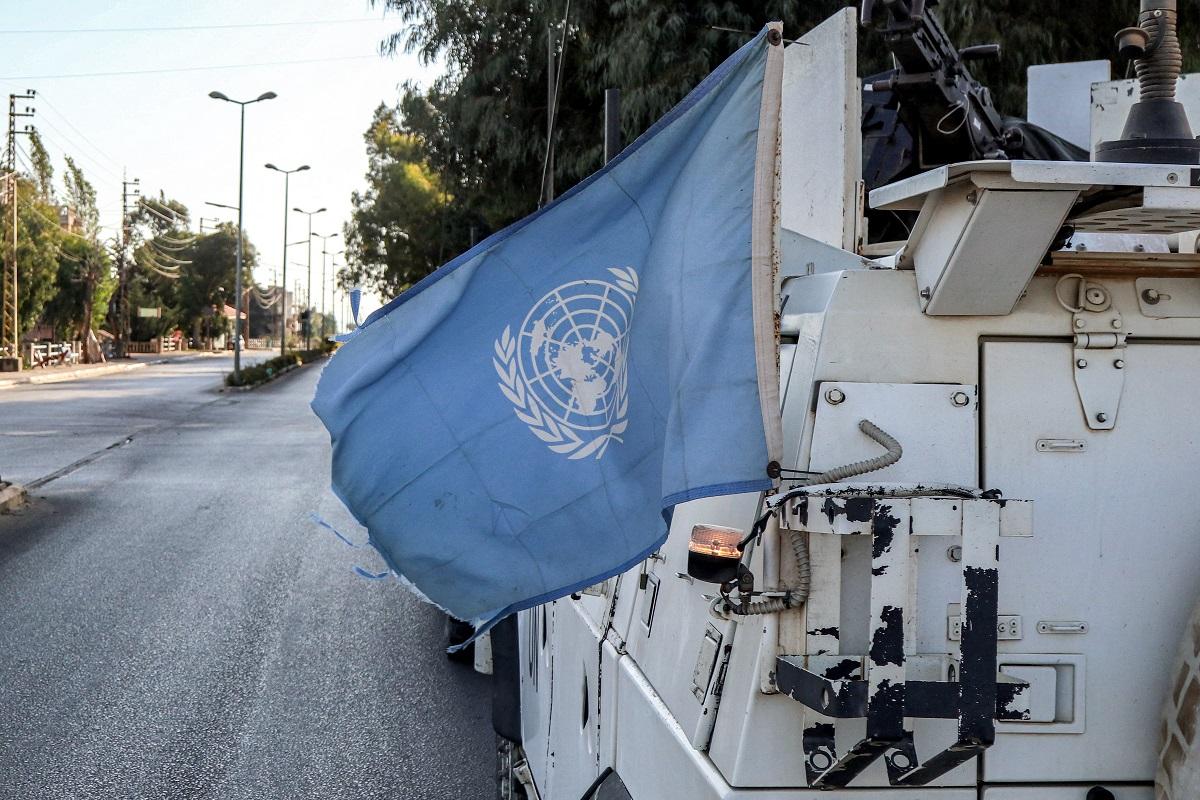
The United Nations Interim Force in Lebanon (UNIFIL) stated that an Israeli tank rammed peacekeeping vehicles on Sunday in the country’s south, where Israel and Hezbollah have been at war since last month.
“On two occasions today, Israel Defense Forces (IDF) soldiers rammed UNIFIL vehicles with a Merkava tank, in one case causing significant damage,” the statement said, adding that the Israeli soldiers had blocked a road in south Lebanon’s Bayada “that is used to access UNIFIL positions”.
“Over the past week, Israeli soldiers have fired ‘warning shots’ in the area, striking and damaging clearly identifiable UNIFIL vehicles. In one case, a ‘warning shot’ landed a metre away from a peacekeeper who had dismounted his vehicle,” the statement added.
“Israeli soldiers have continually blocked peacekeepers’ movements on this road in recent days, in addition to denials of freedom of movement recorded in other areas,” it said.
UNIFIL patrols in south Lebanon near the Israeli border where Israel and Hezbollah have been fighting since last month after the Iran-backed militant group drew Lebanon into the Middle East war with rocket fire at Israel in support of its backer Iran.
Three Indonesian peacekeepers were killed in south Lebanon last month, with a preliminary UN investigation finding one was killed by Israeli tank fire, while the two others were killed by an improvised explosive device likely planted by Hezbollah.
Other UNIFIL peacekeepers have also been wounded since the war erupted.
This month, “Israeli soldiers have also destroyed force protection cameras” in UNIFIL’s headquarters in Naqura “and five other positions”, the statement said.
On Saturday, Israeli soldiers “spray-painted the windows of the headquarters’ pedestrian access gate, denying visibility to the external perimeter”, it added.
UNIFIL said the actions were inconsistent with the “requirement to ensure the safety and security of peacekeepers” and their freedom of movement.
United Nations peacekeepers have served as a buffer between Lebanon and Israel for decades, but their mandate concludes at the end of this year.
United Nations Interim Force in Lebanon (UNIFIL)
The United Nations Interim Force in Lebanon (UNIFIL) is a UN peacekeeping mission established in March 1978 following Israel’s invasion of southern Lebanon. Its mandate is to confirm the withdrawal of Israeli forces, restore international peace and security, and assist the Lebanese government in restoring its authority in the area. While its presence has helped maintain a general cessation of hostilities, it operates in a complex political and security environment along the volatile Blue Line border.
Israel Defense Forces (IDF)
The Israel Defense Forces (IDF) is the unified military force of the State of Israel, established in 1948 shortly after the nation’s declaration of independence. It was formed from pre-existing paramilitary groups and has since played a central role in the country’s defense through multiple major conflicts, while also maintaining a unique structure that includes mandatory conscription for most citizens.
Merkava tank
The Merkava is Israel’s main battle tank, first introduced in 1979. Its design prioritizes crew survivability, featuring a unique front-engine layout and rear troop compartment, and it has been continuously upgraded through several major variants based on operational experience in Israel’s conflicts.
Bayada
“Bayada” does not refer to a widely recognized major cultural site or historical place. It is most commonly a surname, a place name for several small localities, or a commercial brand (such as the home healthcare company Bayada Home Health Care). Without a specific geographic or cultural context, it is not possible to provide a historical summary.
Naqura
Naqura is a coastal town in southern Lebanon, historically known as the location of the United Nations Interim Force in Lebanon (UNIFIL) headquarters since 1978. Its modern significance is largely tied to this peacekeeping mission, established following the Israeli invasion of Lebanon. The area has a longer history as a small fishing village, but its contemporary identity is defined by its role in regional security and monitoring.
Hezbollah
Hezbollah is a Lebanese political party and armed group founded in the 1982 context of the Lebanese Civil War and the Israeli invasion of Lebanon, with ideological and material support from Iran. It positions itself as a resistance movement against Israel and has become a major military and political force within Lebanon. The group is designated as a terrorist organization by several countries and international bodies, while it also operates a vast network of social services for its supporters.
Lebanon
Lebanon is a country on the eastern shore of the Mediterranean Sea, historically known as the heart of Phoenician civilization, which was a major maritime and trading culture from around 3200 BCE. Its rich history includes successive rule by various empires and, in the modern era, it gained independence in 1943, though it has faced significant periods of conflict. The country is renowned for its ancient archaeological sites, such as Baalbek, and its vibrant, diverse cultural heritage.
Israel
Israel is a modern nation-state established in 1948 in the historical region of the ancient Land of Israel, an area central to Judaism, Christianity, and Islam with a history spanning thousands of years. It is home to numerous significant cultural and religious sites, including Jerusalem’s Western Wall and the Dome of the Rock, which reflect its deep historical and spiritual importance to multiple faiths. The country’s contemporary identity is shaped by its ancient heritage, its role as a homeland for the Jewish people, and the complex geopolitical history of the region.