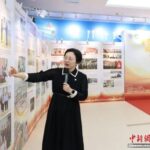
This morning, the Municipal Government Information Office held a press conference. The Director of the Municipal Agriculture and Rural Affairs Commission introduced the “Implementation Opinions on Anchoring Agricultural and Rural Modernization and Solidly Advancing the Comprehensive Revitalization of Shanghai’s Rural Areas” (hereinafter referred to as the “Implementation Opinions”). Officials from the Municipal Planning and Resources Bureau and the Municipal Agriculture and Rural Affairs Commission also attended the press conference and answered questions.
Over the past year, focusing on technological innovation and agricultural/rural reforms, Shanghai has worked diligently to optimize modern agriculture, strengthen the rural collective economy, better secure employment and income growth for farmers, and firmly uphold the baseline of people’s livelihoods. All annual and 14th Five-Year Plan targets and tasks were successfully completed.
Last year, the city’s total grain sown area reached 1.99 million mu, with a total output of 1.05 million tons and a per-mu yield of 526 kilograms. Total output, per-mu yield, and sown area all achieved growth. According to calculations by the National Bureau of Statistics, Shanghai’s comprehensive rural revitalization development index reached 80.5 points, ranking first in the nation for three consecutive years. The per capita disposable income of rural permanent residents reached 48,122 yuan, a year-on-year increase of 5.4%, which was 1.4 percentage points higher than the growth rate for urban permanent residents, further narrowing the urban-rural income gap.
Since the 18th National Congress of the Communist Party of China, the Central Committee has issued 14 No. 1 Central Documents guiding work related to agriculture, rural areas, and farmers. Recently, the city’s “Implementation Opinions” were officially issued and implemented, systematically deploying Shanghai’s rural revitalization work.
I. Overall Considerations of the “Implementation Opinions”
The drafting of the “Implementation Opinions” strives to reflect three characteristics: First, focusing on key points for efficient advancement. It fully aligns with central requirements while concentrating on shortcomings and weaknesses in the city’s recent work progression, ensuring clear problem orientation and effective policy implementation. Second, clarifying responsibilities and ensuring implementation. It integrates with national performance evaluations for advancing the rural revitalization strategy, specifies responsible units and implementing entities, utilizes information technology for “chart-based operations,” and forms a promotion pattern characterized by “clear tasks, definite milestones, and thorough follow-through.” Third, basing on practical conditions for precise policy measures. Closely tied to the characteristics of urban-rural integrated development in a modern international metropolis, while fully implementing the central spirit, it highlights Shanghai’s distinctive features, reflects Shanghai’s standards, and ensures policies are grounded, practical, and operable.
II. Main Content of the “Implementation Opinions”
The “Implementation Opinions” consist of five parts with 20 articles, clarifying five key areas of work.
1. Accelerating the Development of Modern Urban Green Agriculture. This includes resolutely implementing the joint responsibility of the Party and government for food security, promoting modern farming system reforms, improving grain production capacity and levels, promoting quality and efficiency enhancement in the “vegetable basket” industry, implementing actions to modernize and upgrade facility agriculture, and increasing the supply of green, high-quality agricultural products. It involves strengthening farmland protection and quality improvement, accelerating the construction of high-standard farmland, and implementing full-cycle management. Enhancing the effectiveness of agricultural technological innovation, strengthening organized scientific research, tackling key technologies, and building a tiered cultivation system for agricultural technology enterprises.
2. Actively Creating High-Quality Living Spaces in Rural Areas. Promoting the implementation of rural territorial space planning, continuously advancing the construction of livable, business-friendly, beautiful, and harmonious rural clusters, promoting the first batch of pilot projects to create “Shanghai-style Jiangnan” characteristic villages, continuously advancing comprehensive land consolidation across entire regions, and categorically securing land for rural development. Strengthening the construction, management, and maintenance of rural infrastructure, and upgrading the capacity and level of public service provision in rural areas. Improving the quality of the rural ecological environment and the level of social governance.
3. Taking Multiple Measures to Promote Sustained Income Growth for Farmers. First, promoting the integrated development of rural industries, accelerating the cultivation of premium agricultural brands, and promoting the fresh and direct delivery of locally produced agricultural and sideline products. Second, building a rural tourism industry system and creating new rural consumption scenarios integrating digital and physical elements. Legally revitalizing and making good use of idle rural land and houses, deepening the open trading of rural collective assets and resources through the rural property rights trading platform, and comprehensively carrying out the work of confirming rights and issuing certificates for unregistered rural collective immovable properties. Developing and strengthening the rural collective economy. Developing rural industries, implementing