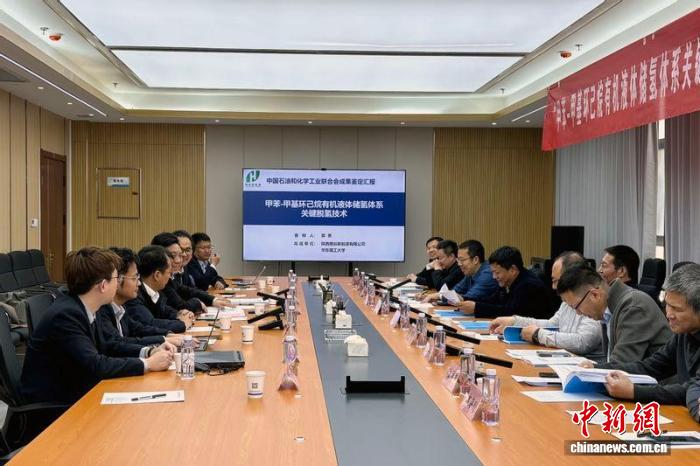
On March 24, it was learned from East China University of Science and Technology that the key dehydrogenation technology for the “Toluene-Methylcyclohexane Organic Liquid Hydrogen Storage System,” jointly developed by a research team and Shaanxi Ligu New Energy Co., Ltd., has completed a scientific and technological achievement evaluation. This achievement successfully realizes a breakthrough in key dehydrogenation technology, laying a solid foundation for industrial application.
Hydrogen energy is a core direction for the green transformation of the national energy structure, and breaking through the storage and transportation bottleneck is key to the large-scale development of the hydrogen energy industry. Toluene-methylcyclohexane organic liquid hydrogen storage technology, with its advantages of high hydrogen storage density, safe storage and transportation, and compatibility with existing petrochemical logistics systems, has become a major focus for industry research.
This technology can “fix” hydrogen, which is difficult to store and transport, into the bulk chemical raw material toluene through a chemical reaction, forming a stable liquid (methylcyclohexane). This liquid can be transported over long distances using existing infrastructure like tanker trucks and oil tankers, similar to gasoline, making it safe and convenient. Upon reaching the destination, hydrogen is efficiently extracted for use through a dehydrogenation device. The entire process achieves low-cost, safe hydrogen storage and transportation. In the future, this technology can be rapidly scaled up to handle 5 tons of hydrogen per day or even larger scales, enabling large-scale hydrogen storage and transportation.
An expert group conducted an on-site inspection of the pilot plant, reviewed technical documentation, and after inquiry and discussion, unanimously agreed: this achievement has established China’s first 200kg H₂/day methylcyclohexane dehydrogenation pilot plant. The new catalyst exhibits excellent performance, the plant operates stably, and key indicators surpass design values, providing a feasible solution for the large-scale safe storage and transportation of green hydrogen. The evaluation committee agreed to pass the evaluation, considering the overall achievement to be at an internationally advanced level.
It was reported that the holding of this evaluation meeting marks a key leap for this technology from the university laboratory towards industrial engineering. This achievement not only aligns with the national hydrogen energy industry and “dual carbon” strategic plan but also solves the bottleneck of long-distance hydrogen storage and transportation, supporting the implementation of the “West Hydrogen East Transmission” and “dual carbon” strategies, with broad application prospects.