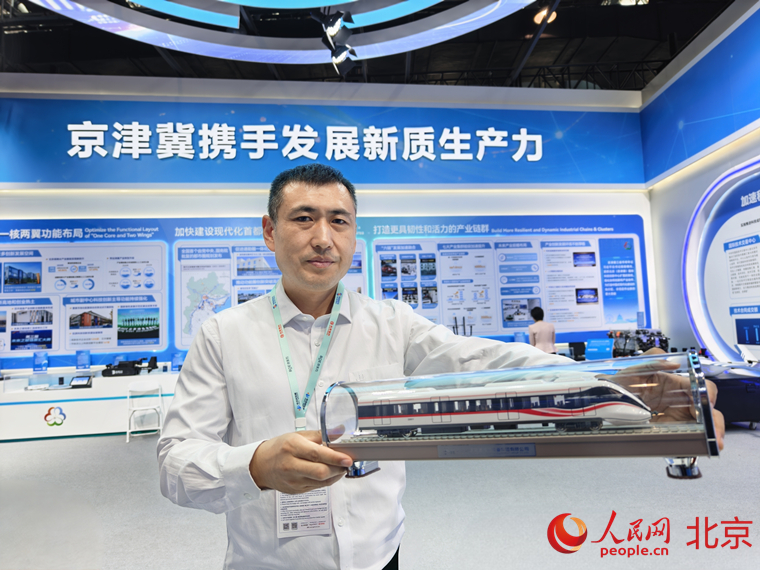
Beijing Subway Line 22 is scheduled to open this year, and residents are already eager to take this inter-provincial journey on the new express line. Recently, a model of the new train was unveiled at the 2026 Zhongguancun Forum Annual Meeting.
As a landmark project in building the “Rail-based Beijing-Tianjin-Hebei Region,” Beijing Subway Line 22 runs from Dongdaqiao in Chaoyang District in the west to Pinggu New Town in the east. It connects key functional areas including the Beijing CBD core area, the sub-center of Beijing, Yanjiao in Hebei, and Pinggu New Town. According to transportation authorities, the section from Hongmiao Station to Pinggu Station is planned to open this year, spanning approximately 79.1 kilometers with 20 stations.
A designer showcased the train model for Line 22 on-site.
“Line 22 utilizes Type D regional trains with an 8-car formation. It not only combines the speed of high-speed rail with the convenience of subway in its design but also achieves significant breakthroughs in intelligence, system integration, and full lifecycle maintenance,” explained a vehicle system designer.
Against the backdrop of coordinated development in the Beijing-Tianjin-Hebei region, cross-regional commuting demand is growing. Traditional subway trains, with speeds mostly between 80 to 100 km/h, struggle to meet the need for long-distance, fast commuting. Line 22, however, has a maximum speed of 160 km/h, which will significantly reduce cross-regional travel time.
Calculations show that traveling from Yanjiao, Hebei to the Beijing CBD core area takes 1.5 to 2 hours by road, but using Line 22’s express service will take only about 35 minutes. “This rapid commuting capability is conducive to relocating industries from Beijing to Hebei and promoting regional industrial coordination,” the designer said.
In the vehicle design, passenger commuting needs were fully considered to create an intelligent, safe, and comfortable travel environment. The carriages feature a “2+2” transverse seat layout, with vertical handrails in standing areas and armrests on seat backs. The seats are equipped with adjustable armrests to alleviate passenger fatigue during long journeys.
The entire train is equipped with an intelligent air conditioning system that automatically adjusts based on passenger count and external temperature. A comprehensive Passenger Information System (PIS) is deployed throughout, with each carriage featuring 8 ultra-clear LCD screens. Passengers can access real-time operation, station, and transfer information, making it easier to plan routes in advance.
The Line 22 trains employ the highest grade of fully automatic operation technology, capable of automated processes including wake-up, self-inspection, depot exit, mainline running, precise station stopping, automatic door operation, automatic turnaround, and dormancy.
The designer explained that the fully automatic operation system possesses advanced fault diagnosis and emergency handling capabilities. When a fault occurs, the system can automatically detect and judge its type and promptly take emergency measures. Fault information is transmitted in real-time to the operation command center, facilitating timely repairs by staff and shortening line recovery time. “The fully automatic operation mode means passengers don’t need to worry about safety issues arising from driver error and can relax or work more comfortably during their journey.”
The trains for Beijing Subway Line 22 are manufactured and tested at the Jingche Smart Manufacturing Base in Baoding, Hebei. Vehicle designers from Beijing have made numerous trips to Hebei to transform Beijing’s advanced designs into brand-new regional trains, which are then delivered for service. This collaborative model of “Beijing R&D, Hebei Manufacturing” has accelerated the coordinated development of the Beijing-Tianjin-Hebei region.