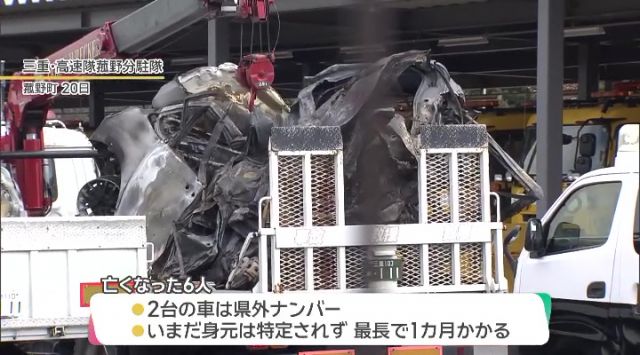
In the investigation so far, the suspect has stated that he was not paying close attention ahead, noticed the traffic jam at the last moment, and applied the brakes but could not stop in time.
The Ministry of Land, Infrastructure, Transport and Tourism has designated this a “Special Important Investigation Subject” due to its significant social impact. An expert investigation committee will begin examining the accident.
The two cars carrying the six deceased all had license plates from outside the prefecture. Their identities have still not been confirmed, and it is estimated the process could take up to a month.
Police plan to conduct an on-site inspection of the burned large truck to investigate the cause of the accident in detail.
Shin-Meishin Expressway
The Shin-Meishin Expressway is a major toll road in Japan, opened in 1963 as a modern replacement for the original Meishin Expressway. It runs parallel to the older route, connecting Nagoya and Kobe, and was built to alleviate traffic congestion and improve safety with more advanced design standards.
Mie Prefecture
Mie Prefecture is located in central Japan’s Kansai region and is historically significant as the home of the Ise Grand Shrine, Japan’s most sacred Shinto site, which has been rebuilt every 20 years since the 7th century. The prefecture also boasts a rich samurai heritage in its castle towns and is famous for its cultured pearls from Ago Bay.
Nodono Tunnel
The Nodono Tunnel is a historic railway tunnel located in the mountainous region of Gunma Prefecture, Japan. Completed in 1893 as part of the Usui Pass section of the Shin’etsu Line, it was a critical engineering feat of the Meiji era, facilitating travel and trade. It is particularly famous for its steep gradient and for being part of the route used by the steam locomotive “SL Usui,” now a popular heritage site.
Osaka
Osaka is a major port city on Japan’s Honshu island, historically known as the nation’s merchant capital and the “kitchen of Japan” for its vital role in the rice trade during the Edo period (1603-1867). Today, it is a vibrant modern metropolis famous for its street food, nightlife, and landmarks like the historic Osaka Castle and the futuristic Dotonbori district.
Ministry of Land, Infrastructure, Transport and Tourism
The Ministry of Land, Infrastructure, Transport and Tourism (MLIT) is a key Japanese government agency established in 2001 through a merger of several ministries. It is responsible for national policy and development related to public works, transportation networks, land use, and tourism. Its history is rooted in Japan’s post-war reconstruction and economic growth, focusing on building and maintaining the country’s extensive infrastructure.