The General Secretary demanded that the Navy must be a solid fulcrum for fishermen to venture out to sea, cling to the sea, and build an increasingly solid national defense posture of the entire people and the “posture of people’s hearts” at sea.
On the morning of February 28, in Hai Phong city, the Navy (Ministry of National Defense) held a Ceremony to receive the title of People’s Armed Forces Hero (for the third time).
The General Secretary, Secretary of the Central Military Commission, attended and delivered a guiding speech at the ceremony.
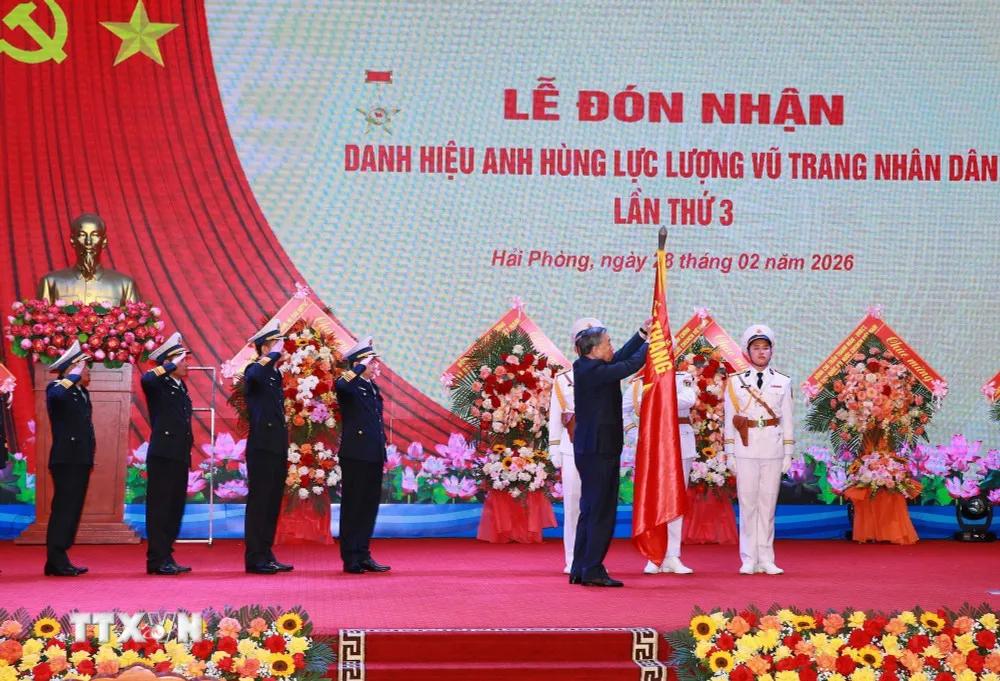
Attending the ceremony were members of the Politburo.
Also attending were members of the Party Central Committee, former members of the Party Central Committee, leaders of the Party and State; leaders of central and local committees, ministries, and sectors; leaders of the Ministry of National Defense, heads of units under the Ministry of National Defense; leaders and commanders of the Navy through various periods; generals, People’s Armed Forces Heroes, Labor Heroes of the Navy; leaders, commanders, and representatives of officers and soldiers of agencies and units under the Navy.
Shining brighter the noble quality “Uncle Ho’s Soldiers – Navy Soldiers”
Recalling the history of the Navy’s construction, combat, and growth, the Vice Admiral, Member of the Party Central Committee, Member of the Central Military Commission, Navy Commander stated that in response to the task requirements of managing and protecting the sovereignty of the nation’s seas and islands, after the North was completely liberated, on May 7, 1955, the Coastal Defense Department, the predecessor of the Navy, was established.
Over the past 70 years, the Navy has continuously developed and matured, achieving many glorious feats of arms, some of which have become legendary, like the miracles of our Army and nation in the Ho Chi Minh era.
During the resistance war against the US for national salvation, the Navy went into battle and won the first battle on August 2 and 5, 1964, driving the Maddox destroyer out of the northern waters, shooting down aircraft, and capturing American pilots alive; together with the military and people of the whole country, they fought courageously, defeating two wars of escalation of destruction and blockade of the North by US imperialism; trained and used naval commandos to fight the enemy on the Cua Viet-Dong Ha battlefield; opened the Ho Chi Minh Trail at Sea to transport supplies to the southern battlefield; participated in the 1975 Spring General Offensive and Uprising, liberating the South to reunify the country and liberating the Truong Sa archipelago and the southwestern islands, contributing to the complete and great victory of the nation.
After the country’s reunification, the Navy continued to excellently fulfill its glorious international duties in Laos and Cambodia.
In the cause of protecting sea and island sovereignty, the Navy has always affirmed absolute loyalty to the Party, the Fatherland, and the people; regularly researched and accurately forecasted the situation, proactively advised and proposed to the Central Military Commission, the Ministry of National Defense, the Party, and the State, and flexibly and correctly handled situations, especially difficult and complex situations at sea, avoiding passivity and surprise, firmly protecting sea and island sovereignty, maritime economic activities, and maintaining a peaceful and stable maritime environment for national development.
In response to the task requirements of protecting sea and island sovereignty in the new situation, the Navy has focused on building towards “lean, compact, and strong,” with a full range of force components: surface ships, submarines, naval aviation, coastal artillery-missiles, naval infantry, and naval commandos. Many new and modern types of vehicles, weapons, and equipment have been put into service. Training and education work has been emphasized; combining training with building regularity, management, and discipline training, contributing to improving the overall quality and combat strength of the entire Navy.
International integration and defense diplomacy have been implemented by the Navy proactively, synchronously, flexibly, and effectively, increasingly going into depth and substance on both bilateral and multilateral levels, prioritizing cooperation with the armies and navies of neighboring countries, major countries, strategic partners, and traditional friends; continuously building trust, enhancing the prestige and position of the Vietnam People’s Navy internationally, building a peaceful and stable sea area, contributing to protecting the Fatherland from afar and early.
With the motto “rescuing the people