Takbiran Night at HI Roundabout: Traffic Engineering and Sudirman-Thamrin Alternative Routes
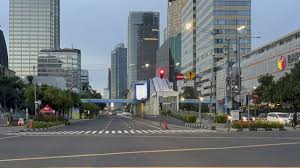
Depok – The Jakarta Transportation Agency (Dishub) has officially implemented a large-scale traffic engineering plan in the heart of the capital tonight, Friday. This step was taken to support the religious cultural event “Jakarta Bedug Kolosal” and the Electric Torch Parade, which is scheduled to begin filling the HI Roundabout area at 8:00 PM local time.
It was explained that road sterilization will be carried out situationally, covering the main corridor from Monas to the Sudirman area.
Mapping of Road Closure Points
Vehicle access will be strictly limited on a number of protocol road sections that serve as the parade route or event center, including:
Main Corridor: Jl. MH Thamrin (Patung Kuda – HI Roundabout) and Jl. Jenderal Sudirman (Simpang Karet – HI Roundabout).
Connecting Sections: Jl. Kebon Sirih, Jl. KH Wahid Hasyim, Jl. Sunda, and Jl. Imam Bonjol.
Alternative Route Guide for Drivers
To avoid total gridlock in the city center, Dishub has mapped out the following traffic diversion scheme:
North to South Flow (Harmoni towards Semanggi): Drivers are directed via Jl. Hayam Wuruk → Jl. Ir H Juanda → Jl. Suryopranoto → Jl. KH Mas Mansyur → Jl. Prof. DR. Satrio.
South to North Flow (Semanggi towards Harmoni): Diverted through Jl. Karet → Jl. KH Mas Mansyur → Jl. Cideng Barat → Jl. Gajah Mada.
West to East Flow (Tanah Abang towards Gondangdia/Tugu Tani): An alternative route is provided through residential areas and supporting arterial roads to avoid congestion at the main Sudirman-Thamrin intersection.
Logistics and Public Transportation
For the public who still wish to witness the festivities at HI Roundabout, Dishub strongly recommends using mass transportation (MRT, LRT, or TransJakarta) to reduce the volume of private vehicles.
If bringing a vehicle is unavoidable, 21 designated parking areas have been prepared with a total capacity of:
Motorcycles: 8,186 spaces.
Cars: 12,295 spaces.
Buses: 98 spaces.
“We urge road users to avoid these sections and follow the instructions of officers on the ground for the common good,” it was stated. TransJakarta operations will also experience dynamic route adjustments (diversions) following the crowd density conditions on the main routes.
Monas
Monas, short for Monumen Nasional (National Monument), is a towering 132-meter obelisk located in central Jakarta, Indonesia, symbolizing the nation’s struggle for independence. It was commissioned by Indonesia’s first president, Sukarno, and its construction began in 1961, finally opening to the public in 1975. The monument is topped with a flame coated in gold foil and houses a historical museum and an observation deck, serving as a major national landmark.
HI Roundabout
The “HI Roundabout” is not a widely recognized historical or cultural site. It appears to be a local nickname for a traffic circle, likely in Hawaii (as “HI” is the postal abbreviation for the state). Without a specific location, it has no notable history as a cultural landmark.
Patung Kuda
“Patung Kuda” (Horse Statue) typically refers to the iconic **National Monument (Monas)** in Jakarta, Indonesia, which features a dramatic bronze statue of Prince Diponegoro riding a horse. The statue, created by Italian sculptor Prof. Cobertaldo in the 1960s, commemorates Prince Diponegoro’s leadership in the Java War (1825-1830) against Dutch colonial rule. It stands as a powerful national symbol of Indonesian resistance and the struggle for independence.
Harmoni
Based on the name alone, “Harmoni” is not a widely recognized specific global landmark. However, it is a common name for buildings, neighborhoods, and cultural centers, particularly in Indonesia and Malaysia, often chosen to symbolize peace and unity.
For example, the **Harmoni Monument** in Central Jakarta marks a historic roundabout that was once the boundary between different ethnic quarters during the Dutch colonial era. Today, the name “Harmoni” generally reflects its meaning of social integration and balance.
Semanggi
Semanggi is a major cloverleaf interchange in Jakarta, Indonesia, famous for its complex network of overpasses. The name, which means “clover” in Indonesian, comes from the shape of the original intersection built in the early 1960s. Historically, the area was also the site of the tragic “Semanggi I” and “Semanggi II” student protests in 1998 and 1999, which were pivotal events during Indonesia’s Reformasi era.
Tanah Abang
Tanah Abang is a historic market district in central Jakarta, Indonesia, originally established by the Dutch East India Company (VOC) in 1735. Today, it is famous as Southeast Asia’s largest textile and clothing market, a bustling commercial hub that has evolved from a traditional bazaar into a massive complex of modern and traditional market buildings.
Gondangdia
Gondangdia is a historic neighborhood in central Jakarta, Indonesia, originally developed in the early 20th century as a residential area for Dutch officials and wealthy citizens during the colonial era. Today, it is known for its well-preserved colonial architecture, the iconic Gondangdia railway station, and its quiet, tree-lined streets amidst the bustling city.
Tugu Tani
Tugu Tani, also known as the “Farmer’s Monument,” is a prominent bronze statue located in central Jakarta, Indonesia. It was a gift from the Soviet Union in 1963, designed by Russian artists, and symbolizes the hard work and resilience of the Indonesian people, particularly farmers. The statue depicts a young man carrying rice sheaves with a woman supporting him, reflecting themes of struggle and national independence.