Thousands of Muhammadiyah Residents in Depok Perform Eid Prayer at PSP Sawangan Field
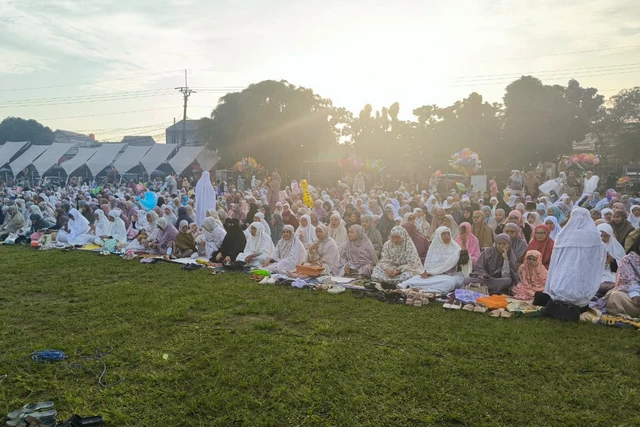
A solemn atmosphere enveloped PSP Field, Sawangan, Depok City, on Friday morning. Starting at 5:30 AM local time, thousands of residents from Muhammadiyah began filling the location to perform the Eid al-Fitr prayer for the year 1447 Hijri.
The takbir resonated, accompanying the arrival of worshippers who came in droves. They laid out prayer mats in the field area while waiting for the prayer to begin at 6:45 AM.
The Eid prayer was led by Ali Fikri, who served as both the imam and the preacher (khatib).
PSP Field was one of the main locations for Eid prayers in Depok. Overall, the Muhammadiyah Regional Leadership of Depok had prepared dozens of prayer points spread across various areas.
The determination of Eid al-Fitr on March 20, 2026, by Muhammadiyah is based on the decision of the Global Unified Hijri Calendar. Meanwhile, the government, through the Ministry of Religious Affairs of the Republic of Indonesia, determined that 1 Shawwal would fall on Saturday after moon sighting observations at various points across Indonesia.
This difference in determining the holiday did not diminish the solemnity of the worship. The congregation still performed the Eid prayer in an orderly and communal manner.
PSP Field
“PSP Field” refers to the former home stadium of the **Pittsburgh Steelers** (NFL) and **Pittsburgh Pirates** (MLB), officially known as **Forbes Field**. It opened in 1909 in Pittsburgh, Pennsylvania, and was renowned for its historic events, including Babe Ruth’s final professional home runs and Bill Mazeroski’s 1960 World Series-winning walk-off home run. The stadium was demolished in 1971, with its legacy preserved at the University of Pittsburgh, where parts of the outfield wall and home plate location remain.
Sawangan
Sawangan is a village located in Depok, West Java, Indonesia, historically known for its role as a significant agricultural area, particularly for rice production. It has developed from a rural settlement into a more urbanized suburb of Jakarta, while still retaining some of its traditional village character and local markets. The area’s history is intertwined with the expansion of Depok and its transformation due to the growth of the greater Indonesian capital region.
Depok City
Depok City is a city in West Java, Indonesia, originally established in the 17th century as a private agricultural estate by Cornelis Chastelein, a Dutch East India Company official. It later developed into a significant educational and residential hub, particularly after its official designation as an autonomous city in 1999. Today, it is a major part of the Greater Jakarta metropolitan area, known for its universities and as a commuter city.
Eid al-Fitr
Eid al-Fitr is the “Festival of Breaking the Fast,” a major Islamic holiday marking the end of Ramadan, the holy month of fasting. Its history dates back to the Prophet Muhammad in the 7th century, and it is celebrated with communal prayers, feasting, charity, and social gatherings.
Muhammadiyah
Muhammadiyah is not a physical place but a major Islamic social and religious organization in Indonesia. Founded in 1912 in Yogyakarta by Ahmad Dahlan, it emphasizes modern education, social welfare, and a return to the Quran and Sunnah while rejecting traditional syncretic practices. It has grown into one of the world’s largest Muslim organizations, operating thousands of schools, universities, and hospitals across Indonesia.
Ali Fikri
“Ali Fikri” is a well-known historic café and cultural landmark located in the heart of Cairo, Egypt. Founded in the early 20th century, it has long been a famous gathering place for Egyptian intellectuals, writers, and artists, serving as a hub for cultural and political discussions. It remains a symbol of Cairo’s vibrant café culture and its history as a center for creative and intellectual life.
Global Unified Hijri Calendar
The Global Unified Hijri Calendar is a proposed international Islamic lunar calendar intended to standardize the start of lunar months for religious observances worldwide. Its history is rooted in modern efforts to resolve discrepancies in moon-sighting methods, aiming to replace the current system where dates vary by country with a single, astronomically calculated calendar for all Muslims.
Ministry of Religious Affairs of the Republic of Indonesia
The Ministry of Religious Affairs of the Republic of Indonesia (Kementerian Agama) is a government institution established in 1946, shortly after the nation’s independence. It was created to manage religious affairs, promote interfaith harmony, and administer religious laws and education for the country’s six officially recognized religions: Islam, Protestantism, Catholicism, Hinduism, Buddhism, and Confucianism.