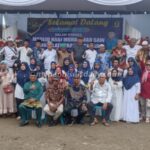
The Mayor of Medan has called on the younger generation to make mosques a fortress against the onslaught of negative influences from gadgets and drugs.
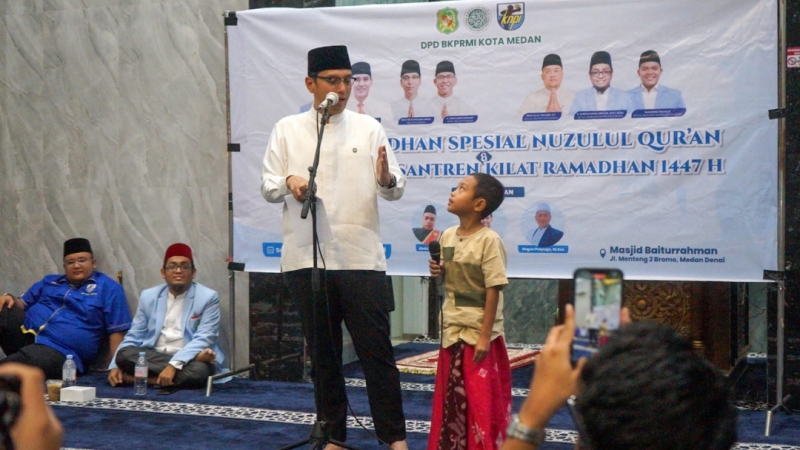
This call was made during an event for the Special Ramadan Safari for Nuzulul Qur’an and the Opening of the Ramadan 1447 H Fast-Track Islamic Boarding School, held at the Baiturrahman Mosque on Menteng II Bromo Street, Medan Denai District.
The Mayor highlighted the social phenomenon where dependence on gadgets is beginning to erode human relationships. He reminded the public not to neglect the people around them just because they are busy with their phone screens.
“Our children, and even we adults, sometimes get too absorbed in our own phones. We must limit this to maintain social bonds,” he said.
In addition to the gadget issue, the threat of drugs in Medan is also a serious concern. Therefore, the Mayor entrusted a message to the local mosque youth communication board and the mosque management board to make the mosque a safe house or defensive fortress for young people so they do not fall into negative activities.
“Invite our young people to engage in activities at the mosque. Do not let them turn to negative things because there is no space for positive expression,” he stated.
For this reason, the Mayor expressed appreciation for the opening of the Ramadan 1447 H fast-track Islamic boarding school. Because activities like this are very important for building the character of the nation’s children.
“We are approaching the Golden Generation of 2045, where the main foundation is religious and moral education from an early age,” he added.
Not only speaking about religion, the Mayor also gave strict instructions to the ranks of government officials present, including district and village heads.
“There must be no more illegal levies in administrative services. Work professionally because our duty is to serve the people,” he emphasized.
On that occasion, the Mayor also handed over a package of Al-Qur’an aid to the management of the Baiturrahman Mosque. This assistance was also given as a form of appreciation to the mosque management for running economic empowerment programs, so that the Mosque is not just a place of worship, but also a place to support community welfare.
Meanwhile, the Chairman of the Baiturrahman Mosque Management Board, in his speech, outlined a number of concrete programs that have been running consistently at the Baiturrahman Mosque, including monthly assistance for orphans and the underprivileged, youth empowerment through the construction of a coffee hall as an economic space for young people, evening Quran recitation and fast-track Islamic boarding schools for children in Medan Denai, as well as free health checks and blood donation every three months.
The event was also attended by the Chairman of the Provincial Board and the Chairman of the City Board, as well as leaders of Regional Agencies within the Medan City Government.
Baiturrahman Mosque
The Baiturrahman Mosque is a historic mosque located in Banda Aceh, Indonesia, renowned for its striking Mughal-style architecture and iconic black domes. Originally built in 1612 during the Sultanate of Aceh, it was destroyed by fire and later rebuilt by the Dutch colonial administration in 1879 as a gesture of reconciliation following the Aceh War. Today, it stands as a major symbol of Acehnese resilience and faith, having famously survived the 2004 Indian Ocean tsunami.
Medan Denai District
Medan Denai is a district within the city of Medan, the capital of North Sumatra, Indonesia. Historically, it was part of the broader development of Medan as a major economic and cultural hub, particularly during the colonial plantation era. Today, it is a densely populated urban area known for its residential neighborhoods, local markets, and community life.
Ramadan 1447 H
“Ramadan 1447 H” refers to the Islamic holy month of fasting, which is a period of religious observance and cultural practice, not a specific physical place or site. In the Islamic lunar calendar, 1447 H (Hijri) corresponds roughly to the Gregorian year 2025-2026. Its history is rooted in the Islamic tradition, commemorating the month when the Quran was first revealed to the Prophet Muhammad in the 7th century CE.
Golden Generation of 2045
The “Golden Generation of 2045” is not a recognized historical place or cultural site. It appears to be a forward-looking concept, likely referring to a future vision or goal—such as Indonesia’s national development initiative aimed at achieving advanced status by its centennial in 2045. Therefore, it lacks a concrete history, representing instead an aspirational target for future prosperity and transformation.
Al-Qur’an
“Al-Qur’an” refers to the central religious text of Islam, believed by Muslims to be the verbatim word of God (Allah) as revealed to the Prophet Muhammad through the angel Gabriel over approximately 23 years, beginning in 610 CE. It is not a physical place but a sacred scripture that serves as the foundation of Islamic faith, law, and culture, and its compilation into a single book was completed after the Prophet’s death.
Nuzulul Qur’an
“Nuzulul Qur’an” refers to the Islamic observance of the revelation of the Quran, commemorating the night (Laylat al-Qadr) when the first verses were revealed to the Prophet Muhammad by the angel Gabriel. This event is traditionally believed to have occurred during the last ten nights of Ramadan in the year 610 CE at the Cave of Hira near Mecca. It is not a physical site but a profound spiritual event, marking the beginning of the Quran’s revelation over 23 years.
Ramadan
“Ramadan” is not a physical place or cultural site, but rather the ninth and holiest month in the Islamic calendar, observed by Muslims worldwide as a period of fasting, prayer, reflection, and community. Its history dates to 624 CE when, according to Islamic tradition, the first verses of the Quran were revealed to the Prophet Muhammad during this month. The observance commemorates this revelation and is one of the Five Pillars of Islam.
Medan City
Medan is the capital of North Sumatra, Indonesia, and a major economic hub on the island of Sumatra. Historically, its modern growth began in the late 19th century with the expansion of Dutch colonial plantations for tobacco, rubber, and palm oil, transforming it from a small village into a bustling trading center. The city’s diverse cultural heritage is reflected in landmarks like the Maimun Palace, a legacy of the Deli Sultanate, and its mix of Malay, Batak, Chinese, and Indian influences.