Michael Biswas, living as Saurav Biswas in North 24 Parganas, arrested; police suspect he was middleman in larger conspiracy
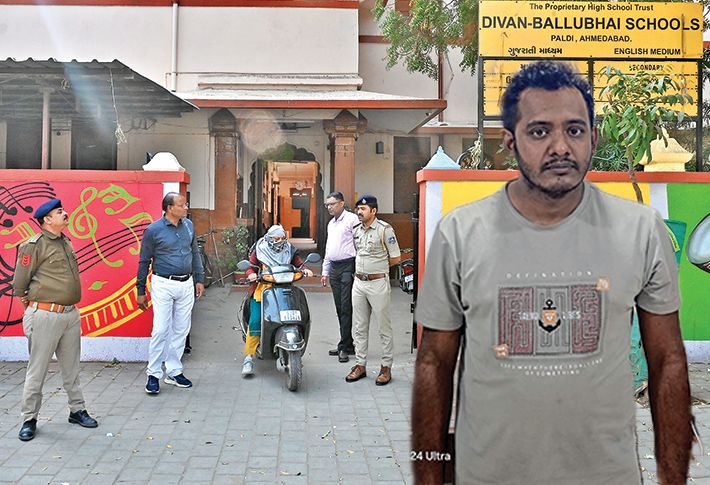
The cybercrime cell and city crime branch have cracked the bomb threat emails that targeted over 40 schools. After days of technical surveillance and interstate coordination, sleuths arrested 30-year-old Michael Biswas, a Bangladesh native who had been living under the alias Saurav Biswas in North 24 Parganas, West Bengal, since 2021.
Top police officials confirmed that while Biswas allegedly sent the emails, investigators believe he acted merely as a “middleman”, a digital operative hired by the real masterminds.
Police seized 3 CPUs, 5 hard disks, 5 mobile phones and one WiFi router from the accused.
‘A major breakthrough’
A senior police official said, “The city cyber cell and the city crime branch had been working on this case for long. This is a major breakthrough as the mails were sent across the country. We are now in touch with our counterparts in other states to break the entire module.”
The accused was produced in court. The public prosecutor argued that Biswas is believed to be behind several such mails sent to government offices and schools across the country. The court remanded him in police custody. The seized devices are now undergoing forensic analysis to trace possible links to a wider network.
Threat mails invoked Khalistani terrorists
The emails were sent using the IDs sarinalovenzo80@gmail.com and rhoniqee20@gmail.com to around 40 schools in Ahmedabad city, Ahmedabad Rural and Gandhinagar. The mails threatened to blow up school premises and invoked the names of prominent political leaders. One message read, “Gujarat Banega Khalistan.”
The threats triggered panic among parents, students and school authorities. Security was heightened and large-scale checks launched across campuses.
Technical trail leads to West Bengal
Investigators traced the digital footprints through IP address analysis and mobile number tracking. The trail led to North 24 Parganas in West Bengal from where Biswas was arrested with help of local police. He was produced before a local court and brought to Ahmedabad on a transit remand.
Larger conspiracy suspected
Investigators have found that Biswas was allegedly approached by a group to send bulk emails. Further investigations are on.
North 24 Parganas
North 24 Parganas is a district in the Indian state of West Bengal, primarily known as a populous administrative and economic hub surrounding Kolkata. Historically, it was part of the larger Sundarbans forest region and the ancient Bengali kingdom of Bhurshut, with its modern formation stemming from the 1947 partition of Bengal. The district contains significant sites like the Dakshineswar Kali Temple and remnants of colonial-era zamindari (landlord) estates.
Bangladesh
Bangladesh is a South Asian country formed in 1971 after its independence war from Pakistan. Historically, it is part of the Bengal region, with a rich cultural heritage dating back millennia, including ancient Buddhist and Hindu kingdoms and later Mughal influence. Today, it is known for its vibrant arts, the world’s largest river delta (the Sundarbans), and its resilient spirit.
West Bengal
West Bengal is a state in eastern India with a rich cultural and historical legacy, most notably as the former capital of British India (in Kolkata) and the epicenter of the Bengali Renaissance in the 19th and early 20th centuries. Its history is deeply intertwined with colonial rule, the Indian independence movement, and the 1947 Partition, which shaped its modern borders and demographics. Today, it is renowned for its vibrant arts, literature, cinema, and festivals like Durga Puja, which is recognized by UNESCO as an Intangible Cultural Heritage.
Ahmedabad
Ahmedabad is a historic city in western India, founded in the 15th century by Sultan Ahmed Shah on the banks of the Sabarmati River. It is renowned for its rich architectural heritage, including the intricately carved stepwells and pols (traditional residential clusters), and served as a major center for India’s textile industry and the non-violent independence movement led by Mahatma Gandhi, whose Sabarmati Ashram is located here. In recognition of its preserved historic urban fabric, the walled city of Ahmedabad was declared India’s first UNESCO World Heritage City in 2017.
Gandhinagar
Gandhinagar is the capital city of the Indian state of Gujarat, built in the 1960s to replace Ahmedabad as the state’s administrative center. It was named after Mahatma Gandhi, who was born in Gujarat, and was planned as a modern, green city with wide avenues and government complexes.
Gujarat
Gujarat is a state in western India with a rich cultural heritage and a long history dating back to the ancient Indus Valley Civilization, including sites like Lothal. Historically, it was a major hub for trade and commerce, home to important ports and the influential kingdoms of the Solankis and the Sultanate of Gujarat. Today, it is renowned for its vibrant festivals, diverse handicrafts, and as the birthplace of Mahatma Gandhi.
Khalistan
“Khalistan” is not a recognized place or cultural site, but a term referring to a proposed independent Sikh homeland in the Punjab region of India. The concept emerged as a political movement in the 1970s and 1980s, leading to a period of significant conflict. The Government of India considers calls for Khalistan a separatist movement, and no such sovereign state exists.