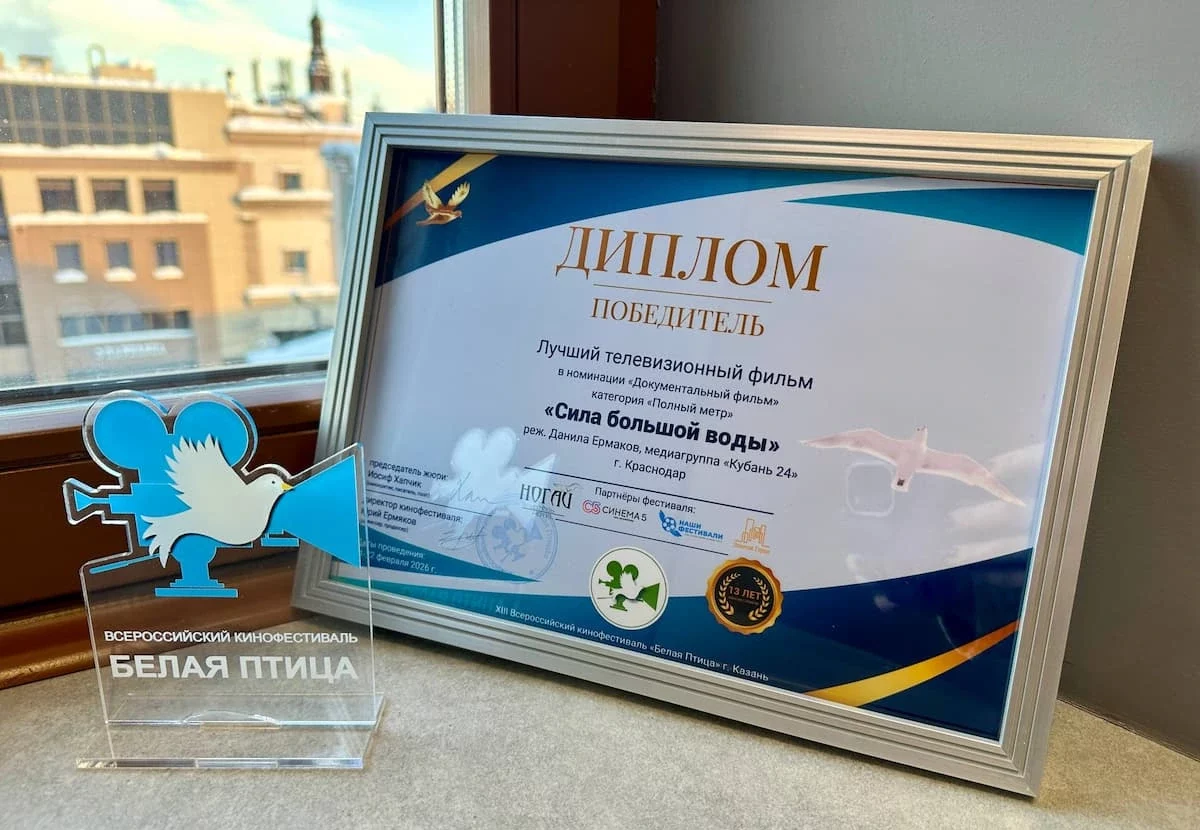
The film “Kuban 24” has become the winner of the All-Russian film festival “White Bird.”
The award ceremony for the winners of the All-Russian film festival “White Bird” took place in Kazan.
The film “The Power of Big Water” was recognized as the best in the “Documentary Film” nomination in the “Full-Length” category. The award was presented to the film’s director. The film was worked on by a screenwriter and a cinematographer.
“It’s great to realize that the film has only recently aired and has already received such high praise,” said the director after the award ceremony.
This year, a total of 510 directors from all over Russia submitted their works to the competition. Most of the films were shot by film studios and directors who specialize in complex artistic projects.
It was noted that it is not easy for a broadcast television company, whose task is to cover hundreds of events in a large region, to compete with such film studios, yet “the wings of the ‘White Bird’ are flying to Krasnodar.”
“The Power of Big Water” is a travel film to Altai, to the shores of Lake Teletskoye. A film crew went there to test how an invention by scientists works and to see how the power of nature changes human life.
All-Russian film festival “White Bird”
The All-Russian film festival “White Bird” is a major annual event held in the city of Krasnodar, dedicated to promoting family values and children’s cinema. Founded in 2007, it was established to support and showcase films for young audiences, encouraging the creation of high-quality, morally uplifting content. The festival serves as a significant platform for filmmakers and a cultural highlight in Southern Russia.
Kazan
Kazan is the capital of the Republic of Tatarstan in Russia, renowned for its iconic **Kazan Kremlin**, a UNESCO World Heritage Site. Historically, it was the capital of the medieval Khanate of Kazan before being conquered by Ivan the Terrible in 1552, leading to a unique blend of Tatar and Russian cultures that is visible in its architecture and city life today.
Krasnodar
Krasnodar is a major city in southern Russia, founded in 1793 as a fortress named Yekaterinodar (meaning “Catherine’s Gift”) in honor of Empress Catherine the Great. It served as the historical and cultural center of the Kuban Cossacks before being renamed Krasnodar (“Red Gift”) in 1920 following the Russian Revolution. Today, it is a vibrant administrative and economic hub for the surrounding agricultural region.
Altai
The Altai is a vast mountain region in Central Asia, spanning parts of Russia, Mongolia, Kazakhstan, and China, renowned for its stunning natural landscapes and deep cultural history. It is considered a sacred area and has been inhabited for millennia, serving as a crossroads for ancient nomadic tribes like the Scythians, whose elaborate burial mounds (kurgans) dot the region. Today, it is a UNESCO World Heritage site recognized both for its biodiversity and for its wealth of archaeological treasures that chronicle the history of Eurasian steppe cultures.
Lake Teletskoye
Lake Teletskoye is a large freshwater lake in the Altai Mountains of southern Siberia, Russia, revered as one of the region’s most significant natural treasures. Formed by tectonic activity millions of years ago, it has a long history of being sacred to indigenous Altai peoples and was later explored by Russian settlers in the 19th century. Today, it is a UNESCO World Heritage site within the Golden Mountains of Altai, known for its exceptional depth, clear water, and surrounding pristine taiga forests.