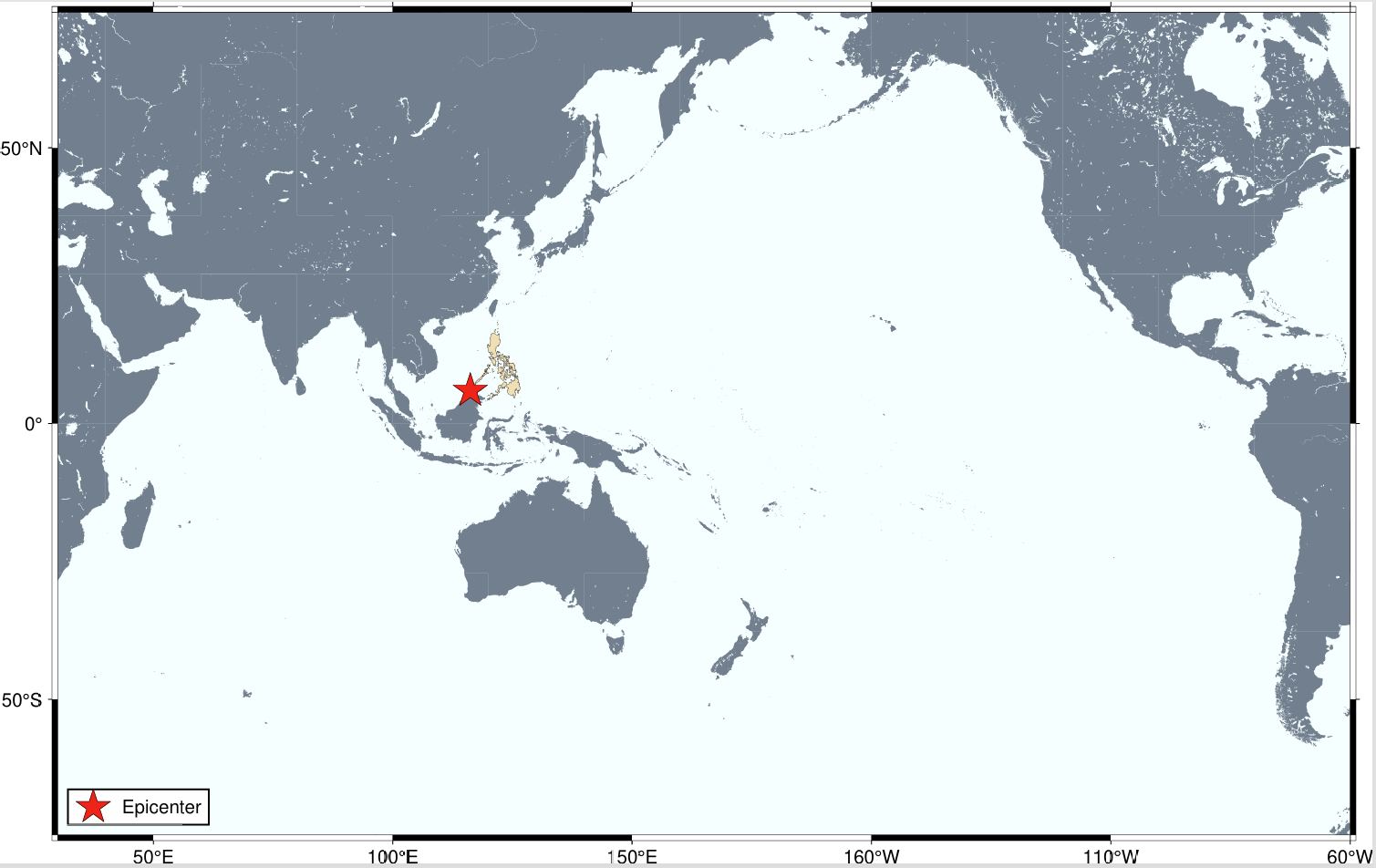
There is no tsunami threat to the Philippines following the earthquake that struck off the north coast of Borneo in the early hours of Monday.
The Philippine Institute of Volcanology and Seismology (PHIVOLCS) issued an advisory stating the earthquake occurred at 12:58 a.m. on Monday at coordinates 6.9° north, 116.2° east off the island of Borneo. It had a depth of 600 kilometers.
“No destructive tsunami threat exists based on available data. This is for information purposes only and there is no tsunami threat to the Philippines from this earthquake,” the advisory said.
It was initially reported as a magnitude 7.1 earthquake but was eventually reclassified as a magnitude 6.8 tremor.
Philippines
The Philippines is an archipelagic nation in Southeast Asia with a rich cultural history shaped by centuries of indigenous traditions, Spanish colonization (from 1565 to 1898), and later American influence. Its key historical sites include the Spanish-era Baroque churches, the historic city of Vigan, and the ancient Banaue Rice Terraces, which are over 2,000 years old. Today, the country is known for its vibrant festivals, diverse languages, and a unique blend of Eastern and Western cultural heritage.
Borneo
Borneo is the world’s third-largest island, shared by the nations of Malaysia, Indonesia, and Brunei. It is renowned for its ancient rainforests, which are among the oldest on Earth, and its incredible biodiversity, including the endangered Bornean orangutan. Historically, the island’s coastal regions were influential trading hubs, part of the Srivijaya and Majapahit empires, while the interior has long been home to diverse Indigenous groups like the Dayak.