Lombok – The Chairman of the Council of the Indonesian Advocates Movement (DePA-RI) emphasized the importance of synergy among Law Enforcement Officials (APH) following the enactment of the new Criminal Code and Criminal Procedure Code.
A statement explained that, in his view, such synergy is the key to ensuring the criminal justice system operates in harmony, effectively, with legal certainty, and justly, in accordance with the mandate of the 1945 Constitution.
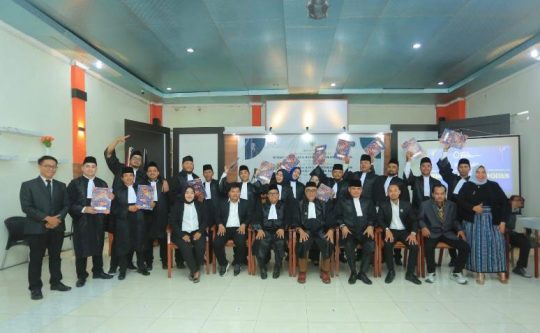
This statement was delivered by the Chairman of DePA-RI during the inauguration of new lawyers in Lombok, West Nusa Tenggara (NTB). On that occasion, he was accompanied by the Chairman of the DePA-RI NTB Regional Leadership Council, the Secretary of the NTB Regional Leadership Council, and several other senior lawyers.
He further advised lawyers to have no more doubts regarding the legal basis (Article 149 of the new Criminal Procedure Code) that their position as law enforcers and their work in defending and assisting their clients cannot be prosecuted.
They cannot be prosecuted, either criminally or civilly, and either in court or out of court. It is here that he stressed the importance of synergy and harmony among Law Enforcement Officials (APH).
It was stated that to achieve synergy and alignment among APH, several proposals were put forward. First, every APH must share the same perception, perspective, and goals of this rule of law system.
Second, every APH must have a common understanding of the human rights of a suspect or defendant that must be protected. Third, all APH must also share the same understanding of the new paradigm of sentencing in Indonesia.
For example, regarding corrective justice, restorative justice, rehabilitative approaches, and alternative sentencing (fines and community service). Imprisonment should only be used as an ultimum remedium and must also be understood as a last legal resort.
Fourth, all APH must also build synergy among the “four pillars of law enforcement” – the police, prosecutors, judges, and lawyers – so that at all stages of investigation, inquiry, or prosecution, they must firmly adhere to due process of law.
Fifth, there is also a need for joint preparation or cross-training among these “four pillars of law enforcement” – police, prosecutors, judges, and lawyers – so that APH have balanced preparedness.
Furthermore, if possible, a joint “guideline book” or “technical manual” for law enforcement should be created to achieve substantive justice, human rights protection, humane and effective sentencing, as well as legal certainty and fairness.
According to the Chairman of DePA-RI, good communication among APH is also essential to uphold due process of law and a free and impartial tribunal.
With synergy among APH, he continued, a good investment climate will also be created, making legal processes in Indonesia relatively predictable.
Until now, many investors have been reluctant or have even left the country, choosing to invest in neighboring nations because the legal system or legal processes in Indonesia are difficult to predict.
Lombok
Lombok is an Indonesian island east of Bali, known for its pristine beaches, the towering Mount Rinjani volcano, and a distinct Sasak culture. Historically, it was influenced by neighboring Hindu-Balinese kingdoms before coming under Dutch colonial rule in the 19th century. Today, it offers a more relaxed alternative to Bali while preserving its traditional villages and Islamic-influenced customs.
West Nusa Tenggara (NTB)
West Nusa Tenggara (NTB) is an Indonesian province comprising the islands of Lombok and Sumbawa, known for its stunning beaches, the majestic Mount Rinjani, and the preserved Sasak culture. Historically, the region was influenced by Hindu-Buddhist kingdoms before the arrival of Islam, and it later became part of the Dutch East Indies colonial empire. Today, it is a major tourism destination, balancing modern development with rich traditional heritage.
1945 Constitution
The **1945 Constitution** is the foundational legal document of Indonesia, drafted and adopted in the months leading up to the nation’s declaration of independence from the Netherlands on August 17, 1945. It established Indonesia as a unitary republic based on the philosophical principles of *Pancasila*, and though it has been suspended and amended, it remains the supreme law of the country, symbolizing the birth of the modern Indonesian state.
new Criminal Code
The “new Criminal Code” is not a specific place or cultural site, but a major piece of legislation. It refers to Indonesia’s comprehensive overhaul of its colonial-era penal system, with the new code (KUHP) being passed by parliament in late 2022 after decades of debate. It is historically significant as the first nationally drafted criminal code for Indonesia, though its implementation has been controversial due to articles seen as restricting civil liberties.
new Criminal Procedure Code
The “new Criminal Procedure Code” is not a physical place or cultural site, but a legal framework governing how criminal cases are investigated and tried in court. Historically, many countries have enacted new codes to modernize their justice systems, often to strengthen protections for the accused, improve efficiency, and align with international human rights standards. For example, Brazil’s 1941 code was replaced in 2023 to incorporate more adversarial elements and technological updates.
Article 149 of the new Criminal Procedure Code
That is not a place or cultural site. Article 149 of a Criminal Procedure Code is a legal provision, typically outlining specific powers, procedures, or rights within a justice system, such as conditions for arrest, detention, or investigation.
For example, in some legal systems, an article like this might define the rules for pre-trial detention. To provide a specific history, one would need to know which country’s code is being referenced, as each nation has its own legal history and revisions.
Indonesia
Indonesia is a Southeast Asian archipelago nation of over 17,000 islands, historically shaped by influential Hindu-Buddhist kingdoms like Srivijaya and Majapahit, followed by centuries of Dutch colonial rule. It is a culturally diverse country with hundreds of ethnic groups, unified by its national motto “Bhinneka Tunggal Ika” (Unity in Diversity) and its status as the world’s largest Muslim-majority nation. Its rich cultural heritage is evident in sites like the ancient Borobudur temple and in its vibrant traditions of dance, batik textiles, and cuisine.
four pillars of law enforcement
The “Four Pillars of Law Enforcement” is not a specific physical place or cultural site, but a conceptual framework often used to describe the foundational elements of a modern police system. It typically refers to the principles of **prevention, detection, deterrence, and recovery** (or similar variations) that guide policing strategy. This model has evolved over the 20th century as law enforcement moved toward more community-oriented and proactive approaches to public safety.