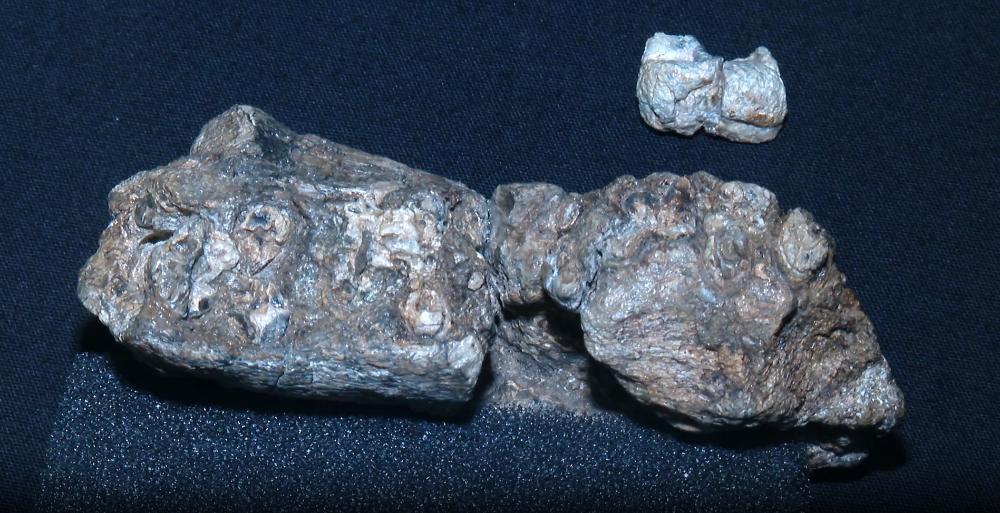
Fossil of human species dating back 2.6 million years found in Ethiopia’s Afar region.
Addis Ababa — A research team has, for the first time, discovered 2.6-million-year-old fossil remains belonging to a hominin species in the Afar region of Ethiopia.
In a briefing, it was explained that the new fossil, named Paranthropus, was found at the Meli-Logia archaeological site in the Afar region.
It was noted that Ethiopia, nicknamed the “Land of Origins,” has made unique contributions to the study of human origins.
Attention was drawn to the fact that numerous fossil and archaeological sites across the country have revealed human fossils and stone tools covering the entire history of the human lineage, dating back six million years.
Among the many sites in Ethiopia, the Afar Depression holds a special status in this regard.
Archaeological discoveries documented at Dikika, Ledi-Geraru, Gona, Hadar, and Middle Awash—all located in Afar—show a sequential evolution of hominin behavior from 3.5 million years ago to the modern era.
Furthermore, dozens of human species belonging to Ardipithecus, Australopithecus, and Homo have been discovered in this region.
However, the genus Paranthropus has been notably absent from the Afar region, despite its presence in South Africa, Malawi, Tanzania, Kenya, and southern Ethiopia.
The absence of Paranthropus from Afar has long puzzled researchers, with many concluding it never reached the Afar area.
It was stated that the discovery of this new type of hominin in the Afar region reaffirms Ethiopia’s status as the “cradle of humankind.”
It was confirmed that Ethiopia, through collaborative efforts, has gained prominent global standing for its contributions to understanding human origins.
It was indicated that recent discoveries of hominin fossil remains will attract global interest, enhancing Ethiopia’s standing in the tourism sector and diplomatic relations.
The discovery of a new hominin species known as Paranthropus in the Afar region represents a pivotal moment in the field of paleoanthropology.
It was stated: “Ethiopia’s Afar region holds a leading position in paleoanthropological research, with evidence of many early human species thriving there.”
The importance of this discovery in highlighting Ethiopia’s unique position in the ongoing search for human origins was also emphasized.
A commitment was expressed to continue successes by focusing on nurturing young researchers, strengthening collaborative relationships with the international scientific community, and providing essential support to individual researchers.
Afar region
The Afar region is a vast, arid lowland area in northeastern Ethiopia, renowned for its extreme landscapes and pivotal role in human evolution. It is most famous as the location where the fossilized remains of “Lucy” (Australopithecus afarensis) were discovered, making it one of the world’s most important paleoanthropological sites. Historically, it has been home to the nomadic Afar people and contains the geologically active Danakil Depression, one of the hottest and most inhospitable places on Earth.
Meli-Logia archaeological site
The Meli-Logia archaeological site is located in the Rethymno regional unit of Crete, Greece. It is primarily known as a significant Minoan settlement and peak sanctuary, dating to the Bronze Age, which was later occupied during the Hellenistic and Roman periods. The site provides important evidence for religious practices and habitation continuity in ancient Crete.
Dikika
Dikika is an archaeological site in Ethiopia, part of the Afar region, famous for the discovery of “Selam” (nicknamed “Lucy’s baby”), a remarkably complete 3.3-million-year-old skeleton of an *Australopithecus afarensis* child. The site has provided crucial evidence about early human development, including indications of a mixed woodland and grassland environment and potential tool use. These findings have profoundly deepened our understanding of human evolution during the Pliocene epoch.
Ledi-Geraru
Ledi-Geraru is an archaeological site in Ethiopia’s Afar region, known for providing some of the oldest known fossil evidence of early *Homo sapiens*. Dated to approximately 2.8 million years ago, a jawbone discovered there in 2013 pushed back the origins of our genus by about 400,000 years, offering crucial insights into human evolution from earlier australopithecines.
Gona
Gona is a town in Papua New Guinea, located in the Oro Province. It is historically significant as the site of the first major Allied land offensive against the Japanese in the Pacific during World War II, with the Battle of Gona taking place from November to December 1942. The area is known for its war memorials and relics, marking a pivotal and costly campaign in the New Guinea campaign.
Hadar
Hadar is an archaeological site in northeastern Ethiopia’s Afar Region, famous as the location where the 3.2-million-year-old hominin fossil “Lucy” (*Australopithecus afarensis*) was discovered in 1974. The area, part of the wider Awash Valley, has yielded numerous other crucial fossils that have profoundly shaped our understanding of early human evolution.
Middle Awash
The Middle Awash is an archaeological region in Ethiopia’s Afar Depression, renowned as one of the most important sites for understanding human evolution. Its sedimentary layers have yielded fossils spanning millions of years, including the famous early hominid “Lucy” (*Australopithecus afarensis*), discovered in 1974. Continuous research there has provided critical evidence of the biological and cultural development of human ancestors.
Ethiopia
Ethiopia is a historically rich nation in the Horn of Africa, widely considered one of the oldest sites of human habitation and home to the ancient Aksumite Kingdom. It is renowned for its unique cultural heritage, including rock-hewn churches of Lalibela and its status as one of the world’s earliest Christian civilizations. Ethiopia is also notable for being one of the few African countries to have largely avoided European colonization, maintaining its independence for millennia.