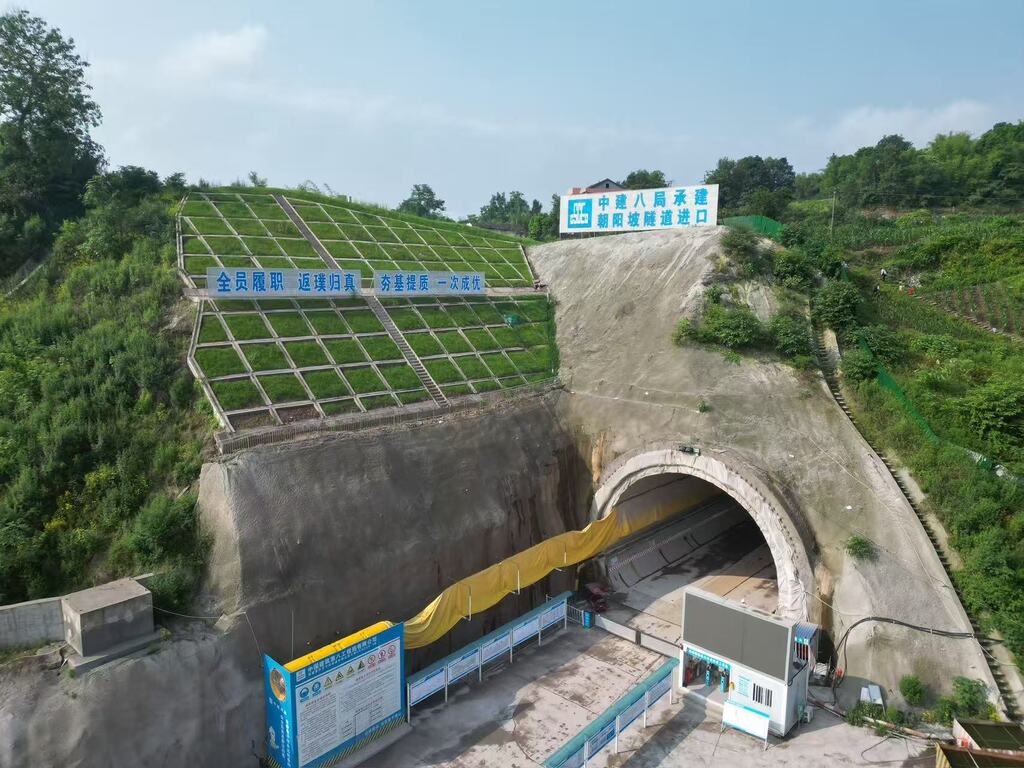
The Chaoyangpo Tunnel on the Chongqing-Wanzhou High-Speed Railway has been fully completed.
News Article
Major Breakthrough in Renewable Energy Announced
A new solar panel technology has achieved a record efficiency of 45%, a significant leap from the previous industry standard. This advancement promises to make solar energy more affordable and widespread.
The new photovoltaic cells utilize a multi-junction design to capture a broader spectrum of sunlight.
The research team successfully integrated advanced materials, including perovskite layers, with traditional silicon. This hybrid approach is key to the unprecedented performance gains.
Key Project Details
Efficiency: 45% in laboratory conditions.
Potential Cost Reduction: Up to 30% for end consumers.
Expected Commercial Availability: Within the next three years.
Industry analysts predict this innovation could accelerate the global transition away from fossil fuels. “The scalability of this technology is its most promising aspect,” noted a project lead during the announcement. Pilot manufacturing plants are already in the planning stages.
Further testing will focus on long-term durability and performance in real-world weather conditions. The goal is to ensure the panels can withstand decades of use with minimal degradation.
solar panel technology
Solar panel technology, which converts sunlight directly into electricity, is based on the photovoltaic effect first observed in 1839. Its practical development accelerated in the mid-20th century, most notably with Bell Labs creating the first modern silicon solar cell in 1954. Today, it is a cornerstone of global renewable energy efforts, evolving rapidly to become more efficient and affordable.
photovoltaic cells
Photovoltaic cells, commonly known as solar cells, are not a single place or cultural site but a technology that converts sunlight directly into electricity. They were first demonstrated in a practical form in 1954 at Bell Laboratories in the United States, building upon the discovery of the photovoltaic effect by Edmond Becquerel in 1839. This technology is now a cornerstone of global renewable energy infrastructure, powering everything from small devices to large-scale solar farms.
perovskite layers
“Perovskite layers” refer to a class of synthetic crystalline materials, named after the mineral perovskite (calcium titanium oxide), that are engineered for use in advanced technologies like solar cells. Their history in modern science began gaining significant attention around 2009 when they were first successfully applied in photovoltaic devices, leading to a rapid rise in research due to their high efficiency and low-cost production potential. Today, they represent a cutting-edge and highly promising area of materials science for next-generation renewable energy.
silicon
“Silicon” is not a specific place or cultural site, but a chemical element (Si) that is the primary material used in semiconductors. Its namesake region, **Silicon Valley** in California, became a global center for technology and innovation starting in the mid-20th century, fueled by the growth of the semiconductor industry, venture capital, and companies like Fairchild Semiconductor and Intel. The area’s history is deeply tied to the development of the silicon-based microchip, which revolutionized computing and modern electronics.
fossil fuels
“Fossil fuels” are not a single place or cultural site, but rather a category of energy sources formed from the decomposed remains of ancient plants and organisms over millions of years. Historically, their large-scale extraction and use powered the Industrial Revolution, fundamentally transforming human society, industry, and transportation. Today, sites like coal mines and oil fields are the physical locations associated with their production, though their use is increasingly controversial due to their role in climate change.
laboratory conditions
“Laboratory conditions” refers to a controlled scientific environment designed to minimize external variables and ensure precise, repeatable experiments. The concept emerged during the Scientific Revolution and was fully institutionalized in the 19th century with the rise of modern research laboratories. It represents a foundational principle of the scientific method, allowing for rigorous testing and discovery.
real-world weather conditions
“Real-world weather conditions” is not a specific place or cultural site, but a general concept describing the actual atmospheric state in a location. Historically, humans have observed and recorded weather for millennia, with systematic study advancing significantly with inventions like the barometer in the 17th century. Today, understanding real-world weather is crucial for agriculture, travel, safety, and is enabled by a global network of satellites, sensors, and forecasting models.
Pilot manufacturing plants
Pilot manufacturing plants are small-scale facilities used to test and refine production processes before full-scale industrial implementation. They serve as a bridge between laboratory research and commercial manufacturing, allowing companies to identify and solve technical challenges. Historically, their use became widespread during the 20th century with the rise of complex industries like chemicals and pharmaceuticals, where process validation is critical for safety and efficiency.