An ATR 42-500 aircraft belonging to Indonesia Air Transport, which was reported to have lost contact while flying from Yogyakarta to Makassar on Saturday, has finally been found in the Mount Bulusaraung area, Maros Regency, South Sulawesi.
The aircraft was carrying 10 people, consisting of seven crew members and three passengers.
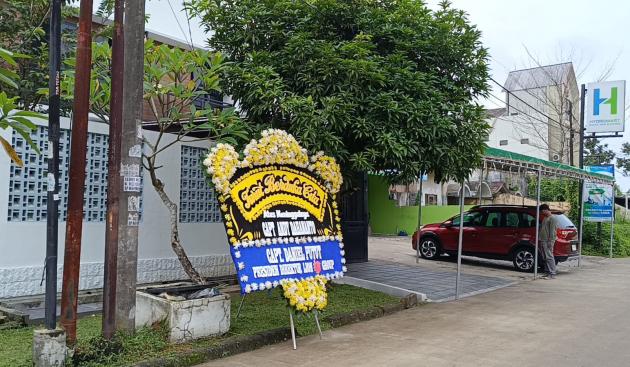
Activity at the residence appeared quiet. Two people were seen inside the white house. They were the child and sibling-in-law of the pilot. However, the family was still unable to provide statements to the media.
A tent was seen set up in front of the residence. In addition, there was a condolence wreath from the President Director of Lion Group.
The head of the local neighborhood association confirmed the pilot is a resident of the PWS Tigaraksa housing complex and has lived there for a long time.
“It is true that Mr. Andy is our resident who has long lived in the neighborhood. He met with the disaster of the plane crash he was piloting in the Makassar area,” he said.
He stated that the pilot’s wife and eldest child have departed for Makassar to undergo DNA matching tests with the victim’s remains that have been found.
“We, the residents, are also waiting for news from Makassar. Coincidentally, his child and wife have already left for Makassar earlier to identify the victim,” he explained.
He added that the Deputy Minister of Marine Affairs and Fisheries visited the pilot’s residence on Sunday.
Based on information, to date, the joint search and rescue team has found a number of aircraft fragments and one victim’s body, which is in the process of identification.
The evacuation process is still facing obstacles due to bad weather and the extreme terrain in the Mount Bulusaraung area.
Yogyakarta
Yogyakarta is a historic city and special region on the Indonesian island of Java, serving as a centuries-old center of Javanese culture, art, and education. It was the seat of the Mataram Sultanate, founded in the 16th century, and later became a focal point of resistance during Indonesia’s struggle for independence. Today, it is renowned as the gateway to the magnificent 9th-century Buddhist temple Borobudur and the Hindu temple complex Prambanan.
Makassar
Makassar is the capital city of South Sulawesi, Indonesia, historically known as a major port and trading hub in the archipelago since at least the 16th century. It was the center of the powerful Gowa Sultanate, which engaged in trade and conflict with European powers like the Dutch East India Company (VOC). Today, it remains a vital economic gateway to eastern Indonesia, with historical sites like Fort Rotterdam reflecting its colonial past.
Mount Bulusaraung
Mount Bulusaraung is a prominent mountain in South Sulawesi, Indonesia, forming part of the Quarles Range. Historically, the area is significant as part of the ancient Bantaeng Kingdom and is deeply woven into local Bugis and Makassar folklore. Today, it is a key feature of the Bantimurung-Bulusaraung National Park, known for its biodiversity and extensive limestone cave systems.
Maros Regency
Maros Regency is a region in South Sulawesi, Indonesia, renowned for its significant prehistoric archaeological sites, most notably the limestone karst formations containing ancient cave paintings. These include the UNESCO World Heritage site of the Maros-Pangkep karst area, which features some of the world’s oldest known figurative art, dating back over 40,000 years. Historically, the area was also part of the Bugis kingdom and its culture, with its modern economy based on agriculture, cement production, and tourism centered on these natural and historical attractions.
South Sulawesi
South Sulawesi is a province in Indonesia known for its distinctive cultural heritage, including the seafaring Bugis people and the ancient megalithic traditions of Tana Toraja. Historically, it was home to several powerful kingdoms like Gowa and Bone, which were major centers of trade and politics in the archipelago prior to Dutch colonization. Today, it is celebrated for its unique traditional houses (tongkonan), elaborate funeral rites, and vibrant weaving and shipbuilding traditions.
PWS Tigaraksa housing complex
The PWS Tigaraksa housing complex is a modern residential development located in Tigaraksa, Tangerang Regency, Indonesia. It was built as part of the region’s suburban expansion to accommodate the growing population and demand for housing near Jakarta, reflecting the area’s rapid urbanization in recent decades.
Lion Group
The “Lion Group” (石獅群) is a famous collection of ancient stone lion sculptures located at the entrance to the Ming Xiaoling Mausoleum in Nanjing, China, the tomb of the Hongwu Emperor, founder of the Ming Dynasty. Dating back to the early 15th century, the statues line the Sacred Way and are meant to guard the spirit of the emperor, with lions symbolizing power and majesty. This impressive procession is a key example of Ming dynasty stone carving and imperial tomb architecture.