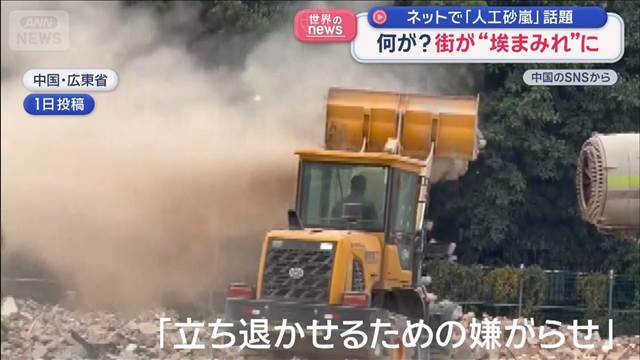
Jiangsu Province, China, was hit by strong winds. A security camera captured a clothes drying rack being blown away by the wind, yet it managed to land perfectly. Meanwhile, at a car dealership in Guangdong Province, all the cars parked in front of the store are covered in dust. Last month, an incident occurred where the town was enveloped in a cloud of dust. The focus was on footage reportedly filmed at a nearby construction site. An excavator scooped up debris and placed it in front of a large industrial fan. This caused a massive amount of dust to begin scattering. The surrounding area is reportedly part of a redevelopment zone, and affected shops and residents claim this might be harassment to force them to vacate. Online, it was dubbed an “artificial sandstorm” and became a major topic. Authorities have immediately halted the construction and begun an investigation.
Jiangsu Province
Jiangsu Province, located on China’s eastern coast, is a historically rich region that formed the core of the ancient Wu and Yue cultures. It became a major economic and cultural center during the Ming and Qing dynasties, famed for its classical gardens in Suzhou, the Grand Canal, and as a hub for literature, art, and scholarship. Today, it remains one of China’s most prosperous provinces, known for its water towns, silk production, and modern industrial development.
Guangdong Province
Guangdong Province is a major coastal region in southern China, historically significant as a longstanding center of maritime trade and cultural exchange. Its history is deeply shaped by its role as a key terminus of the Maritime Silk Road and, later, as the primary launch point for China’s reform and opening-up policies in the late 20th century. Today, it is one of China’s most populous and economically dynamic provinces, known globally for its manufacturing hub, the Pearl River Delta, and the distinct Lingnan culture of cities like Guangzhou and Shenzhen.