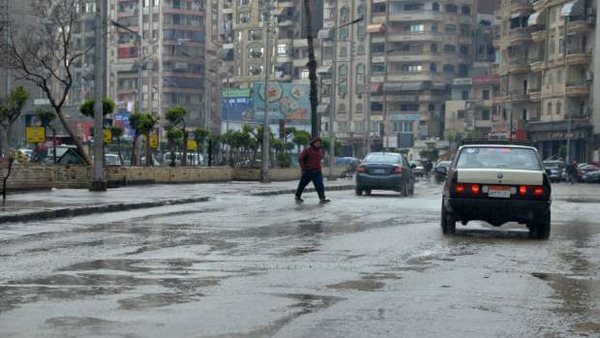
The General Meteorological Authority announced details of the expected weather conditions, warning of the continuation of very cold weather and the appearance of several weather phenomena affecting most parts of the country.
Today’s Weather
There are chances of dense water mist forming from 2 AM until 10 AM in areas from the north of the Republic up to Greater Cairo, northern Upper Egypt, and central Sinai. In some places, it may reach fog levels, leading to reduced horizontal visibility on roads.
The weather will be very cold during the early morning hours, tending to warmth during the day, then returning to very cold at night in most areas, with frost forming on crops in areas of northern Upper Egypt, central Sinai, and the Western Desert.
Tomorrow’s weather will be very cold in the morning, tending to be relatively warm during the daytime hours. The expected maximum temperature in Greater Cairo is 19°. There are chances of light rain, sometimes moderate, falling intermittently on the northeastern coasts and northern Delta, and light rain on areas of the northwestern coasts at intermittent periods. The warning for dense water mist on some agricultural roads, highways, and areas near water bodies remains in effect.
Regarding temperatures, Greater Cairo and the northern coast are expected to record a maximum of 19 degrees and a minimum of 10 degrees, while the northern coasts will record a maximum of 23 degrees and a minimum of 6 degrees, northern Upper Egypt a maximum of 20 degrees and a minimum of 10 degrees, and southern Upper Egypt a maximum of 19 degrees and a minimum of 11 degrees.
There are also chances of moderate rain falling intermittently on areas of the northern coasts, with chances of light rain on the northern coast. It may extend weakly to areas of the southern coast, Canal cities, and Greater Cairo, along with noticeable wind activity on the northern coasts, the northern coast, and southern Sinai.
Temperatures
Cairo: Max 19 – Min 10
Alexandria: Max 19 – Min 11
Giza: Max 20 – Min 9
Qalyubia: Max 19 – Min 10
Dakahlia: Max 20 – Min 10
Sharqia: Max 19 – Min 9
Kafr El Sheikh: Max 19 – Min 10
Gharbia: Max 19 – Min 10
Monufia: Max 19 – Min 9
Port Said: Max 19 – Min 12
Ismailia: Max 20 – Min 9
Suez: Max 19 – Min 10
Faiyum: Max 20 – Min 7
Beni Suef: Max 20 – Min 7
Cairo
Cairo is the sprawling capital of Egypt, founded in 969 CE by the Fatimid dynasty near the ancient Egyptian capital of Memphis. It is famously home to historic Islamic districts, the Egyptian Museum, and the nearby Giza pyramid complex, which dates back over 4,500 years. The city has long served as a major political and cultural center of the Arab world.
Alexandria
Alexandria is a major port city on Egypt’s Mediterranean coast, founded by Alexander the Great in 331 BCE. It was renowned in antiquity for its legendary Lighthouse (one of the Seven Wonders) and its Great Library, a center of Hellenistic scholarship. Today, it remains a vibrant cultural hub, with modern landmarks standing alongside ancient ruins like the Roman-era catacombs of Kom el Shoqafa.
Giza
The Giza Plateau, located on the outskirts of Cairo, Egypt, is a UNESCO World Heritage Site most famous for its iconic trio of 4th Dynasty pyramids—including the Great Pyramid of Khufu—built as monumental tombs for pharaohs around 2580–2560 BCE. The site also features the Great Sphinx, a colossal limestone statue with the body of a lion and the head of a pharaoh, believed to date from the same period. These structures represent the pinnacle of ancient Egyptian engineering and religious belief in the afterlife.
Sinai
Sinai is a triangular peninsula in Egypt, linking Africa and Asia, and is historically significant as the location where, according to the Bible, Moses received the Ten Commandments at Mount Sinai. It has been a crossroads of ancient trade routes and a site of strategic and religious importance for millennia. Today, it is known for its stark desert landscapes, Red Sea resorts, and the revered St. Catherine’s Monastery at the foot of the mountain.
Western Desert
The Western Desert is a vast, arid region spanning parts of Egypt, Libya, and Sudan, historically inhabited by nomadic Berber and Bedouin peoples. It is renowned for its dramatic landscapes of sand seas, rock plateaus, and oases, which have served as crucial trade and migration routes for millennia. Significant historical sites within it include the Siwa Oasis, known for the Oracle of Amun visited by Alexander the Great, and the Gilf Kebir plateau with its prehistoric cave paintings.
Delta
“Delta” is a broad term, but if referring to the **Nile Delta** in Egypt, it is the fertile, triangular river mouth where the Nile River empties into the Mediterranean Sea. Historically, it was the cradle of ancient Egyptian civilization, providing rich agricultural land that supported major cities and was a crucial center of Hellenistic culture following the founding of Alexandria in 331 BCE.
If you meant a different Delta (e.g., a geographic region, airline, or cultural institution), please provide more specific details for a more accurate summary.
Canal cities
Canal cities are urban settlements built around extensive networks of artificial waterways, historically used for transportation, commerce, and drainage. Famous examples like Venice, Italy, and Suzhou, China, originated centuries ago, with their canals often central to their economic growth and cultural identity during medieval or imperial periods. These cities remain iconic today for their unique architecture and the way their waterways define daily life and tourism.
Port Said
Port Said is a major Egyptian city and seaport situated at the northern entrance of the Suez Canal, where the canal meets the Mediterranean Sea. It was founded in 1859 during the canal’s construction and named after Khedive Said Pasha, growing rapidly as a vital coaling station and cosmopolitan trading hub. Its strategic location has made it historically significant for global maritime trade and a focal point during military conflicts, including the Suez Crisis of 1956.