Libyan parties call on the United Nations to support the electoral commission to end the political deadlock.
Libyan Warnings of Risks to Undermine the Electoral Commission and Threaten the Democratic Path
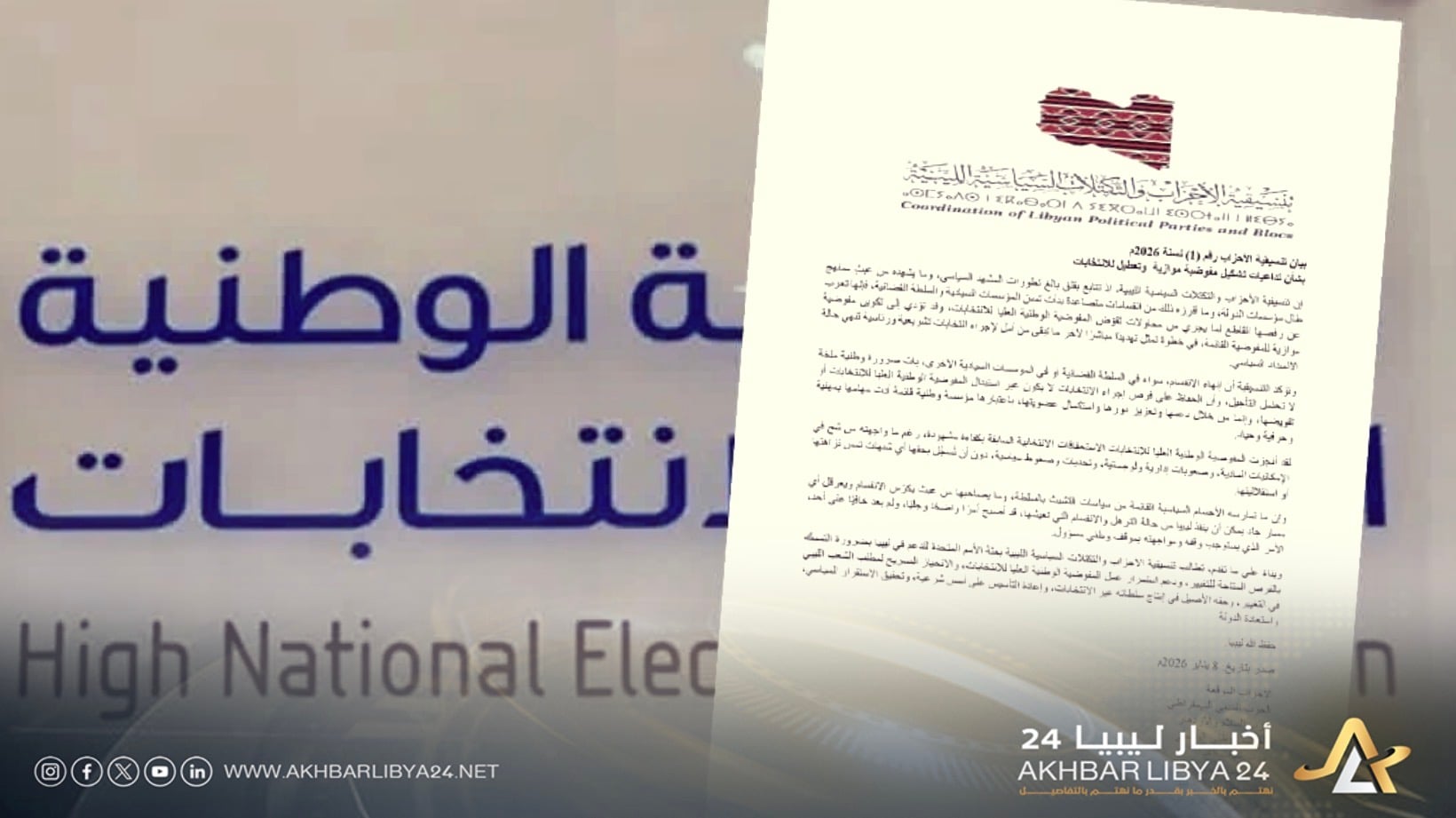
A coordination body of Libyan parties and political blocs has issued serious warnings about the imminent risk of the electoral process collapsing, amid fears of attempts to undermine the election commission and establish a parallel body, which would shatter the last hope for ending the ongoing political crisis.
In an official statement, the coordination body made an urgent appeal to the UN mission in Libya, demanding its immediate intervention to support the continued work of the electoral commission and to clearly side with the people’s demands for change. It affirmed that the right to produce authorities through free and fair elections represents the fundamental will of the citizens and cannot be relinquished or obstructed by narrow political maneuvers.
The Libyan parties’ coordination body warns of attempts to undermine the election commission and form a parallel body, and calls on the UN mission to support it as the last hope for ending the political deadlock through elections that would end division and rebuild the state on legitimate foundations.
Fears of Sovereign Institutions Cracking
The statement expressed grave concern over what it described as systematic tampering that has affected state institutions, confirming that the serious repercussions of this tampering have begun to extend to sovereign institutions and the judiciary, threatening the legal foundations of the state. It warned that the continuation of this path heralds a complete collapse of the institutional system and deepens existing divisions.
Call for Re-establishment on Legitimate Foundations
The coordination body stressed that exiting the current dark tunnel requires re-establishment on legitimate foundations that achieve the desired political stability and rebuild the state. It noted that the electoral commission, despite all challenges, efficiently completed previous electoral milestones with notable competence and maintained its neutrality and integrity without any suspicions.
Rejection of Replacing the Commission
The coordination body categorically rejected any attempts to replace or undermine the commission, affirming that preserving the chances of holding elections is achieved by supporting this national body, enhancing its role, and completing its membership, considering it a safety valve for the democratic process. It described the commission as having performed its duties with high professionalism despite scarce material resources and various political pressures.
Accusation Against Political Bodies of Clinging to Power
The statement leveled a clear accusation against the existing political bodies of practicing policies of clinging to power, which perpetuates division and obstructs any serious path to save the country from a state of weakness and fragmentation. It confirmed that ending the division has become an urgent national necessity that cannot tolerate delay or procrastination.
UN mission in Libya
The United Nations Support Mission in Libya (UNSMIL) was established in 2011 by the UN Security Council following the civil war and the fall of the Gaddafi regime, to assist the country’s transitional authorities. Its mandate has evolved to focus on mediating political dialogue, supporting governance, and facilitating a ceasefire and elections amid ongoing instability and conflict. The mission represents the international community’s ongoing effort to help Libya achieve peace and build unified, legitimate state institutions.
electoral commission
An electoral commission is an independent government body responsible for organizing and overseeing elections within a country. Its history is tied to the development of modern democracies, emerging to ensure fair and impartial voting processes, manage voter registration, and certify results. These commissions are fundamental to upholding democratic integrity and public trust in the electoral system.
state institutions
“State institutions” refer to the formal organizations and structures through which a government functions, such as legislatures, courts, and executive agencies. Historically, they evolved from ancient administrative systems, like those in Mesopotamia or Imperial China, into the complex bureaucracies of modern nation-states, often shaped by documents like constitutions. Their primary purpose is to establish order, implement laws, and provide public services within a defined territory.
sovereign institutions
“Sovereign institutions” refer to the foundational bodies of a state that exercise its supreme authority, such as a monarchy, parliament, or supreme court. Historically, these institutions evolved to centralize governance, often from feudal systems or colonial rule, establishing a nation’s legal and political independence. They embody the state’s autonomy and are responsible for creating and upholding its laws and sovereignty.
judiciary
The judiciary refers to the system of courts and judges responsible for interpreting and applying the law within a country. Its history is rooted in ancient civilizations, but modern independent judiciaries, as a separate branch of government, were largely established following Enlightenment ideas, most notably through documents like the U.S. Constitution (1789). It serves as a cornerstone of the rule of law, ensuring justice, resolving disputes, and checking the powers of other government branches.
institutional system
An institutional system is not a specific place or cultural site, but rather a structured framework of rules, norms, and organizations that govern a society or a specific field, such as education, law, or finance. Historically, such systems have evolved from informal customs into formalized structures, often shaped by political, economic, and social developments over centuries to maintain order and achieve collective goals.
democratic process
The “democratic process” is not a physical place but a foundational political system and set of procedures for collective decision-making, where power is vested in the people who exercise it through voting and representation. Its history is often traced to ancient Athens, but its modern form evolved through centuries of philosophical thought, documents like the Magna Carta, and revolutions that established principles of popular sovereignty, civil liberties, and constitutional rule. Today, it encompasses the ongoing practices of free elections, debate, and civic participation that define many nations’ governance.
political bodies
“Political bodies” is not a specific place or cultural site, but a general term for institutions that govern, such as parliaments, congresses, or councils. Historically, such bodies have evolved from ancient assemblies, like the Roman Senate or Athenian Ecclesia, into the complex representative and administrative systems found in modern nation-states. They are the foundational structures through which laws are made, policies are implemented, and a society’s political will is organized.