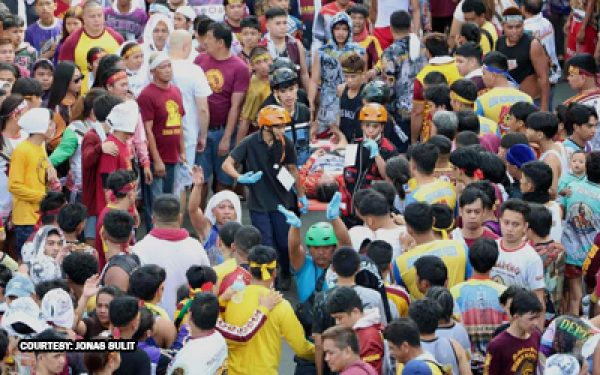
The National Capital Region Police Office (NCRPO) has recorded four fatalities related to the celebration of the Feast of the Poong Hesus Nazareno in 2026, which was held from January 9 to January 10. This is according to the initial report released by police following the annual Traslacion.
According to the NCRPO Director, based on their initial data, four individuals have died. However, it was clarified that this still needs to be confirmed as verification of reports from various agencies continues.
Among the deceased is a 55-year-old photojournalist who reportedly collapsed suddenly at the Manila Police District–Ermita Station, near the Quirino Grandstand, hours before the official start of the Traslacion of the Poong Nazareno.
The NCRPO had earlier confirmed two more deaths reported during the procession but has not yet released further details regarding the identification of the victims or the cause of their deaths.
Meanwhile, the Jose R. Reyes Memorial Medical Center reported that three of the patients brought to their hospital during the height of the Traslacion have died. According to the hospital, the patients were rushed in due to various medical emergencies.
However, it is not yet clear if the three fatalities reported by the hospital are included in the four cases mentioned by the NCRPO, prompting continued coordination between police and hospitals for a clearer accounting of the incidents.
It will be recalled that the Traslacion of the image of Poong Hesus Nazareno lasted 30 hours and 50 minutes and was attended by 9 million devotees. During the event, the wheel broke three times and the rope of the Andas snapped twice, making it the longest Traslacion in the history of the devotion.
Feast of the Poong Hesus Nazareno
The Feast of the Poong Hesus Nazareno, also known as the Feast of the Black Nazarene, is a major annual religious festival in the Philippines, most famously celebrated in Manila’s Quiapo district. Its history dates back to the 17th century when a dark wooden statue of Jesus Christ, believed to have miraculous powers, was brought from Mexico. The feast day on January 9 involves a massive, passionate procession where millions of devotees participate in hopes of receiving blessings and healing.
Traslacion
The Traslación is the massive annual procession of the Black Nazarene statue in Manila, Philippines, held every January 9. Its history dates back to 1787 when the life-sized wooden image was transferred from its original church in Intramuros to the Quiapo Church, an event now reenacted by millions of barefoot devotees. The procession symbolizes deep Filipino Catholic faith and penance, with participants believing that touching the statue or its ropes grants miracles and spiritual cleansing.
Manila Police District–Ermita Station
The Manila Police District–Ermita Station is a police station located in the Ermita district of Manila, Philippines. Historically, it has served as a key law enforcement outpost in a central and historically significant area of the capital, which was heavily damaged during the Battle of Manila in 1945. Today, it continues to operate as part of the city’s public safety infrastructure.
Quirino Grandstand
The Quirino Grandstand is a prominent public viewing stand in Manila’s Rizal Park, originally built in 1949 and named after the sixth Philippine President, Elpidio Quirino. It is best known as the traditional venue for presidential inaugurations, large national celebrations, and major public gatherings. The site gained particular historical significance as the location of Pope John Paul II’s Mass during his 1995 visit to the Philippines, which drew a record-breaking crowd.
Poong Nazareno
“Poong Nazareno” refers to the revered image of the Black Nazarene, a life-sized statue of Jesus Christ carrying the cross, enshrined in the Minor Basilica of the Black Nazarene (Quiapo Church) in Manila, Philippines. Its history dates back to the 17th century when it was brought from Mexico by Spanish missionaries, and it is famed for its annual January Traslación procession, one of the world’s largest Catholic gatherings. The dark wooden statue is a profound symbol of Filipino faith and resilience, drawing millions of devotees who believe in its miraculous powers.
Jose R. Reyes Memorial Medical Center
The Jose R. R. Reyes Memorial Medical Center (JRRMMC) is a major public hospital in Manila, Philippines, originally established in 1906 as the *Hospital de la Cruz Roja* (Red Cross Hospital). It was renamed in 1965 to honor Dr. Jose R. Reyes, a distinguished Filipino surgeon and former director of the hospital, cementing its legacy as a key institution for healthcare and medical training in the country.
Andas
“Andas” typically refers to the ornate processional platforms or litters used in religious festivals, particularly within Catholic traditions in Spain and Latin America. Historically, they evolved from medieval biers and are used to carry statues of saints or religious figures during parades, especially during Holy Week. These structures are often elaborately decorated and symbolize both devotion and community craftsmanship.
Poong Hesus Nazareno
Poong Hesus Nazareno, also known as the Black Nazarene, is a revered life-sized statue of Jesus Christ located at the Minor Basilica of the Black Nazarene (Quiapo Church) in Manila, Philippines. The dark wooden image was brought from Mexico by Spanish Augustinian friars in the early 17th century and is believed to have survived several fires. It is the focal point of an intense annual January procession, drawing millions of devotees who believe in its miraculous powers.